Accountability Without Surveillance on a Remote Team
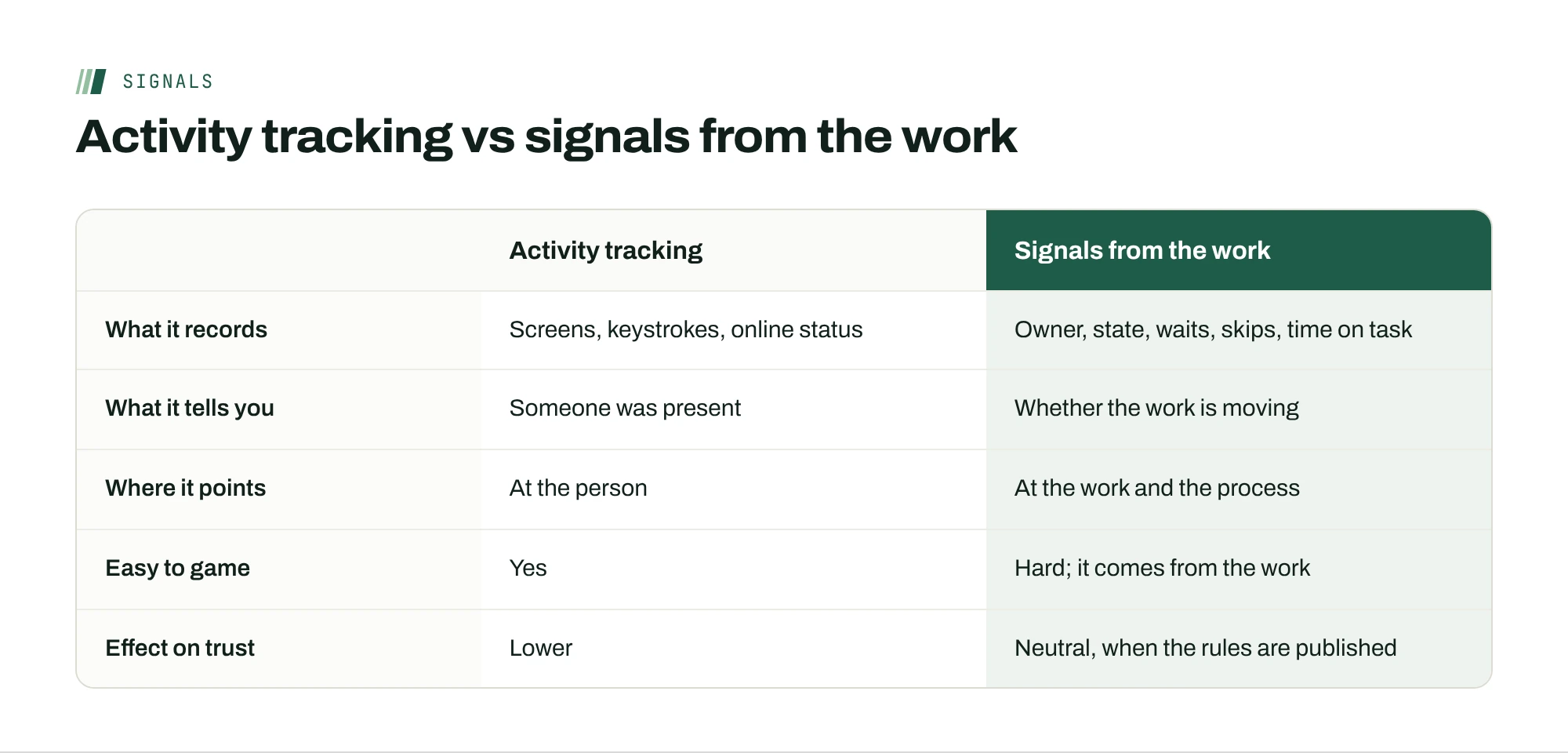
Activity tracking shows someone was busy, not that work moved, and monitoring can make rule-breaking more likely. Measure the work instead: how long it waits, how often it’s skipped, and time against its estimate.
When a team goes remote, someone eventually suggests software that takes screenshots, counts keystrokes or flags when a status goes idle. It promises accountability. What it delivers is a record of activity, which isn’t the same thing, and research suggests it can make the behavior you’re worried about more likely.
Accountability on a remote team doesn’t need surveillance. It needs the work to be visible: who owns it, whether it’s moving and where it’s stuck. This guide covers how to build that, and what to leave out.
Why monitoring is tempting
The pull is real. In Microsoft’s 2022 Work Trend Index survey of 20,006 people, 85% of leaders said the shift to hybrid work had made it hard to be confident their people were productive, while 87% of employees said they were productive. Microsoft called the gap productivity paranoia. Monitoring software looks like a fix for the leader’s half of it. But what leaders actually want isn’t proof that people are online. It’s confidence that the right work is moving, and that they’ll hear early when it isn’t.
What monitoring does to people
In Harvard Business Review, Chase Thiel, Julena Bonner, John Bush, David Welsh and Niharika Garud reported two studies in which monitored employees were substantially more likely to break rules, including cheating on a test, stealing equipment and deliberately working slowly. Their explanation: being monitored leads people to subconsciously feel less responsible for their own conduct, because responsibility has shifted to whoever is watching.
They also found a moderator worth remembering. When people felt they were treated fairly, the effect was weaker. That’s the opening for a better approach: be open about what you measure, and measure things people would agree are fair.
Activity isn’t progress
Online status, mouse movement and the apps someone has open all measure presence. A field study in Harvard Business Review found people toggled between apps about 1,200 times a day. Someone can look extremely active while finishing nothing, and someone who spends two quiet hours on one hard problem can look idle. Activity metrics are also easy to satisfy without doing any work, which means you’re measuring compliance with the metric, not the job.
Measure the work instead
Four signals tell you far more than any activity log, and every one of them is about the work, not the person:
- Queue time: how long work waits before anyone starts it. Long waits point at overload, unclear ownership or a missing skill.
- Skips: how often a piece of work is put aside for something else. Repeated skips are usually the first sign that something is stuck.
- Stuck flags: work the owner has marked as blocked, and how long it stayed that way.
- Time against the estimate: self-reported time on the task, compared with what it was expected to take.
Each of these leads to a useful question about the work: why is this waiting, what’s making it hard to start, what does the owner need? None of them requires watching anyone, and all of them get better as more of the team’s work runs through them.
What to do with a signal
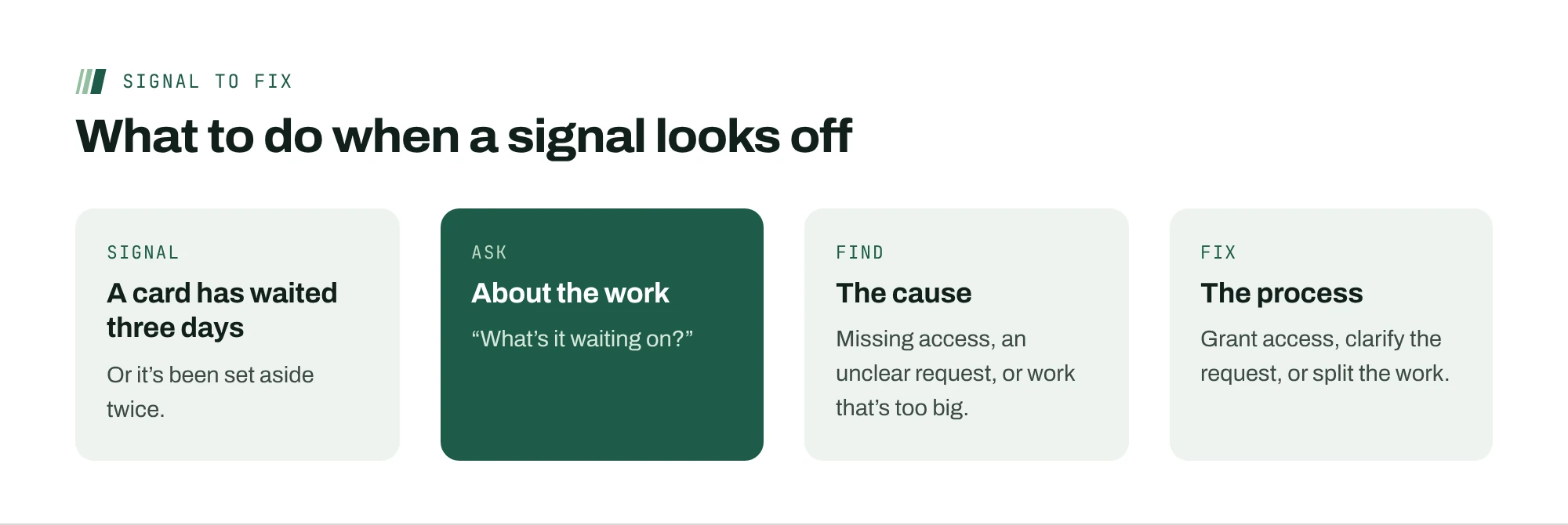
A signal is a reason to ask about the work, never a verdict about the person. When something looks off, open with the work: “This has waited three days. What’s it waiting on?” or “This keeps getting set aside. Is it bigger than we thought?” Don’t open with someone’s numbers. Most of the time the answer is a missing input, an unclear request or a task that should be split, and the signal did its job by surfacing it early.
Show people their own patterns first
Here’s the less common move: let each person see their own signals before anyone else looks at them. Most people fix patterns they can see. Someone who notices they’ve skipped the same task three times will usually either do it or say what’s in the way, without a conversation with their manager. Accountability that starts with the person feels like information. Accountability that starts with the manager feels like an audit.
Trust self-reported time, and let people correct it
Self-reported time is the option that respects people, and it’s more accurate than it gets credit for when it’s logged on the task, as the work happens. Let people correct their own entries, because they’ll forget to stop a timer. For teams paid on logged time, keep a record of changes, so corrections are visible rather than forbidden. That’s the balance: you trust what people log, and the record protects everyone if a question comes up later.
Signals that look useful and aren’t
- Hours online. Being logged in says nothing about whether the work moved, and it penalizes people who work in focused blocks.
- Messages sent. A high count often means someone is coordinating work that should be clearer, not that they’re productive.
- Tasks closed. Easy to inflate by splitting work into small pieces. Compare kinds of work instead.
- Reply speed. Rewarding fast replies rewards constant interruption. Check whether anything waited longer than agreed.
Each of these can be worth a look when you’re diagnosing a process. None of them should appear next to a person’s name.
Start every conversation with the work
When a signal looks off, the first words matter. “I noticed the migration card hasn’t moved since Tuesday. What’s getting in the way?” invites a useful answer. “You seem to have been less active this week” invites a defense.
Keep the conversation about the task, the blocker and what would help. If the same person is stuck repeatedly, look at what they’re being given before you look at them: unclear requests, missing access and too many priorities explain most stuck work.
Write down what you agreed at the end of each conversation: what changes, who does it and when you’ll look again. A short note on the card keeps the follow-up about the work, and it gives the person a record they can point to if the same blocker comes back.
Never rank people
A leaderboard of hours logged or tasks closed rewards picking easy work and penalizes the person who takes on the hard problem. It also turns every signal into something to manage rather than something to learn from. Compare kinds of work, not people. If refund requests always wait longest, that’s a process problem, whoever owns them this week.
Write the rules down
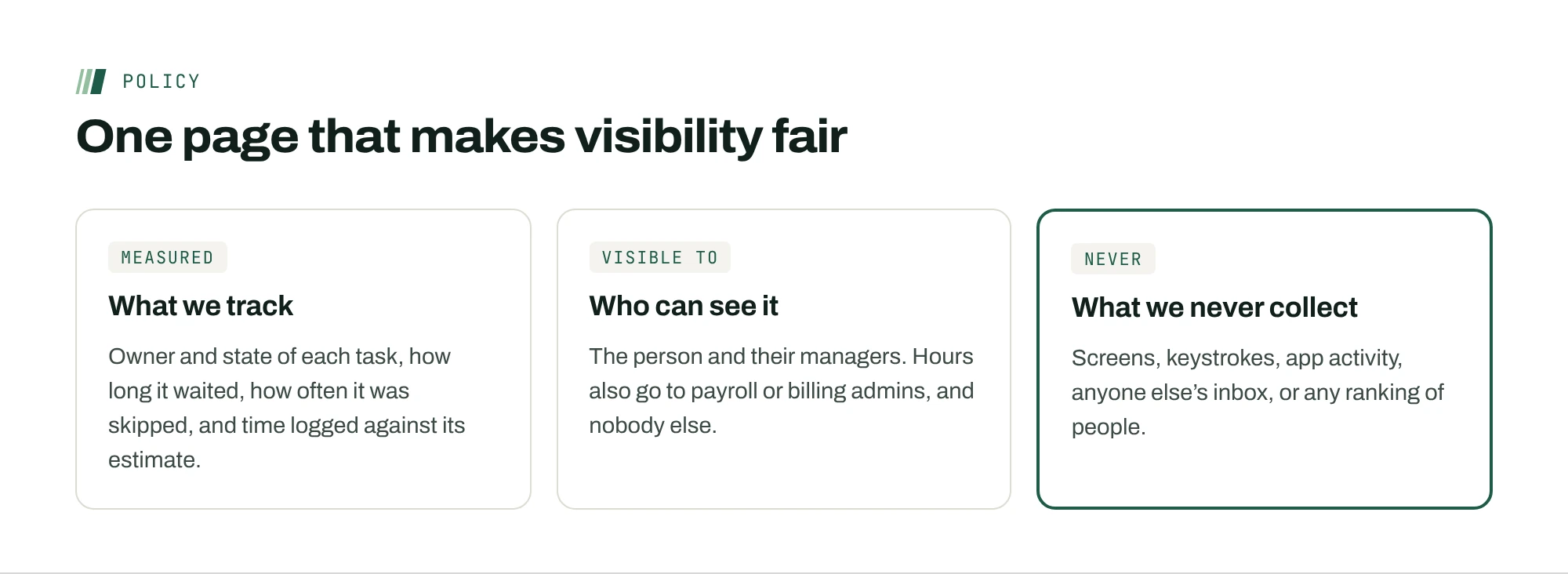
Since fairness weakens the effects of monitoring, make fairness visible. Publish one short page: what’s measured, who can see it and what’s never collected. Everyone should be able to answer “who can see my hours?” without asking. Rules people can read are rules they can hold you to, and that’s what makes the system feel fair. Review the page with the team once a year, and change it in the open.
A visibility policy you can adapt
The one-page policy needs only five headings. Here’s a version a remote team can start from.
- Why we measure: to see where work waits and get it moving, not to judge individuals.
- What we track: each task’s owner and state, how long it waited, how often it was set aside, and time logged against its estimate.
- Who sees it: you and your manager. Logged hours also go to payroll or billing. Nobody else.
- What we never collect: screenshots, keystrokes, app or website activity, or anyone else’s inbox.
- How it changes: in writing, with a week’s notice, after the team has had a chance to comment.
A worked example
After a missed deadline on a client escalation, a director asked Alex to install screen-monitoring software for a twelve-person support team. Alex asked for two weeks to try something else first. Queue time showed the answer: refund escalations waited two days on average, because only one person had the access needed to approve them. Everyone had been busy, so activity tracking would have shown nothing wrong. Alex gave two more people access, and refund escalations stopped waiting. The monitoring software was never installed.
If you already use monitoring software
Switching away from monitoring is easier than it sounds, but it needs to be done openly. Announce an end date, and say what replaces it: the work signals and the visibility policy. Say what happens to the activity data already collected, and follow your own retention rules and any legal obligations when you delete it.
Expect some skepticism. People who have been watched for a while may assume the new signals are monitoring by another name. The best answer is to show them: publish the policy, let each person see their own data first, and keep the first few conversations about stuck work focused on fixing the process.
Give it a quarter before you judge the results. Trust that was spent takes longer to rebuild than it took to lose.
Where ActionOrder fits
ActionOrder never sees anyone’s screen, keystrokes or app activity, and nothing runs in the background. The team view shows each card’s owner and status, how long it’s waited, how often it’s been skipped and time logged against its estimate. People log their own time on cards and can correct it, and hours are visible only to the person, their managers and admins with a payroll or billing role. There’s no ranking of people. See security and privacy.
Questions people ask
Does employee monitoring software improve productivity?
The evidence is mixed at best. In two studies reported in Harvard Business Review in 2022, monitored employees were substantially more likely to break rules, including deliberately working slowly. Activity data also measures presence rather than progress, so it can miss the problems that matter.
How do I hold a remote team accountable without monitoring them?
Make the work visible instead: one owner per task, its state, how long it has waited, how often it’s been skipped and self-reported time against the estimate. These point at problems in the work, which you can fix, without watching anyone.
Is self-reported time accurate enough?
Usually, if it’s logged on the specific task as the work happens rather than reconstructed at the end of the week. Let people correct entries, keep a record of changes for teams paid on logged time, and don’t rank people by hours, which encourages padding.
What should a remote team’s visibility policy include?
What’s measured, who can see it and what’s never collected. Everyone should be able to answer “who can see my hours?” from one short page. Research on monitoring found its harmful effects were weaker when people felt treated fairly.
Sources
- Monitoring Employees Makes Them More Likely to Break Rules (June 27, 2022)Harvard Business Review
- Hybrid Work Is Just Work. Are We Doing It Wrong? (September 22, 2022)Microsoft Work Trend Index (Microsoft sells Microsoft 365 and Teams)
- How Much Time and Energy Do We Waste Toggling Between Applications? (August 29, 2022)Harvard Business Review