Paying Remote Contractors: Hourly, by Outcome, or Both
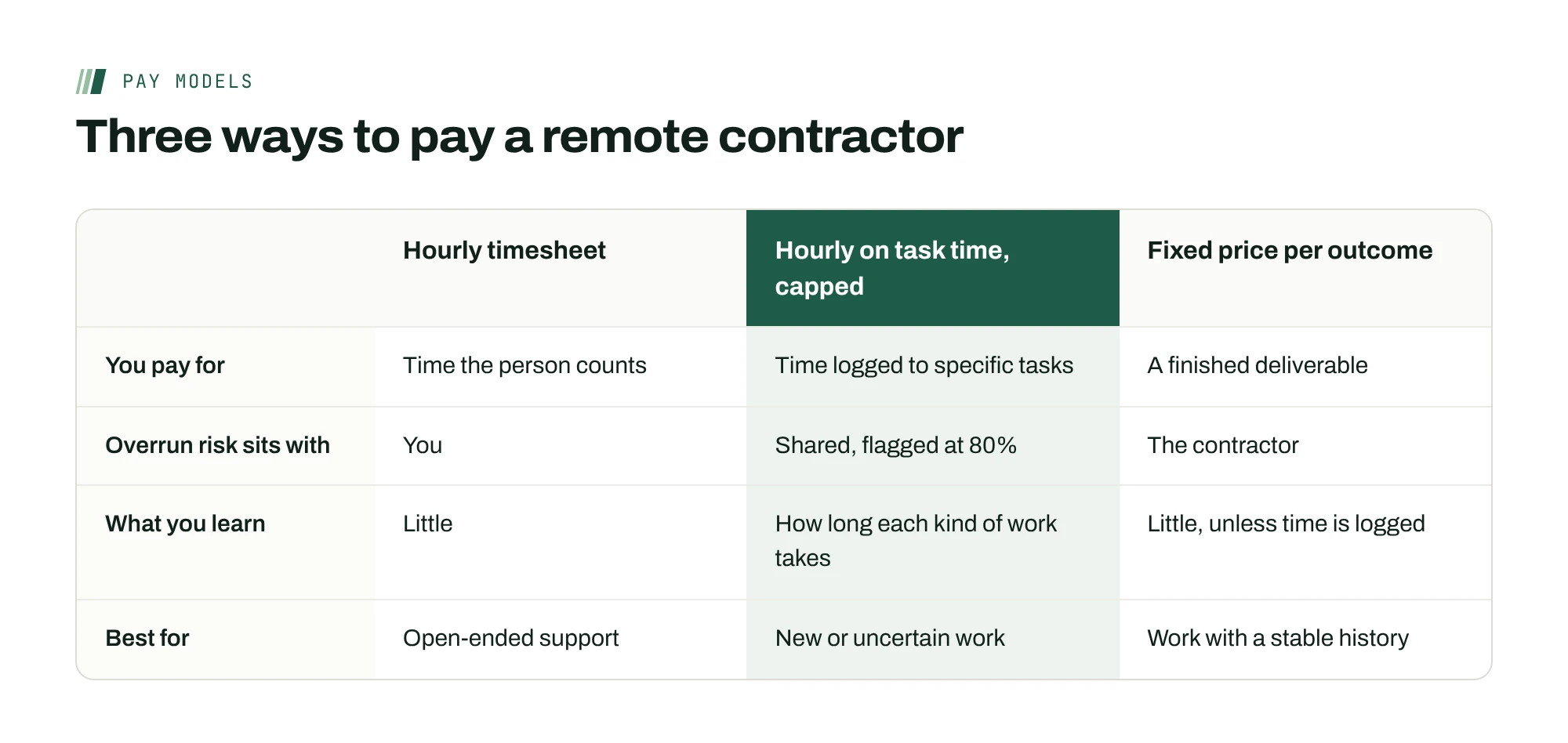
Hourly pay buys time, and fixed prices buy a guess. Most remote teams do better with both: hourly on time logged to tasks, with a cap, then a fixed price once logged time shows how long the work takes.
Sam manages six contractors across three countries. Some invoice by the hour: “32 hours, website updates.” Some work on fixed prices, and when a job runs long, they absorb it and quietly cut a corner on the next one. Neither arrangement tells Sam what the work costs, and both create friction at invoice time.
The usual debate is hourly versus fixed price. For most remote teams, the better answer is a mix, built on one habit: logging time to the specific task. This guide covers how to set it up. It isn’t legal or tax advice; see the note on classification below.
What hourly pay buys
Hourly pay buys the time someone counts. On a weekly timesheet, that usually means time they were working or available, including the parts of the day that weren’t spent on any piece of work. That isn’t a character flaw. It’s how a working day goes.
Research on employees shows how much of the day that can be. Economists using 35,548 American Time Use Survey diaries found employees spent nearly 7% of their time at the workplace not working, about 34 minutes a day. A field study published in Harvard Business Review, covering 137 people across three Fortune 500 companies, found people toggled between apps about 1,200 times a day and spent roughly 9% of their time at work getting reoriented. Those studies are of employees, not contractors, but the shape of a working day is similar.

Pay for time logged to tasks
The less common approach: keep paying by the hour, but only for time logged against specific tasks. Time not working stays off the clock, and nobody has to watch a screen to make that true. The contractor reports their own time, on the task they did, in a place you can both see.
It doesn’t make switching costs disappear. Getting reoriented after an interruption still takes time, and it gets logged on the task that was interrupted. That’s useful: when one kind of work keeps running long, you can see it, and often the cause is the interruptions you’re sending.
Give every task an estimate and a cap
Hourly work drifts because nobody notices until the invoice. Fix that with two numbers on every task: an estimate and a cap. At 80% of the estimate, the contractor flags it if they won’t finish within it, with a short note on why. Time beyond the cap needs your approval.
This turns overruns into a conversation that happens while you can still change something: cut scope, give more context or decide the extra time is worth it. Invoices stop being surprises, and contractors stop absorbing overruns they didn’t cause.
Move work to a fixed price once it’s stable
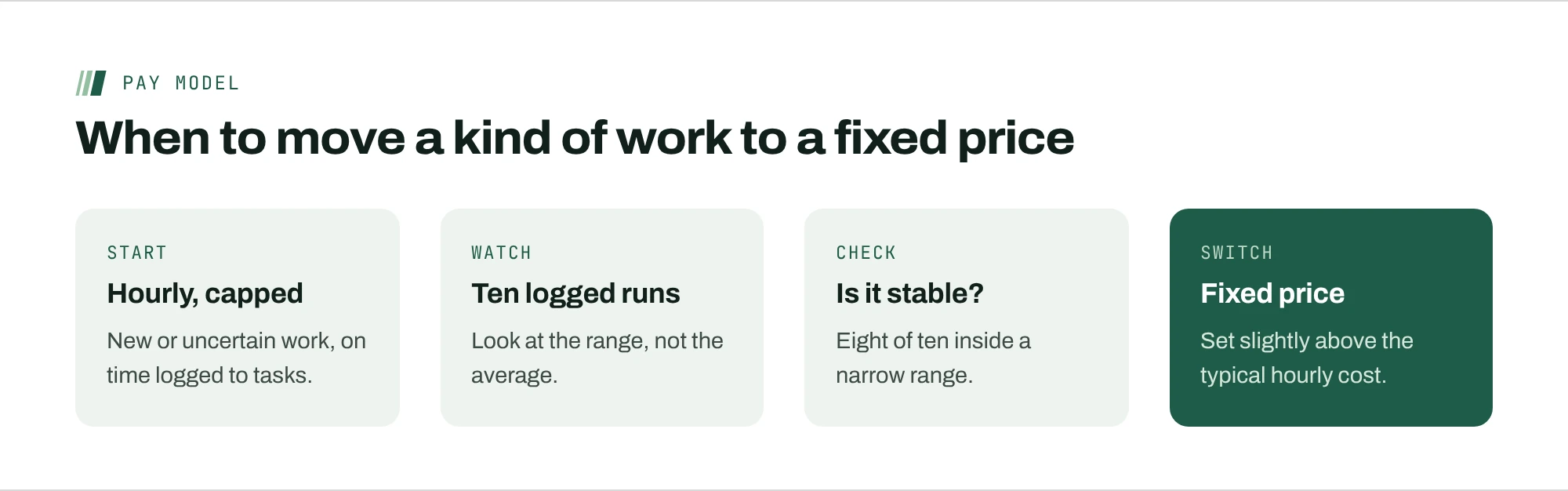
Fixed pricing is the right tool for work you understand, and the wrong one for work you don’t. Your logged time tells you which is which. Once a kind of task has a stable history, for example eight of the last ten finishing within a narrow range, offer a fixed price for it, set slightly above the typical hourly cost.
The contractor keeps the gain from getting faster, which rewards exactly what you want. You know the cost before the work starts. Keep exploratory work, first-time work and anything with a wide range on hourly terms with a cap, where nobody has to bet on a guess.
A worked example
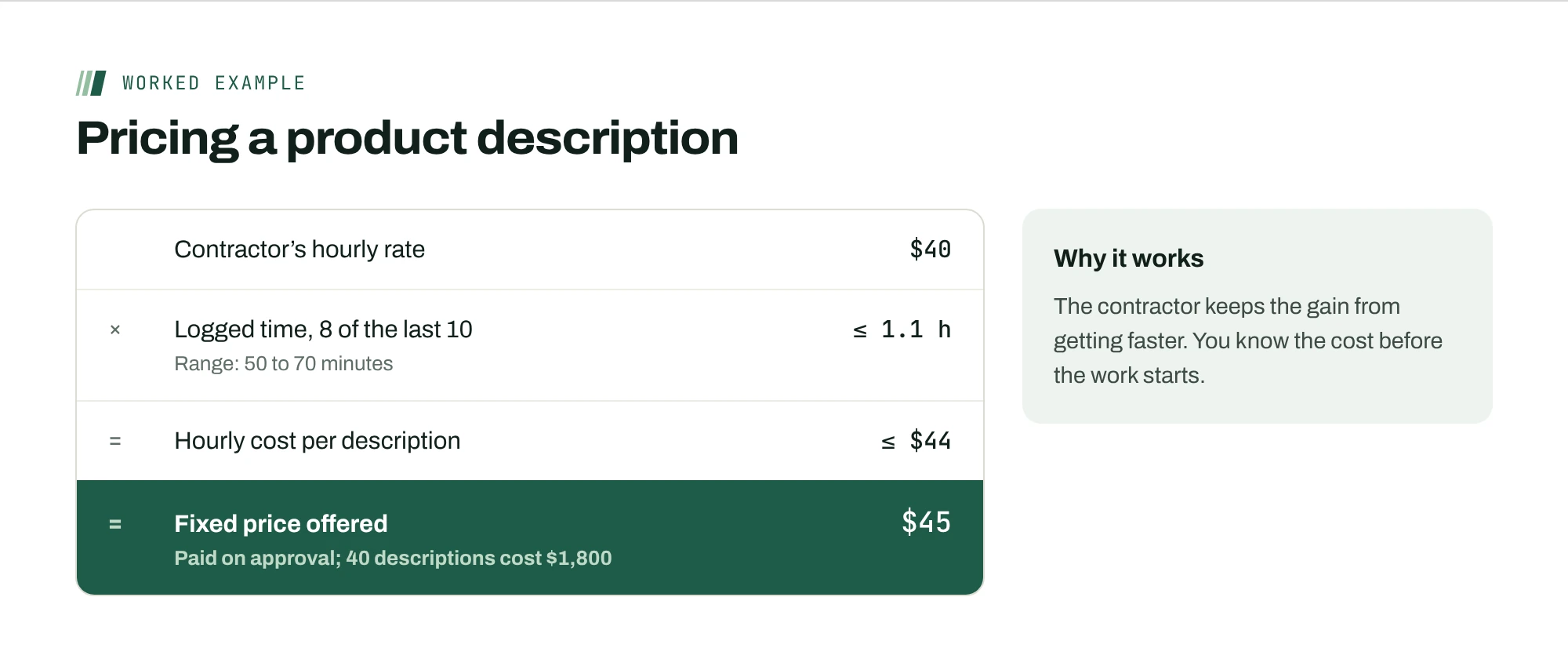
One of Sam’s contractors writes product descriptions at $40 an hour. Over the last ten, logged time ranged from 50 to 70 minutes, and eight of the ten took 1.1 hours or less. Sam offers a fixed price of $45 per description, paid on approval. If the contractor gets faster, they earn more per hour. Sam knows that 40 descriptions cost $1,800, before anyone starts. Website updates, which vary from 20 minutes to a full day, stay hourly with a cap per task, because nobody can price them well yet.
Terms to put in writing before work starts
Most disputes with contractors come from things nobody wrote down. A one-page agreement for each engagement should cover:
- How time is counted: logged to specific tasks, in a shared tool, as the work happens.
- Caps and flags: the cap on each task, and the point at which the contractor flags an overrun.
- What a fixed price includes: the deliverable, the number of revision rounds, and what counts as a new request.
- Payment timing: the day you pay and the cycle, weekly or every two weeks.
- Availability, if you’re paying for it: the hours, the response window and the fee.
- Who owns the work: check this with a lawyer for your jurisdiction.
When hourly is still the right answer
Fixed prices aren’t always better. Keep hourly pay for work where the scope can’t be known in advance: investigating a bug, open-ended research, early design exploration, or support that depends on what comes in that week.
Forcing a fixed price onto uncertain work pushes the risk onto the contractor, and good contractors price that risk in or turn the work down. A simple rule is to start hourly, log to tasks, and move a kind of work to a fixed price only once you’ve seen it done about ten times, with most of those runs landing in a narrow range.
Revisit the split every quarter. Work that was uncertain often settles into a pattern once you’ve seen it a few times.
Pay on a short, predictable cycle
Contractors are running small businesses, and slow payment is a cost you’re pushing onto them. If logged time is already on every task, an invoice is just an export, so there’s little reason to pay monthly at net 30. Pay weekly or every two weeks, on a fixed day, from the logged time you’ve both been able to see all along. It costs you nothing extra, and good contractors notice which clients pay on time.
Pay for availability explicitly
Sometimes you need a contractor to be reachable: during a launch, or for a few overlap hours a day. Don’t let that leak into hourly totals as time spent waiting for messages. If you need availability, pay for it explicitly: a set fee for defined hours of responsiveness, separate from task time. It’s more honest for both of you, and it makes the cost of “always on” visible enough to question.
Review the variance monthly, not invoice by invoice
Questioning individual invoices line by line damages trust and teaches people to log defensively. Once a month, compare estimates with logged time by kind of work instead. Look for patterns: a task type that always overruns, a client whose work always takes longer, a cap that’s always hit. Fix those, and let individual invoices be. When a fix works, for example logged time on a task type drops after you stop interrupting it, tell the contractor. It shows the logs are used to fix the work, not to judge the person.
Mistakes that make contractors expensive
- Switching to a fixed price too early. Pricing work you’ve done twice is guessing. Wait for a stable history.
- Using caps as targets. A cap is the trigger for a conversation, not the expected time. If every task lands on its cap, the caps are too generous or the estimates are padded.
- Leaving contractors without context. Contractors who don’t see the background make reasonable guesses that turn out wrong. Give them the context they need for the work they’ve agreed to do.
- Paying late. Slow payment costs you the contractors who have other options, and those are usually the good ones.
A note on classification
How you pay someone can matter for whether they’re treated as a contractor or an employee. The IRS, for example, looks at behavioral control, financial control and the type of relationship, and lists how the worker is paid as one part of financial control. Rules differ by country and state. Before changing how you pay contractors, check with an employment lawyer or an accountant. Nothing here is legal or tax advice.
How to introduce task-time pay to existing contractors
Changing how you pay people you already work with needs care. Contractors will reasonably worry that logging to tasks is a way to pay them less.
- Explain the reason. You want to see which work takes longest so you can fix the causes, and to move stable work to fixed prices they can earn more on.
- Run both for a month. Keep paying as before while they log time to tasks. Compare the totals together at the end of the month.
- Protect their effective rate. If task logging shows they were absorbing work you never saw, such as extra revisions, fix the scope rather than the rate.
- Agree on the first fixed prices together. Use their logged history, and invite them to suggest which kinds of work are ready.
Where ActionOrder fits
On the Pro and Business plans, people log time on the card they’re working on, against an estimate ActionOrder suggests from similar cards, which the person or their manager can change. Logged time exports to CSV for invoicing or payroll. Hours are visible to the person, their managers and admins with a payroll or billing role. See the use case for billing every hour to a task.
Questions people ask
Should I pay remote contractors hourly or per project?
Many teams do best with both. Pay hourly, on time logged to specific tasks with a cap per task, for new or uncertain work. Move a kind of work to a fixed price once its logged time is stable, so the contractor gains from getting faster and you know the cost upfront.
How do I stop hourly contractors from padding their time?
Pay for time logged to specific tasks, set an estimate and a cap on each task, and ask for a flag at 80% of the estimate. Review patterns by kind of work monthly rather than questioning each invoice. Screen monitoring tends to damage trust more than it protects you.
When should I switch a contractor to a fixed price?
When a kind of task has a stable history, for example eight of the last ten finishing within a narrow range. Set the fixed price slightly above the typical hourly cost. Keep first-time or exploratory work hourly with a cap.
Does paying by the hour affect whether someone is a contractor?
It can be one factor. The IRS, for example, lists how a worker is paid as part of financial control, alongside behavioral control and the type of relationship. Rules vary by country and state, so check with an employment lawyer or accountant. This isn’t legal or tax advice.
Sources
- Not Working at Work: Loafing, Unemployment and Labor Productivity (NBER Working Paper 21923, 2016)Burda, Genadek and Hamermesh
- How Much Time and Energy Do We Waste Toggling Between Applications? (August 29, 2022)Harvard Business Review
- Independent contractor (self-employed) or employee?Internal Revenue Service