Protect Focus on a Remote Team Without Another Meeting Policy
Remote teams lose focus to half-finished work and constant checking, not just meetings. One active task, a one-minute note before switching, and set times to check messages help more than a new policy.
Ask a remote team what hurts their focus and most people will say meetings. Cut the meetings, though, and focus often doesn’t come back. The rest of the problem is quieter: five tasks in progress at once, each half-finished, each pulling at attention, and a stream of messages that makes every task feel interruptible.
Focus on a remote team is less about protecting time and more about protecting attention. This guide covers four habits that do that, none of which needs a new meeting policy.
The cost of half-finished work
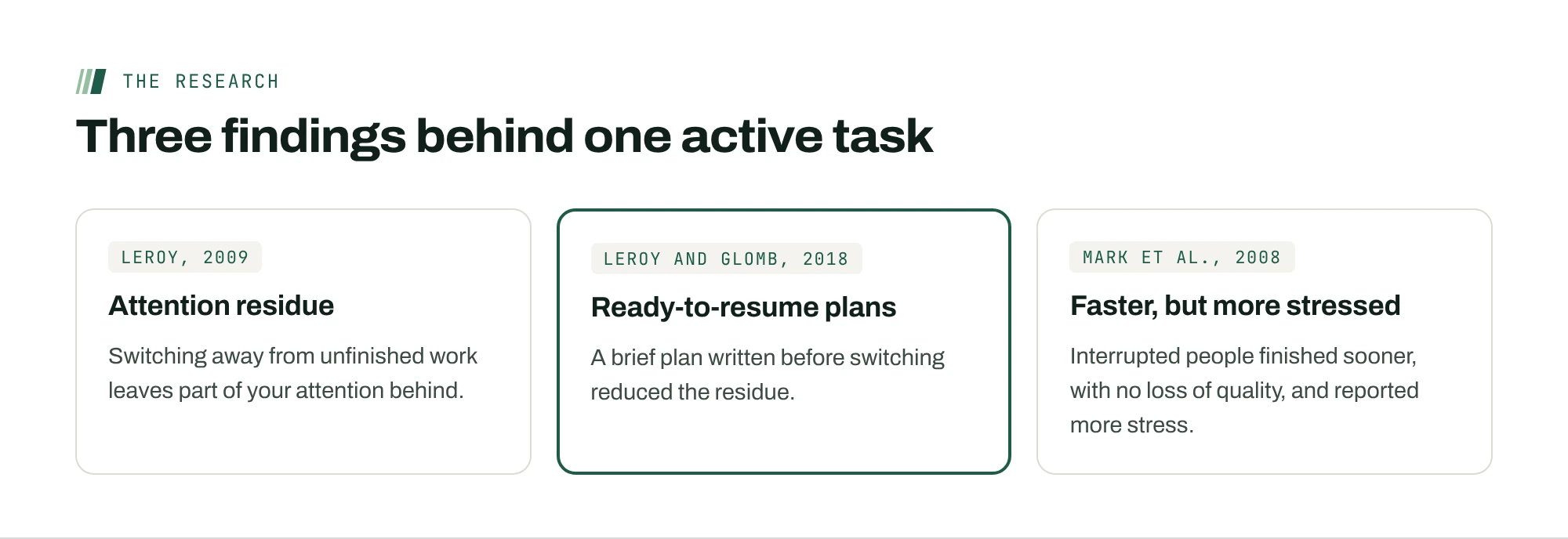
Sophie Leroy, an organizational researcher, named the problem attention residue: when people switch away from a task they haven’t finished, part of their attention stays behind, and their performance on the next task suffers. Her 2009 studies found it was worse when the first task was left incomplete.
Interruptions also change how people work. In a 2008 experiment by Gloria Mark and colleagues with 48 participants, people who were interrupted finished their tasks in less time, with no difference in quality, but reported more stress, frustration, time pressure and effort. Interrupted people compensate by working faster, and they pay for it.

Limit each person to one active task
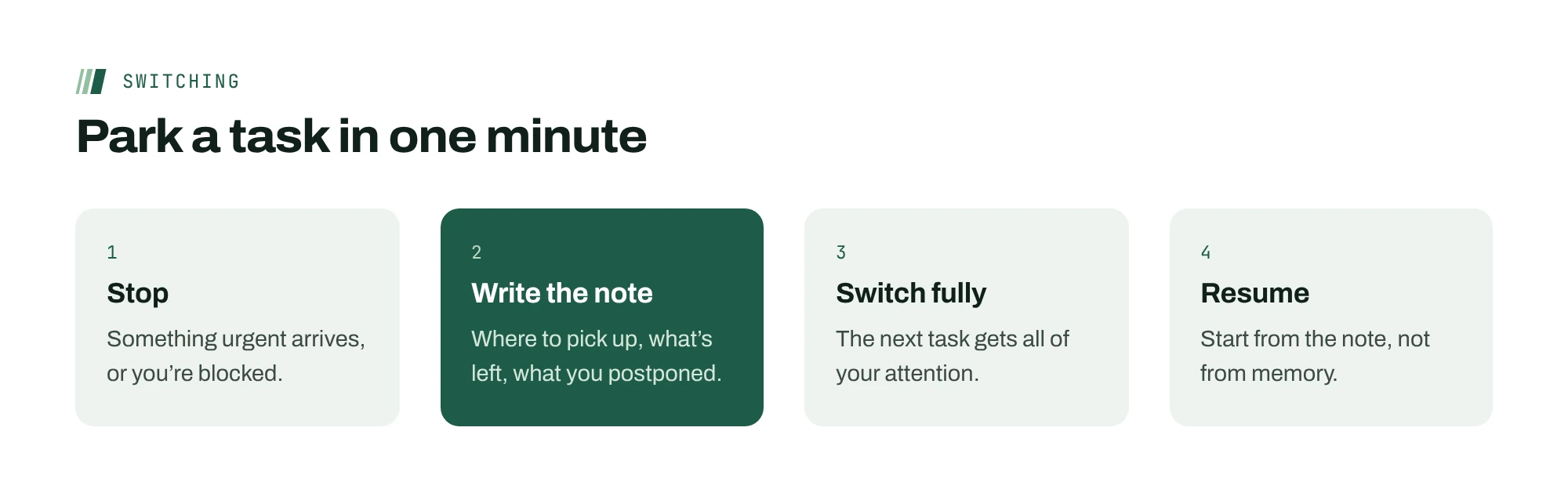
The simplest fix is also the least common: one active task per person. Not one project, one task. Everything else waits in a visible order, so nobody has to hold the list in their head. When something urgent arrives, the person parks the active task deliberately rather than leaving it open in a tab.
This feels slow for about a week. Then people notice they finish more, because work stops sitting at 80% while three other things get started. Managers notice something too: when every person has one active task, you can see exactly what the team is doing at a glance.
Be precise about what counts as active. Work waiting on someone else isn’t active: mark it waiting, with what it’s waiting for, and pick up the next task. That’s the difference between limiting work in progress and sitting idle. The limit applies to what you’re doing, not to what you’re responsible for.
Write a one-minute note before switching
Switching is sometimes unavoidable. Leroy and Theresa Glomb tested what helps, and published it in Organization Science in 2018. Before switching, people wrote a brief ready-to-resume plan: where they’d pick up, what challenges were left and what they had to postpone. It significantly reduced attention residue, and people did better on the interrupting task. As Leroy put it, even a minute’s work will do.
A related finding comes from Masicampo and Baumeister, who found that making a specific plan for an unfinished goal reduced how much it intruded on other work. Writing the next step down tells your brain it doesn’t need to keep rehearsing it.
Make the note part of parking a task. It goes on the task itself, so when the person comes back, or someone else picks it up, the first step is already written.
What to write in a ready-to-resume note
The note works when it’s specific enough that you, or someone else, could pick up without rereading everything. Three lines are usually enough.
- Where I am: “Drafted sections 1 to 3. Section 4 needs the client’s numbers.”
- Next step: “Pull the Q3 figures from the dashboard and finish the table.”
- What I parked: “Haven’t checked the legal wording. Flag it before sending.”
Leroy and Glomb’s plan covered where people would pick up, what challenges were left and what they’d postponed. The exact wording matters less than writing it before you switch, not after.
Cluster meetings so focus has room
Focus time disappears fastest when meetings are scattered across the day. A single call in the middle of the afternoon splits it into two pieces, and neither is long enough for difficult work.
Agree on meeting windows instead: for example, mornings for focus and early afternoons for calls, adjusted to your overlap hours. Ask people to decline invitations that fall outside the window unless the meeting can’t move. Review the calendar together once a month and remove any recurring meeting nobody would miss.
Expect the first month to feel uncomfortable. People used to instant replies will notice the gap, and a few will test whether the urgent path really works. Hold the windows anyway, keep the urgent path open, and look at the urgent count each week. If it stays low, the team has its answer.
Let people choose their own focus hours
Team-wide focus blocks are hard across time zones: 9 a.m. in Toronto is late evening in Manila. Instead, ask each person to choose their own two or three focus hours based on when they do their best work, and publish them where the team works. During those hours, they’re not expected to reply to anything that isn’t urgent.
Researchers who studied 76 companies that introduced meeting-free days, writing in MIT Sloan Management Review, found that one meeting-free day a week improved autonomy, communication, engagement and satisfaction, and reduced micromanagement and stress. Personal focus hours apply the same idea at a scale that works across time zones. They also respect a simple fact managers often overlook: people do their best thinking at different times of day, and on a remote team, nobody needs everyone’s best hours to line up. Ask for overlap only where the work needs it, such as decisions and handoffs.
Check messages at set times
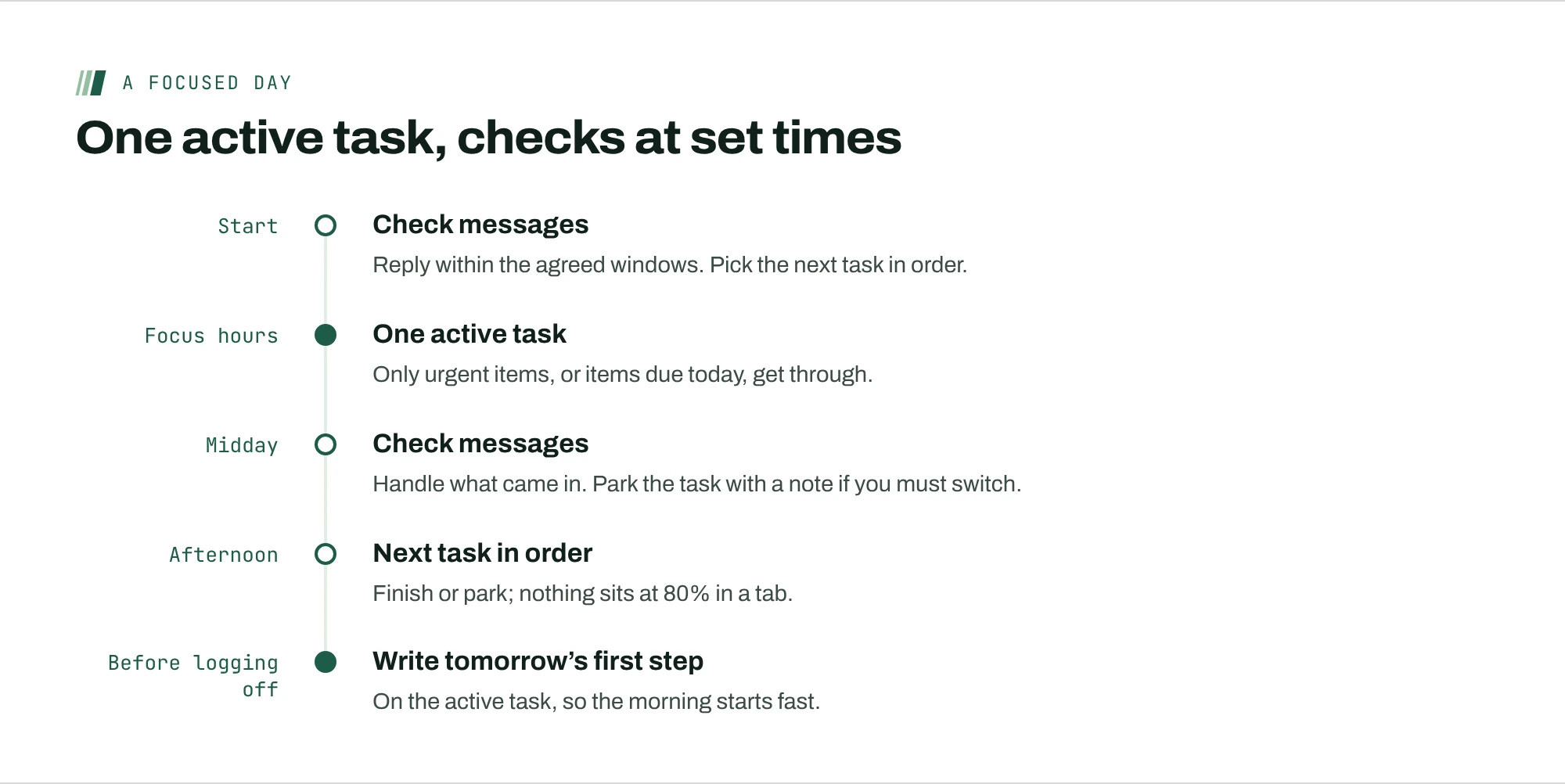
Constant checking keeps every task interruptible. In an experiment by Kushlev and Dunn, people who limited email to three checks a day for a week reported significantly lower daily stress than in a week of unlimited checking. Agree as a team on when people check messages, and define urgent narrowly enough that the windows are safe. A short response-time agreement makes this explicit.
Make “not now” safe
People can’t focus if they’re afraid of missing something. One active task and set checking times only work if two things are true: nothing gets lost while it waits, and genuinely urgent work has a way through. Keep the waiting work in one visible order that everyone trusts, and keep the urgent path narrow and reliable. When people know the next task will still be there and the real emergency will still reach them, ignoring everything else becomes easy.
Close the day on purpose
Remote work blurs the end of the day, and open loops follow people into the evening. The same ready-to-resume note works here. Before logging off, write the first step for tomorrow on the active task. It takes a minute, it makes the morning start faster, and it lets people stop thinking about work when they stop working. For managers, it has a side benefit: if someone is out unexpectedly, the next step on their active task is already written down.
A worked example
Taylor’s eight-person content team averaged five tasks in progress per person. Taylor asked everyone to try one active task for a month, with a ready-to-resume note whenever they parked something, and to publish their focus hours. In the first week, two people said it felt rigid. By the fourth, the number of drafts sitting unfinished for more than a week had dropped sharply, and the weekly recap showed more finished work with the same hours logged. The two skeptics changed their minds for the same reason: they stopped starting each morning by working out where they’d left five different things.
Mistakes that quietly undo focus
- Calling everything urgent. If more than a handful of items a week jump the queue, focus hours exist only on paper. Look at why work keeps arriving late.
- Treating focus hours as unavailable hours. Focus hours protect attention, not the person’s whole day. Keep the urgent path open.
- Judging by how busy people look. One active task can feel slower at first. Judge it by what’s finished each week.
- Managers exempting themselves. If you message people during their focus hours, the team will assume the hours don’t really count.
Design the urgent path on purpose
Focus only holds if there’s a reliable way for real emergencies to get through. Design it rather than letting it happen by accident.
- Who can mark urgent: managers and account owners, and nobody else by default.
- What counts: anything a manager marks urgent, plus anything due today.
- How it arrives: one visible signal the person can open or ignore, not a stream of pings.
- How you review it: count urgent items each week. A rising count means planning is slipping upstream, not that people need to be more available.
End the week with a two-minute park
On the last working day, ask everyone to look at their open work and park each item with a short note, even if they’ll pick it up first thing next week. It takes a couple of minutes, and Monday starts with a written next step instead of a scramble to remember where everything stood.
Where ActionOrder fits
ActionOrder is built around one active card per person. While someone has a card active, new cards wait their turn, and only items a manager marks urgent, plus items due today, get through, as a small bar they can open or ignore. When a card is parked, the person adds a note on where to pick up. See how focus works.
Questions people ask
What is attention residue?
A term from researcher Sophie Leroy for the part of your attention that stays on a task after you switch away from it, especially if it’s unfinished. Her studies found it lowered performance on the next task. Writing a short ready-to-resume note before switching reduced it.
How do you protect focus time on a remote team across time zones?
Instead of team-wide focus blocks, let each person choose their own two or three focus hours and publish them. Agree on set times to check messages and a narrow definition of urgent, so people can safely ignore non-urgent messages during focus hours.
Should remote workers only work on one task at a time?
One active task at a time, with everything else waiting in a visible order, helps most teams finish more. When something urgent arrives, park the active task deliberately, with a short note on where to pick up.
What should a ready-to-resume note include?
Where you’ll pick up, what challenges are left and anything you had to postpone. A minute is enough. Put it on the task itself, so whoever picks it up next, you or someone else, starts with the next step written down.
Sources
- Why is it so hard to do my work? The challenge of attention residue when switching between work tasks (2009)Sophie Leroy, Organizational Behavior and Human Decision Processes
- Task interrupted: A plan for returning helps you move on (January 16, 2018)University of Washington, on Leroy and Glomb, Organization Science
- The Cost of Interrupted Work: More Speed and Stress (CHI 2008)Mark, Gudith and Klocke
- Consider it done! Plan making can eliminate the cognitive effects of unfulfilled goals (2011)Masicampo and Baumeister, Journal of Personality and Social Psychology
- The Surprising Impact of Meeting-Free Days (2022)MIT Sloan Management Review