How to Delegate Across Time Zones Without Losing Context
On a remote team, every unanswered question costs a day. Write handoffs for someone who can’t ask you anything, hand over decisions instead of tasks, and ask for a plan back before work starts.
You hand a task to a teammate before you log off. They pick it up eight hours later, hit a question in the first twenty minutes, and send it to you. You answer the next morning. The task has now lost a full day, and nothing about it was hard.
That’s the real cost of delegating across time zones: not the work, but the round trips. In an office, a missing detail costs a walk to someone’s desk. On a remote team that works asynchronously, it costs a day. This guide is about cutting round trips to zero, using four habits that experienced managers often skip because they were never needed in a shared office.
Why handoffs break across time zones
Most delegation advice assumes you can clarify later. You agree on the goal, the person starts, and questions get answered as they come up. That works when “later” means ten minutes. On a distributed team, GitLab’s remote handbook warns that follow-up questions can take hours or days to answer, which is why it pushes teams to write things down so people can find answers whether or not their teammates are online.
Hospitals learned the same lesson because patients change hands at every shift. The Joint Commission’s 2017 alert on hand-off communication recommends standardized handoffs that include an action list, contingency plans and the sender’s contact details, with time for the receiver to ask questions. When the pediatric residency programs of nine hospitals adopted one structured handoff program, I-PASS, medical errors fell 23% and preventable adverse events fell 30%, and the handoffs took no longer. A remote team’s stakes are lower, but the mechanism is the same: structure moves the context the receiver would otherwise have to ask for.

Write for someone who can’t ask you anything
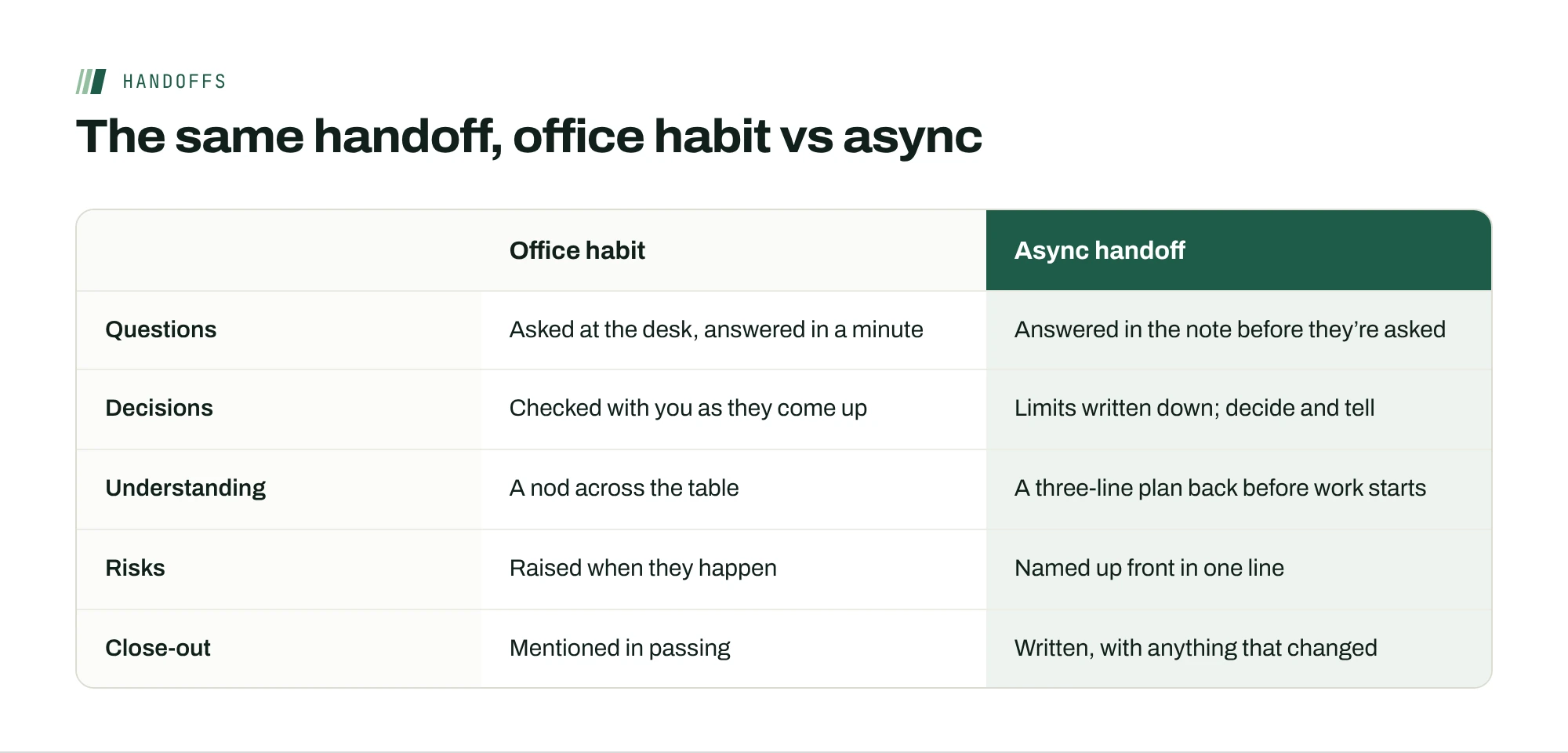
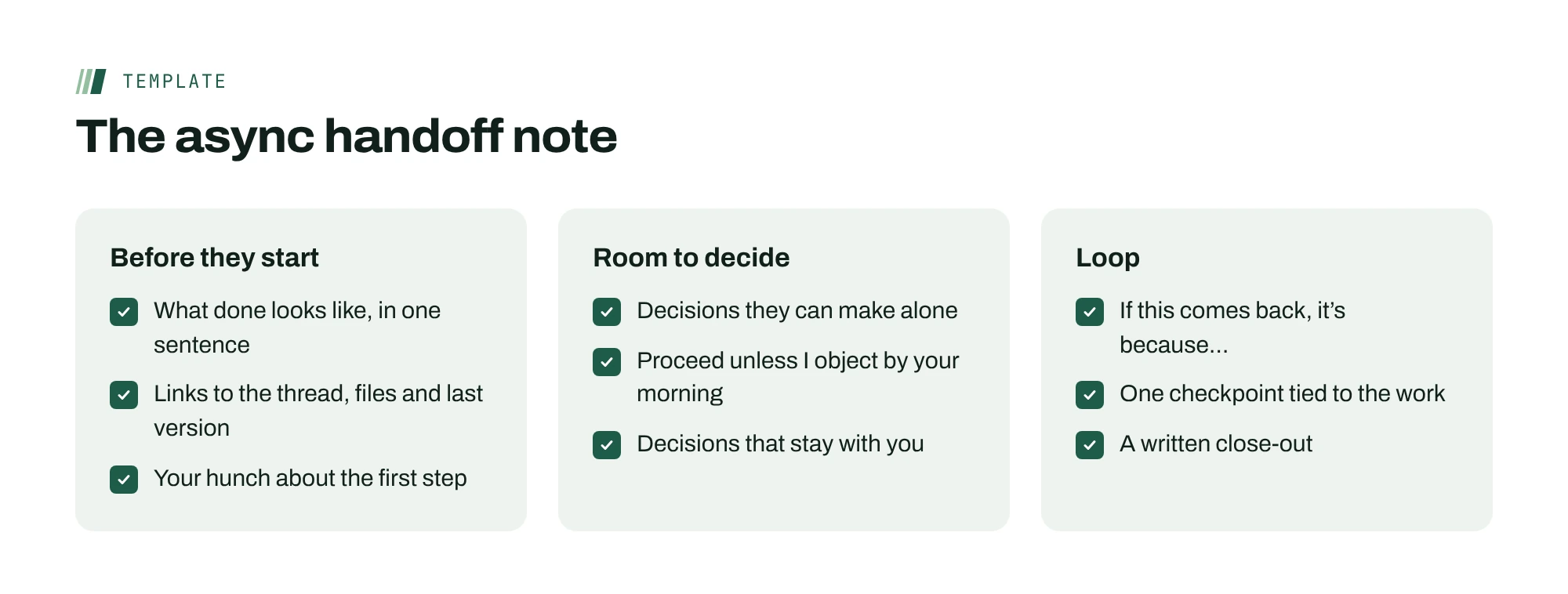
Here’s the test for an async handoff: could the person finish the work if you were unreachable for a day? If not, the note is missing something. Before you send it, imagine the first three questions they’ll have and answer them in the note.
- What does done look like? One sentence with a finish line. “Sandpiper’s project plan, reviewed by Priya, in the shared folder by Thursday” beats “work on the Sandpiper plan.”
- Where’s the background? Link the client thread, the kickoff notes and last time’s version. Links beat summaries, because your summary drops the detail they’ll need.
- What would you do first? If you have a hunch about the first step, say so. It’s the cheapest context you can give.
A useful trick is to write the note, then read it as if you’d never heard of the client. Every “you know the one” is a round trip waiting to happen.
Delegate the decision, not just the task
The handoffs that bounce back most often aren’t missing information. They’re missing permission. The teammate knows what to do but isn’t sure they’re allowed to, so they ask, and wait.
Fix it by delegating the decision along with the work, inside written limits. “You can move the launch email by up to two days without asking. If the client wants anything beyond that, choose the option you’d pick, tell me why, and go ahead unless I object by your morning.” That last clause is the unusual part. It turns the default from “wait for approval” into “proceed unless stopped,” which suits a team that’s never online at the same time.
Keep the decisions that can’t be undone. Jeff Bezos described these as one-way doors in Amazon’s 2015 shareholder letter, and argued that most decisions are two-way doors that should be made quickly by people with good judgment. Most handoffs are full of two-way doors. Give those away.
Ask for a plan back, not a yes
A thumbs-up tells you the message arrived. It doesn’t tell you it was understood. Instead, ask the receiver to reply with three lines before they start: what done looks like in their words, the first step they’ll take, and what they think could go wrong.
This is the async version of the read-back that hospital handoff programs build in, where the person taking over summarizes the plan before the sender leaves. It takes a teammate two minutes. When their version of “done” doesn’t match yours, you catch it in their morning instead of at the deadline.
It also changes who’s accountable. Once someone has written down the plan, the work is theirs in a way a forwarded email never is.
Name the likely failure in one line
Add one sentence to every handoff: “If this comes back to me, it’ll probably be because…” Then finish it. “…the client asks for the Spanish pages early.” “…the estimate in the template is a year old.”
You know where the work usually goes wrong, and the person taking it over doesn’t. Writing it down is the cheapest contingency plan there is, and it’s exactly what the Joint Commission asks clinicians to pass on. It also tells the receiver where to spend their care, so they don’t treat every detail as equally risky.
A worked example
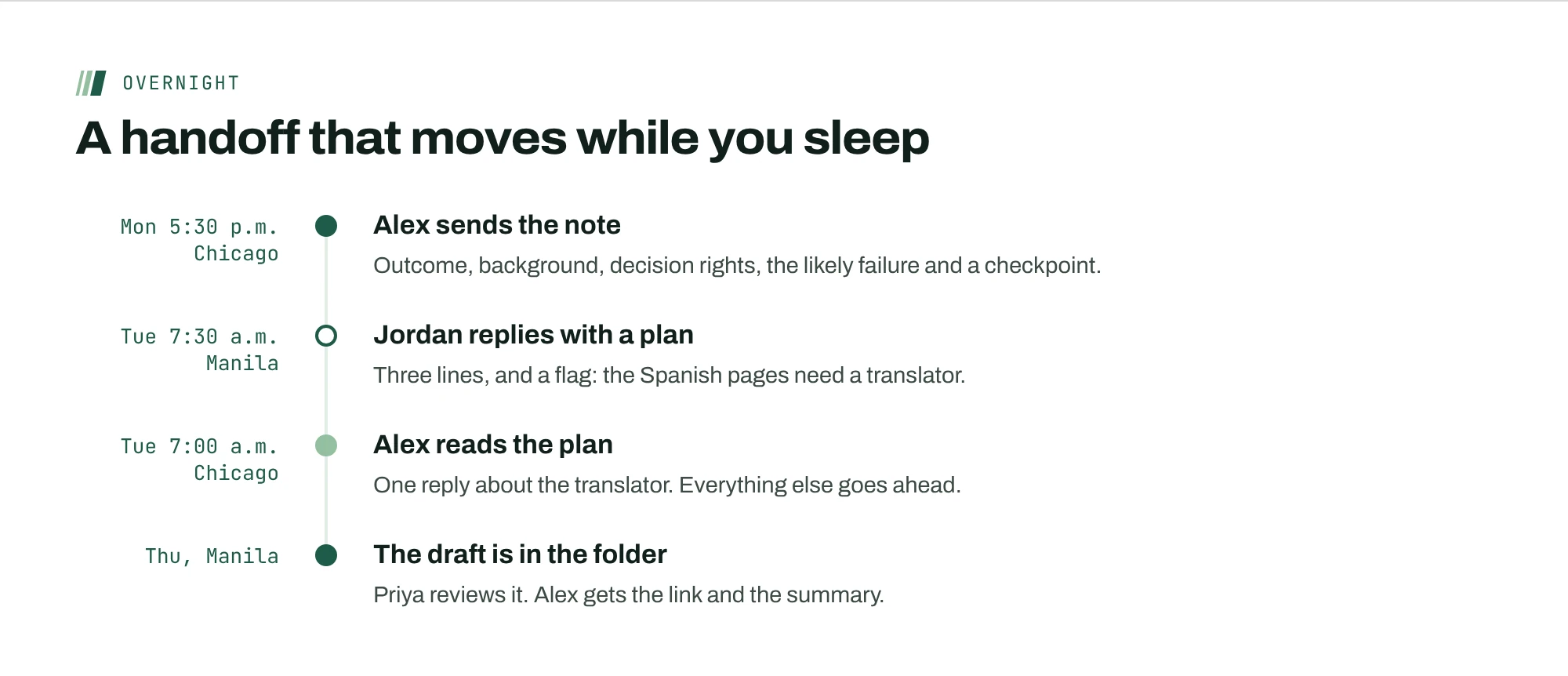
Alex manages a delivery team spread from Chicago to Manila. Before logging off on Monday, Alex hands the Sandpiper project plan to Jordan, who starts work while Alex is asleep. Here’s the note, in full.
- Done looks like: a six-week project plan for the Sandpiper website rebuild, in the shared folder by Thursday, reviewed by Priya.
- Background: the kickoff notes from September 19, the client thread, and the plan from Sandpiper’s last project, which ran two weeks over while we waited on content.
- First step I’d take: list the three must-haves from the kickoff notes (online booking, a blog, Spanish pages) and build the plan around them.
- You can decide: task order, owners for design and QA, and estimates within 20% of the template. Bigger changes: pick one, tell me why, and go ahead unless I object by your morning.
- If this comes back to me, it’ll be because: the template’s estimates are a year old. Use last quarter’s logged time where it’s different.
- Checkpoint: when the first draft is in the folder, send me the link and your three-line plan.
It took Alex about six minutes to write. Jordan replied with a plan that flagged one thing Alex hadn’t thought of: the Spanish pages need a translator, who isn’t on the team. That surfaced on day one instead of week four.
Close the loop in writing
Delegated work that disappears is the other failure mode. Agree on one checkpoint when you hand off, not a standing check-in. Make it a moment in the work, such as “when the first draft is in the folder,” rather than a time on your calendar, since you may be asleep when it happens.
When the work is done, ask for a short written close-out: what was delivered, anything that changed from the plan, and anything you need to know. Over a few weeks, those close-outs become the best record your team has of how work actually gets done, and they make the next handoff of the same kind faster to write.
If you’re handing off the same kind of work repeatedly, turn the note into a template. Most teams find that the second or third handoff of a given type is where the note gets short, because the background links and limits stop changing.
Three mistakes that undo a good handoff
Most handoffs that fail were written well and then undone by what happened next. Watch for these three.
- Editing the brief in direct messages. You think of one more thing at 10 p.m. and send it as a quick message. Now the brief lives in two places, and the person working from the note misses the change. Add it to the note itself and say what changed.
- Rescuing the work when it stalls. When a handoff goes quiet, the instinct is to take it back. Ask what the plan needs first. Taking work back teaches people that handoffs are provisional, and the next one gets less ownership.
- Handing off at the last minute. A note sent as you log off, with a deadline the next morning, leaves no room for the plan back. Hand off at least one working day before the first checkpoint, counted in the other person’s time zone.
How to tell whether your handoffs are working
You don’t need a survey. Look at three things over a month: how many handoffs came back with a question the note could have answered, how long the plan back took, and how often you changed the brief after sending it.
Each one points at a different fix. If the first number is high, your notes are missing context, usually the background or the decision rights. If the plan back is slow, the checkpoint is unclear, so name what you want to see and by when. If you keep changing the brief, you’re handing off before you’ve decided what done looks like.
Track these for the handoffs that matter most, such as client deliverables and anything with a fixed date. Small requests don’t need the full note, and asking for one will make people avoid delegating at all.
Where ActionOrder fits
ActionOrder is built for remote teams that work asynchronously. When you delegate a card, it goes to a teammate with its prep attached: the records it came from, the analysis and a first draft, plus your note and due date. They can act on it, ask a question, hand it back or pass it on, and you get a card back when it’s done. The team view shows who has each card, how long it’s waited and how its logged time compares with the estimate, so delegated work stays visible without a check-in. See the delegation use case for a full example.
Questions people ask
How do you delegate to someone in a different time zone?
Write the handoff so it can be finished without asking you anything for a day. Include what done looks like, links to the background, your best guess at the first step, the decisions they can make, and the most likely way it goes wrong. Ask them to reply with a three-line plan before they start, and agree on one checkpoint tied to the work rather than a meeting.
What should an async handoff note include?
An outcome in one sentence, links to the records, the decisions the person can make and the limits on them, one line on the most likely failure, a checkpoint and a due date. It usually fits in a short message, and it gets shorter once you turn repeated handoffs into a template.
How do I stop delegated work from coming back to me?
Most work comes back for permission, not information. Delegate the decision with written limits, and make the default “proceed unless I object by your morning” for anything reversible. Keep only the decisions that can’t be undone.
Isn’t asking for a plan back a sign I don’t trust them?
It’s a check on the handoff, not the person. A three-line plan shows whether your note said what you meant. When it doesn’t match, the fix is usually in your note, and you catch it before any work is wasted.
Sources
- Asynchronous communication for remote workGitLab Handbook
- Sentinel Event Alert 58: Inadequate hand-off communication (September 12, 2017)The Joint Commission
- Safer Patient Handoffs (November 18, 2014), on the I-PASS study in the New England Journal of MedicineHarvard Medical School
- 2015 letter to shareholders (Exhibit 99.1)Amazon, filed with the SEC