
Chapter 1 of 7
Why async teams need a different model
Working apart hides the work. The fix isn’t more check-ins. It’s a few written habits that let the work show itself.

The visibility gap
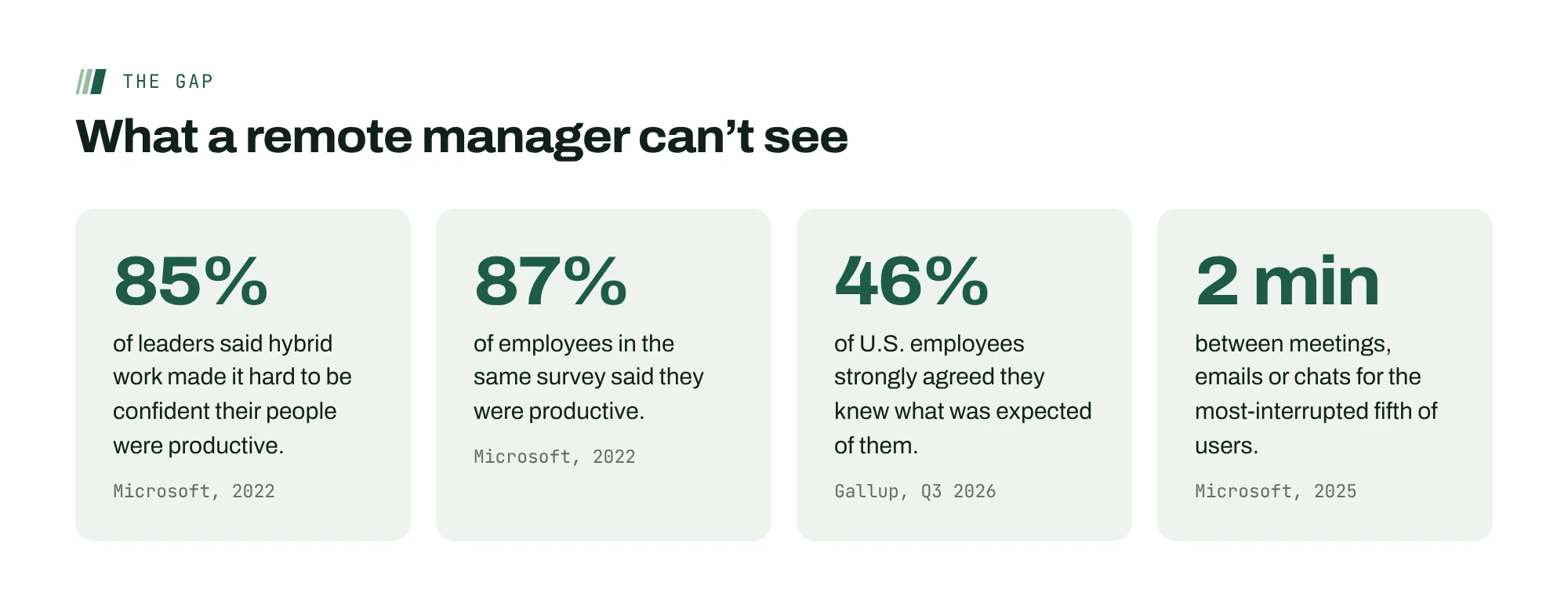
In Microsoft’s 2022 Work Trend Index survey of 20,006 people, 85% of leaders said the shift to hybrid work had made it hard to be confident their people were productive, while 87% of employees said they were. Both groups are describing the same week from different seats. The work is happening. The manager can’t see it.
The natural response is to ask: a standup, a check-in, a quick “any update?” Each one feels small. Together they interrupt the people doing the work, and they still tell you less than a glance at the work itself would.
Three things break when a team spreads out
Priorities scatter. In Gallup’s Q3 2026 survey, 46% of U.S. employees strongly agreed that they knew what was expected of them at work. Gallup also found that from 2020 to 2023, the drop in knowing what’s expected was about twice as large for hybrid and fully remote workers as for on-site workers whose jobs could be done remotely.
Status has to be chased. Microsoft’s 2025 analysis of Microsoft 365 data found that the most-interrupted fifth of users already get a meeting, email or chat every two minutes during core hours. Every status question adds to that stream, often for the person you most need to be focused.
Time gets hard to account for. Two studies that measure different things show how much of a paid day slips. A field study in Harvard Business Review found people spent roughly 9% of their time at work reorienting after switching apps. Economists using American Time Use Survey diaries found nearly 7% of time at the workplace went to not working at all. Added together, that’s about 16% of the day. It’s an estimate, not a measurement, but it’s a useful sense of scale.
Replace asking with writing
Office teams run on information that floats around the room: who’s busy, what the boss cares about this week, which client is upset. Remote teams don’t get that for free. They have to write it down, once, where the work lives, so anyone can find it on their own schedule.
This playbook turns that into five habits, one chapter each: a ranked priority post, status that comes from the work, handoffs that carry their own context, protected focus, and accountability built on signals from the work rather than on watching people. The last chapter puts them into a 30-day plan, and the templates give you every document you need to start.
Four principles behind every chapter
- Write it once, where the work lives. A decision in a direct message is lost by Wednesday. A decision on the task is found by whoever picks it up next.
- Make the default clear. Silence should move work forward, not stall it. Say what happens if nobody replies.
- Look at the work, not the people. How long a task has waited tells you where to help. How active someone looks tells you very little.
- Change one habit at a time. Run each change as a short experiment, measure it, and keep what works.
Who this playbook is for
It’s written for managers and team leads of remote teams, from a handful of people to about fifty, especially teams spread across time zones. If you manage several teams, run it with one first. Everything here works with the tools you already have: a shared document, your project tool and a calendar.
Go deeper on the blog
Sources
- Hybrid Work Is Just Work. Are We Doing It Wrong? (September 22, 2022)Microsoft Work Trend Index (Microsoft sells Microsoft 365 and Teams)
- U.S. Employee Engagement Below 30% for First Time in 15 Years (October 28, 2026)Gallup
- In New Workplace, U.S. Employee Engagement Stagnates (January 22, 2024)Gallup
- Breaking down the infinite workday (June 17, 2025)Microsoft WorkLab
- How Much Time and Energy Do We Waste Toggling Between Applications? (August 29, 2022)Harvard Business Review
- Not Working at Work: Loafing, Unemployment and Labor Productivity (NBER Working Paper 21923, 2016)Burda, Genadek and Hamermesh
