
Chapter 3 of 7
Make status come from the work
Stop asking for updates. Agree on four states, a stuck rule and a Friday recap, and status shows up on its own.

Give every piece of work three facts
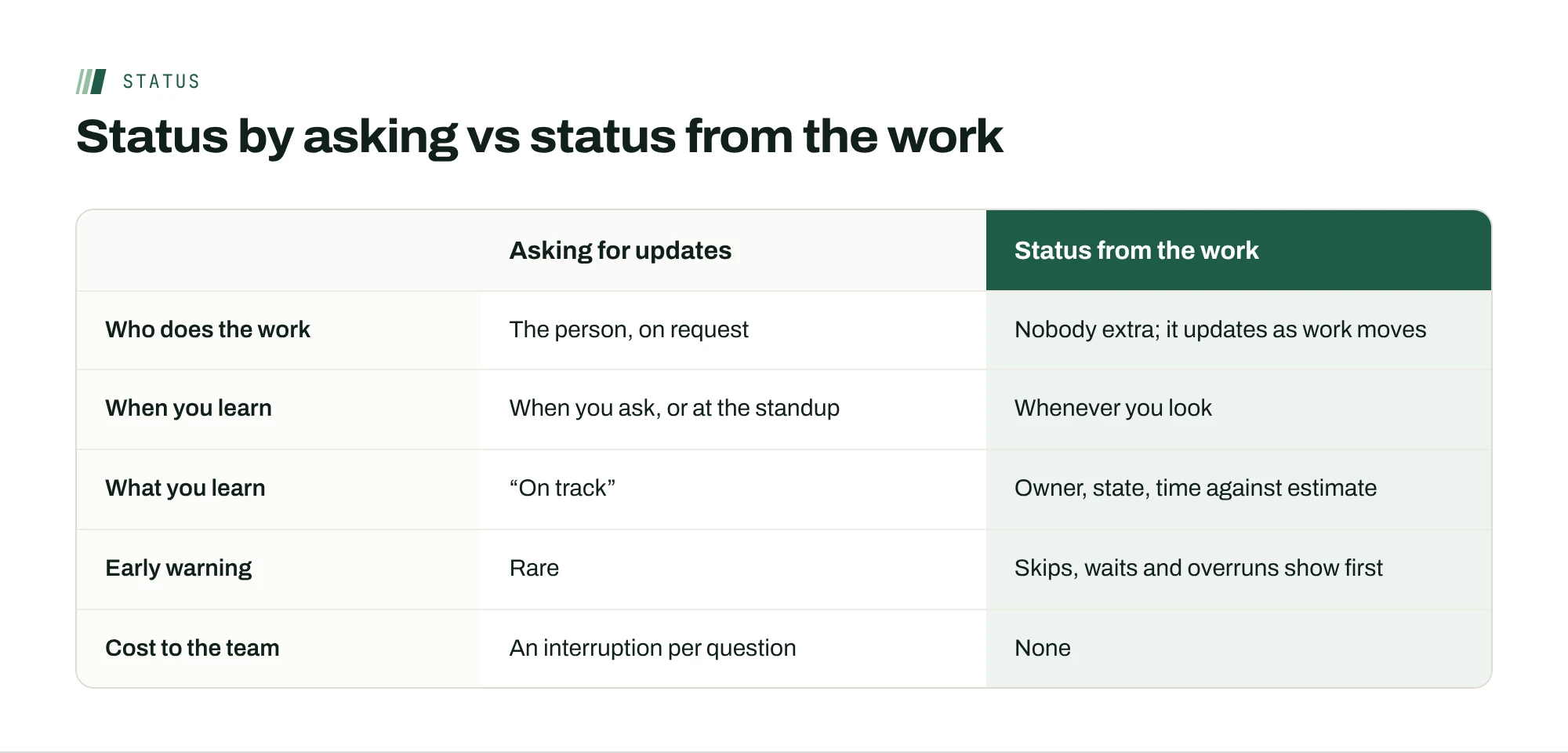
Status should be something the work produces as it moves, not something a person writes on request. That takes three facts on every task, visible to the whole team at any time:
- One owner. Not a team, not “we.” One person whose name is on it.
- A state. Done, in progress, waiting or stuck. Four states are enough, and fewer arguments start about what they mean.
- Time. How long it waited before anyone started, and how long it has been in progress against its estimate.
When those facts are current, most status questions answer themselves. “Is QA moving?” becomes a glance: in progress, Jordan, two hours past the estimate. That last detail tells you where to look before anyone says there’s a problem.
Agree that silence means on track
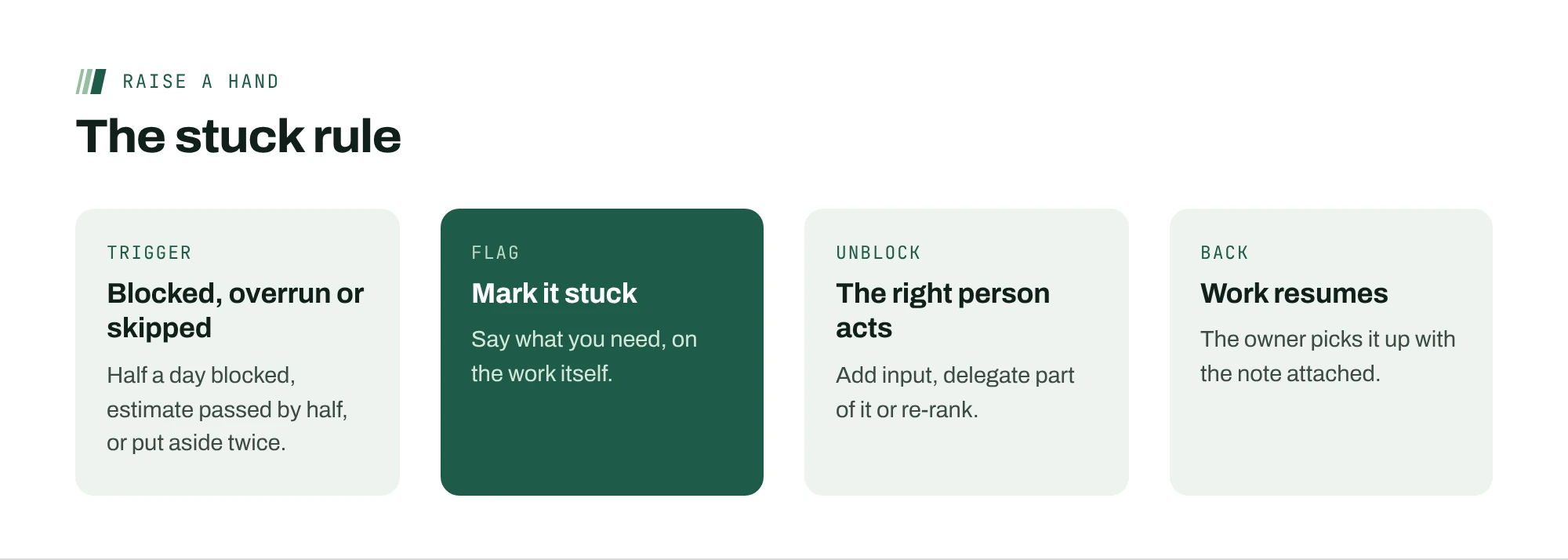
Make silence meaningful: no news means the work is on track. In return, agree on exactly when someone must raise a hand. Good triggers are specific and early:
- Blocked for more than half a working day.
- Past the estimate by half again, and not close.
- The same task put aside twice in favor of something else.
- Anything that changes the deadline, even if they think they can recover.
The third trigger is the one most teams miss. Repeatedly skipping a task is usually the first sign it’s stuck, long before anyone says so.
Swap the standup for a Friday recap
A written recap replaces the standup only if it’s quick to write and quick to read. Keep it to four parts, built from the work rather than from memory: what moved, what’s stuck and since when, decisions needed with a date, and next week’s top three, copied from the priority post. If it takes more than fifteen minutes to write, status isn’t living on the work yet.
Run the change as an experiment. Researchers who studied 76 companies that introduced meeting-free days, writing in MIT Sloan Management Review, found that a single meeting-free day a week improved autonomy, communication, engagement and satisfaction, and reduced micromanagement and stress. Cancel one standup for a week, say you’ll bring it back if things slip, and see what happens.
Track one number
If you measure only one thing, make it how long work sits stuck before the person who can unblock it hears about it. On teams that chase status, it’s often days. When status comes from the work and people flag early, it should be hours. When a task was stuck for two days before you heard, don’t ask why nobody said anything. Ask which trigger should have fired, and whether it was clear enough.
Go deeper on the blog
Sources
- The Surprising Impact of Meeting-Free Days (2022)MIT Sloan Management Review
- Breaking down the infinite workday (June 17, 2025)Microsoft WorkLab
