
Chapter 5 of 7
Protect focus without going dark
Agree how fast people need to reply, keep one active task, and park work in a minute before switching.

The cost of instant replies
Every check of a message is a switch, and switches aren’t free. In a Microsoft Research study, Iqbal and Horvitz found it took nearly 10 minutes, on average, after switching to an email alert before people got back to the application they had been using. After 27% of alerts, they stayed away from that window for more than two hours. Gloria Mark, who studies how people use screens at UC Irvine, found people now average 47 seconds on one screen before switching.
Checking less often helps. In an experiment by Kushlev and Dunn, 124 adults who limited email to three checks a day for a week reported significantly lower daily stress than in a week of unlimited checking.
Agree on response windows by type
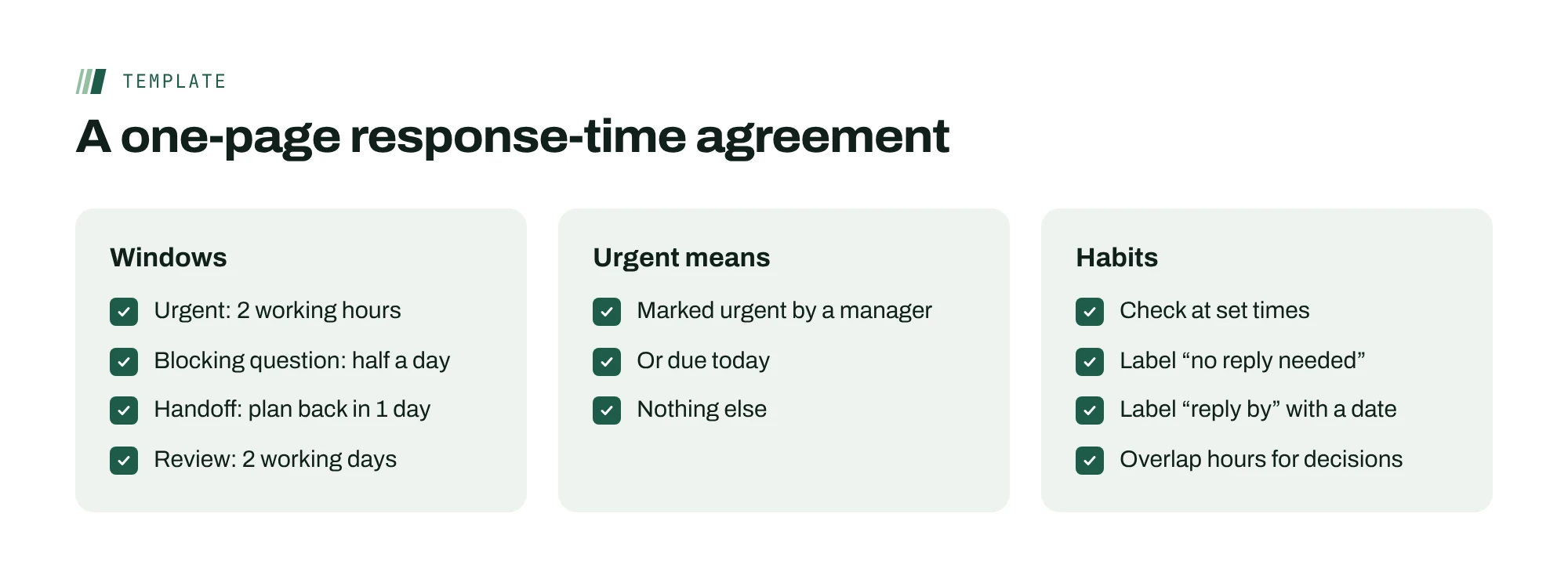
A response-time agreement replaces “reply right away” with windows that fit the kind of message. Draft it, let the team edit it in writing for two days, then publish it where the work lives:
- Windows: urgent within two working hours; a blocking question within half a day; a handoff gets a plan back within a day; a review within two working days.
- Urgent means marked urgent by a manager, or due today. Nothing else.
- Habits: check at set times, label “no reply needed” and “reply by” with a date, and save the overlap hours for decisions.
Windows count the recipient’s working hours, not the sender’s. That one line stops most late-night replies.
Keep one active task
Sophie Leroy named the problem attention residue: when people switch away from a task they haven’t finished, part of their attention stays behind, and their performance on the next task suffers. Her 2009 studies found it was worse when the first task was left incomplete. Mark and colleagues found that interrupted people finished faster, with no loss of quality, but reported more stress, frustration and time pressure.
So keep one active task per person. New work waits its turn unless it meets the urgent rule.
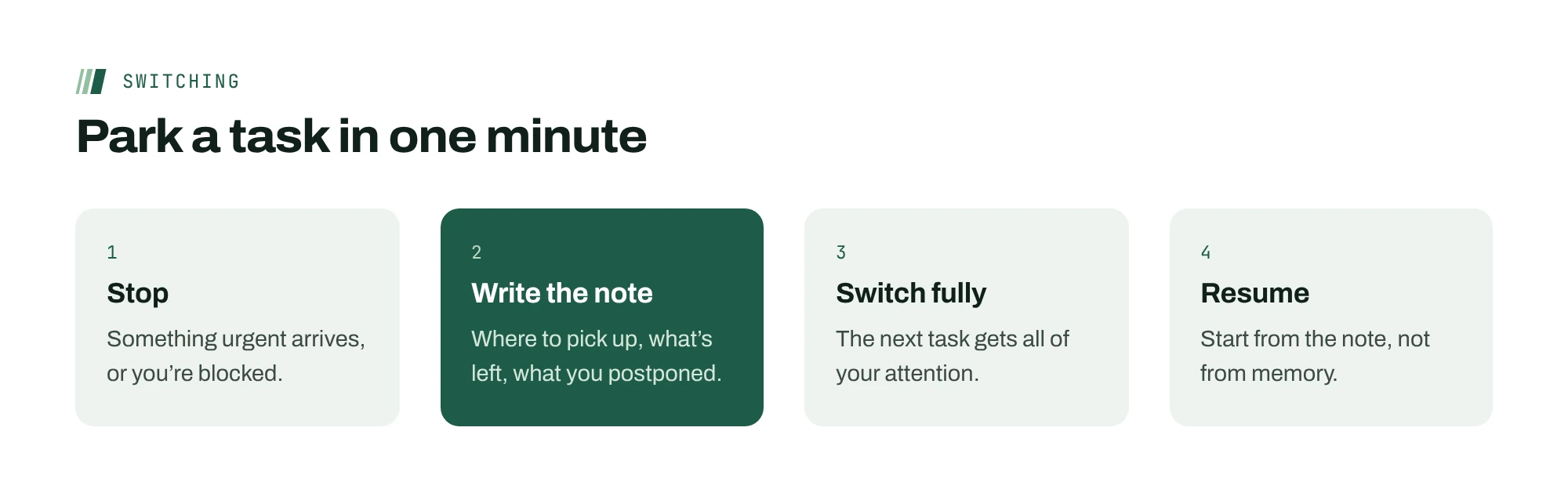
Park a task in one minute
When you do have to switch, write a ready-to-resume note first. Leroy and Theresa Glomb found that a brief plan for returning, covering where you’ll pick up, what’s left and what you postponed, reduced attention residue. Three lines are usually enough, and the exact wording matters less than writing it before you switch.
Cluster meetings so focus has room
One call in the middle of the afternoon splits it into two pieces, and neither is long enough for difficult work. Agree on meeting windows, for example mornings for focus and early afternoons for calls, adjusted to your overlap hours. Review the calendar together once a month and remove any recurring meeting nobody would miss.
Go deeper on the blog
Sources
- Disruption and Recovery of Computing Tasks (CHI 2007)Iqbal and Horvitz, Microsoft Research
- Can’t pay attention? You’re not alone (May 11, 2023)University of California, on Gloria Mark’s research
- Checking email less frequently reduces stress (Computers in Human Behavior, 2015)Kushlev and Dunn
- Why is it so hard to do my work? The challenge of attention residue when switching between work tasks (2009)Sophie Leroy, Organizational Behavior and Human Decision Processes
- The Cost of Interrupted Work: More Speed and Stress (CHI 2008)Mark, Gudith and Klocke
- Task interrupted: A plan for returning helps you move on (January 16, 2018)University of Washington, on Leroy and Glomb, Organization Science
