Context Switching: What It Costs and How Attention Residue Works
Context switching costs more than the minutes it takes. See what research measured, how attention residue works, and five team rules to protect focus.
Context switching is moving your attention from one task to another before the first is finished. Each switch has a cost: part of your attention stays on the old task, a gap researchers call attention residue, so the next task starts slower. On a remote team, every message that pulls someone off a task adds to that cost.

What is context switching?
Context switching is the act of stopping one task to start another, then coming back later. Each time, you have to drop the rules, details and goals of the first task and load those of the second.
Task switching is the term psychologists use for the same thing in the lab. The American Psychological Association describes experiments that compare how long people take to finish tasks when they switch between them against when they don't, so "the psychologists can measure the cost in time for switching tasks."
At work, a context switch can be small, like glancing at a chat thread, or large, like dropping a report to handle a client issue. Both count, and they add up across a day.
What is attention residue?
Attention residue is the part of your attention that stays on a previous task after you have moved to a new one. Sophie Leroy studied it in her 2009 paper, "Why is it so hard to do my work? The challenge of attention residue when switching between work tasks", in Organizational Behavior and Human Decision Processes.
Across two experiments, the paper found that "people need to stop thinking about one task in order to fully transition their attention and perform well on another." It also found that "it is difficult for people to transition their attention away from an unfinished task." In plain terms: leaving work half done makes it harder to focus on whatever comes next.
That is why a quick reply mid-task costs more than the minute it takes to write. The reply is quick; the residue is not.
How much time does context switching cost?
Context switching costs real time, but the size depends on the study, the population and what was measured. No single number applies to every team, so read each figure with the population it came from.
| Study | Who was studied | What it found |
|---|---|---|
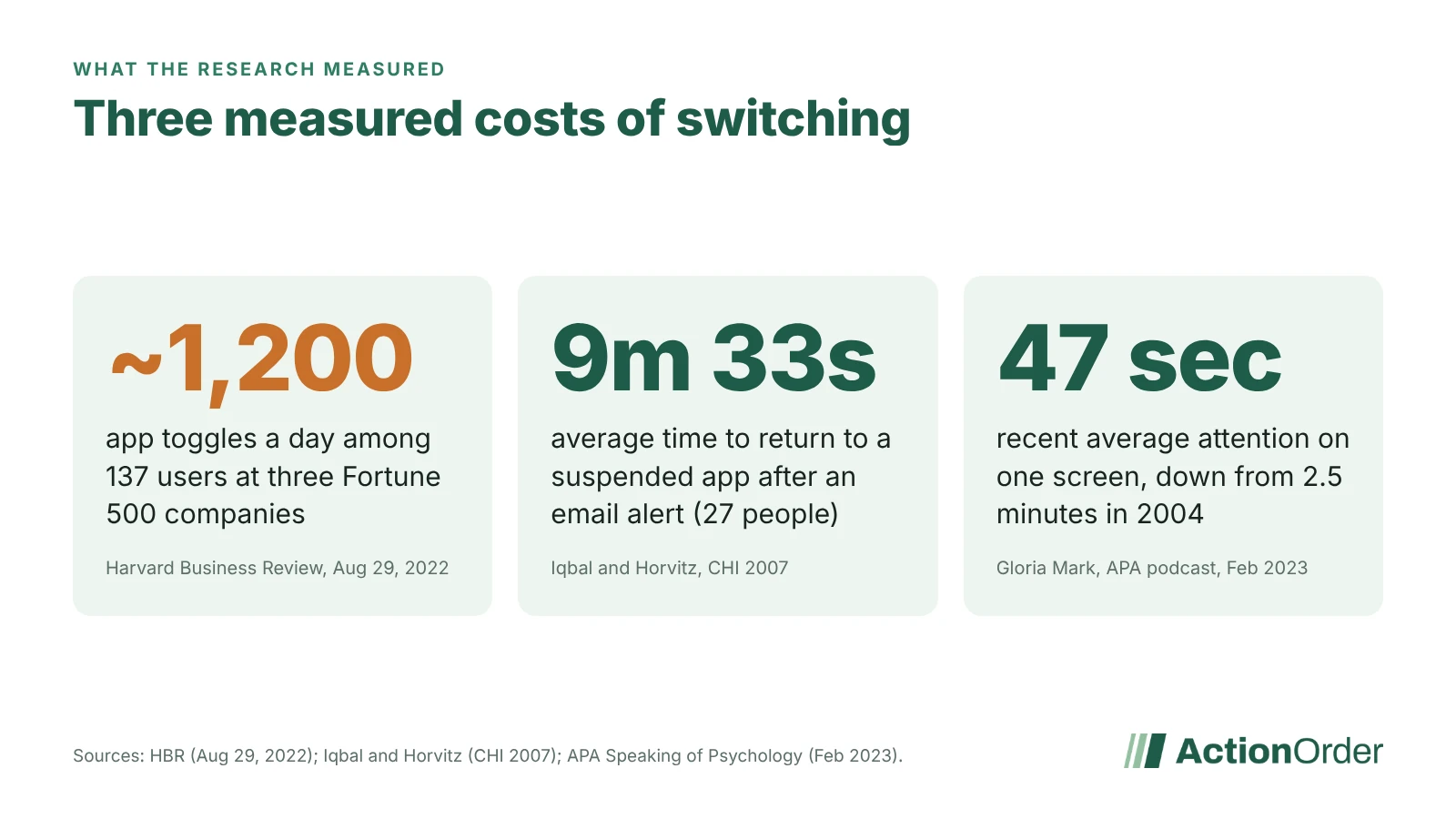
| Murty, Dadlani and Das, Harvard Business Review, Aug 29, 2022 | 137 users on 20 teams at three Fortune 500 companies, up to five weeks | Workers toggled between apps roughly 1,200 times a day and spent just under four hours a week reorienting, about 9% of their time at work |
| Iqbal and Horvitz, CHI 2007 | 27 people at the authors' organization, two weeks of logged computer use | After an email alert, the average time to return to a suspended application was 9 minutes and 33 seconds |
| Mark, Gudith and Klocke, CHI 2008 | 48 participants in a controlled study | Interrupted people finished faster with no drop in quality, but reported more stress, frustration, time pressure and effort |
| Gloria Mark, APA podcast, Feb 2023 | Her research group's studies of people at work on screens | Average attention on one screen fell from two and a half minutes in 2004 to about 47 seconds recently |
The HBR toggling study by Rohan Narayana Murty, Sandeep Dadlani and Rajath B. Das is the clearest measure of switching between tools. Iqbal and Horvitz show how long it takes to come back. Mark, Gudith and Klocke add a warning: people often compensate by working faster, so the cost shows up as stress rather than missed work.
In an APA Speaking of Psychology episode from February 2023, Gloria Mark of the University of California, Irvine, said: "So back in 2004, we found the average attention span on any screen to be two and a half minutes on average." For recent years, "we found it to average about 47 seconds."
You will often see the claim that switching wastes 40% of productive time. The APA's page, dated March 20, 2006, says something narrower: psychologist David Meyer has said that "even brief mental blocks created by shifting between tasks can cost as much as 40 percent of someone's productive time." That is an upper bound from one researcher, not an average for every team.
Is multitasking the same as context switching?
Mostly, yes. What people call multitasking on knowledge work is usually rapid context switching: attention moves back and forth between tasks rather than handling both at once.
The APA page on multitasking summarizes four experiments by Joshua Rubinstein, Jeffrey Evans and David Meyer, published in 2001, that measured the time lost when people switched between tasks. The practical point for managers is simple. A person "multitasking" on three projects is switching between them, and each switch carries residue.
How do you reduce context switching on a team?
You reduce context switching on a team by changing how work arrives, not by asking people to concentrate harder. These five team focus rules cover most of it.
One active task per person. Each person has one task in progress. New work waits in a queue behind it, ranked, until the current task is done or paused on purpose.
An urgent lane with a written definition. Agree what counts as urgent, such as a client deadline today or a teammate who is blocked. Only that lane may interrupt; everything else waits.
Batch the rest. Read messages and review requests at set times, such as late morning and mid-afternoon, instead of as they arrive.
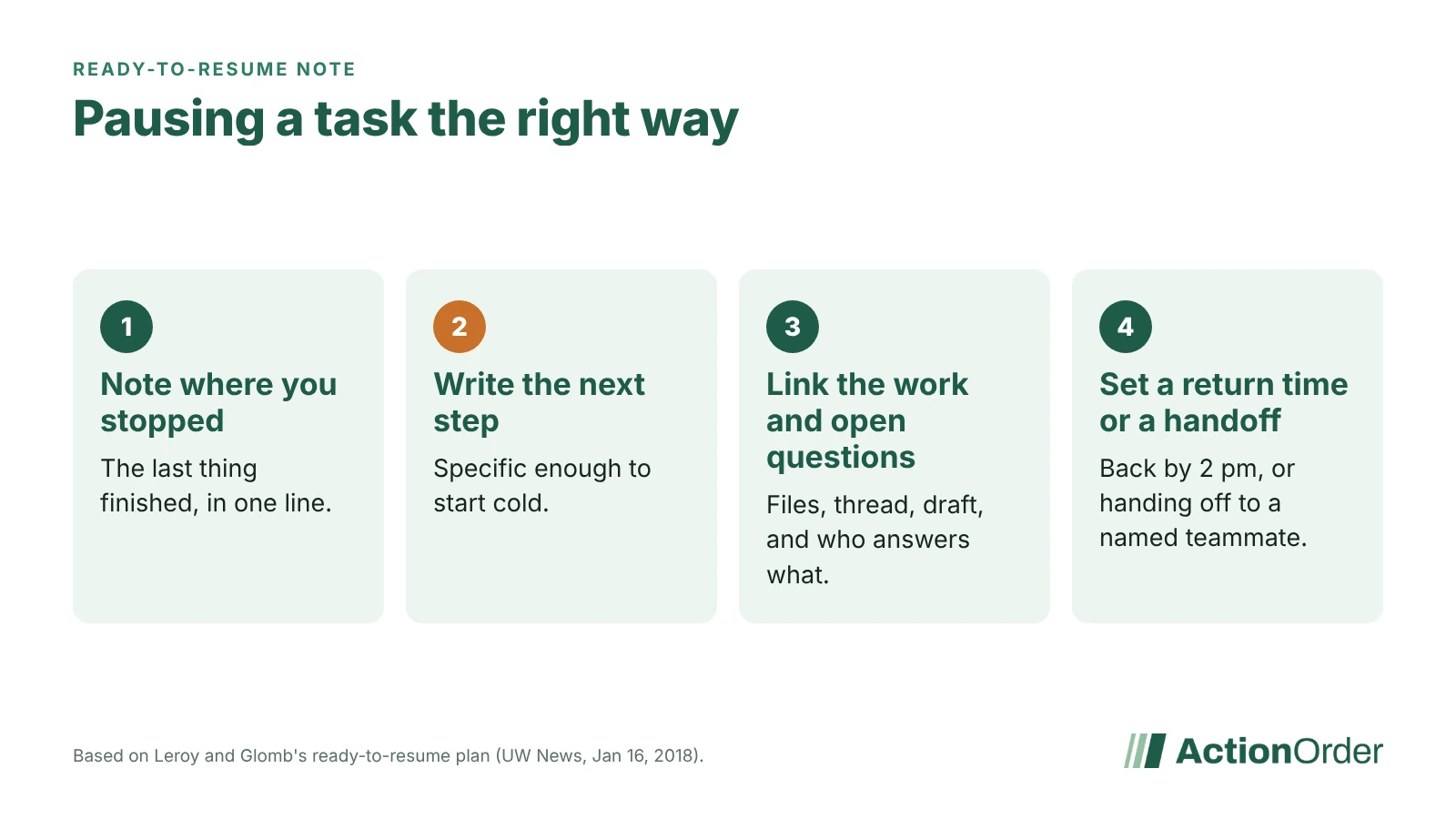
Ready-to-resume notes before every pause. When someone has to stop mid-task, they write a short note first (template below).
Default to async for updates. Status that lives where the work lives doesn't need a ping. See our guide to asynchronous communication for channel rules.
Ranking matters here too. When the order of work keeps changing, people switch more. Our guide to task prioritization covers how to set one ranked list and re-rank on a schedule. For protecting focus blocks without another meeting policy, see Protect Focus on a Remote Team Without Another Meeting Policy.
How do you pause a task without losing your place?
You pause a task well by writing a ready-to-resume note before you switch. The idea comes from research by Sophie Leroy and Theresa Glomb, reported by UW News on January 16, 2018 when the paper was accepted by the journal Organization Science.
Their studies included a field survey of 202 working professionals and lab experiments with 66 and 44 student participants. In the lab, "taking a minute when interrupted to create a 'ready-to-resume' plan" significantly reduced attention residue on the new, interrupting task and improved performance on it. The studies did not test whether the plan helped with the original task, so treat that part as a reasonable bet rather than a finding.
Ready-to-resume note template
Copy this into the task itself, so it's there when you or a teammate come back.
| Field | What to write |
|---|---|
| Where I stopped | The last thing finished, in one line |
| Next step | The very next action, specific enough to start cold |
| Open question | Anything unresolved, and who can answer it |
| Where things are | Links to the file, thread or draft |
| Back by | When you expect to return, or the teammate you're handing off to |
Example: Sam is halfway through the Northwind homepage mockups when Jordan flags a bug that meets the team's urgent definition. Before switching, Sam writes: "Stopped: hero and nav done. Next: pricing section, use the three-column layout. Open: Priya to confirm the new tagline. Files: mockup link in the task. Back by: 2 pm." Sam fixes the bug, then picks up the mockups from the note instead of from memory.
How ActionOrder handles this
ActionOrder, an efficiency and accountability tool for managers of remote teams, is built around one card at a time. Each person sees a single next step, already prepped with context, analysis, research and a first draft. Starting a card holds focus: new cards queue behind it instead of interrupting. Only items a manager marks urgent, and items due today, get through, and they arrive as a small bar rather than a takeover. Skipped cards come back later, and every card keeps one owner and a status, so pausing work doesn't mean losing it. Join the waitlist. ActionOrder is in pre-launch.
Questions people ask
What is an example of context switching?
Example: Taylor, a designer, is writing a proposal for Northwind when a chat message asks for a quick logo file. Taylor stops, finds the file, replies, then returns to the proposal and rereads the last page to remember the argument. The file took two minutes; getting back into the proposal took longer. That return trip is the cost of a context switch.
Is context switching bad for everyone?
Not always. Some roles, such as support or on-call work, are built around interruptions, and switching is the job. The cost matters most for work that needs sustained thought, like writing, analysis, design or code. For those tasks, fewer switches and a ready-to-resume note before each pause keep the cost down.
What is the difference between context switching and task switching?
They describe the same thing from two angles. Task switching is the term psychologists use in experiments that measure the time lost when people change tasks. Context switching is the everyday workplace term, and it also covers changing tools, projects or clients. Both lead to attention residue when the first task is left unfinished.
How do you recover after an interruption?
Start with your ready-to-resume note if you wrote one: read the next step and do it, without rereading everything. If you didn't write one, reopen the last thing you changed and write the next step down before acting. Then close the tabs and threads from the interruption, so they don't pull you back.
Does focus time help with context switching?
Yes, if it is protected by how work arrives. A blocked calendar does little if messages still interrupt. Focus time works best alongside an urgent lane with a written definition and set times for reading messages, so people can stay on one task without missing what matters.
Sources
- How Much Time and Energy Do We Waste Toggling Between Applications?Rohan Narayana Murty, Sandeep Dadlani and Rajath B. Das, Harvard Business Review, August 29, 2022
- Multitasking: Switching costsAmerican Psychological Association, March 20, 2006
- Why is it so hard to do my work? The challenge of attention residue when switching between work tasksSophie Leroy, Organizational Behavior and Human Decision Processes, vol. 109, no. 2, pp. 168-181, 2009 (EconPapers record)
- Task interrupted: A plan for returning helps you move onPeter Kelley, UW News, University of Washington, January 16, 2018
- The Cost of Interrupted Work: More Speed and StressGloria Mark, Daniela Gudith and Ulrich Klocke, CHI 2008
- Disruption and Recovery of Computing Tasks: Field Study, Analysis, and DirectionsShamsi T. Iqbal and Eric Horvitz, CHI 2007
- Why our attention spans are shrinking, with Gloria Mark, PhDSpeaking of Psychology, American Psychological Association, February 2023