Deep Work: What It Means and How Remote Teams Protect It
A plain definition of deep work, where the term comes from, and how a manager protects it on a remote team that works asynchronously.
Deep work is a stretch of focused, uninterrupted effort on a cognitively demanding task, such as writing, designing, analyzing or solving a hard problem, done with chat, email and notifications set aside.
The opposite is shallow work: replies, scheduling, status updates and other tasks you can do while distracted. Shallow work is necessary. The trouble starts when it fills every hour, because hard work rarely gets done in the gaps between messages. Deep work isn’t about long hours. It describes the quality of attention during a block.
Where the term comes from
Deep work is a term defined by author Cal Newport. When he announced his book on his blog in November 2015, he described deep work, “which I define to be the act of focusing without distraction on a cognitively demanding task.” He also set out the idea behind the book: “Deep work is becoming increasingly valuable at the same time that it’s becoming increasingly rare.”
The book, Deep Work: Rules for Focused Success in a Distracted World, went on sale January 5, 2016, according to its publisher, Grand Central Publishing. The publisher’s page calls deep work “the ability to focus without distraction on cognitively demanding tasks” and lists the book’s four rules, from “Work Deeply” to “Drain the Shallows.”
Protecting deep work on a remote async team
Remote work removes the tap on the shoulder, then replaces it with chat. On a team spread across time zones, someone is always awake and asking a question. Your job as a manager is to make long, undisturbed blocks normal and safe, which is a core part of managing a remote team well.
Let people choose their blocks: each person picks two or three hours that suit their time zone and publishes them where the team works.
Give each block one task: agree the goal before the block starts, so nobody spends the first half hour deciding what to do.
Keep the urgent path narrow: agree what counts as urgent, so ignoring chat during a block is safe.
Move status into writing: if status lives on the work, nobody needs to interrupt a block to ask where things stand.
Judge the output: look at what deep work produced this week, not how fast people replied.
For the team habits in depth, see focus time for remote teams and context switching.
Example: a designer’s deep work block
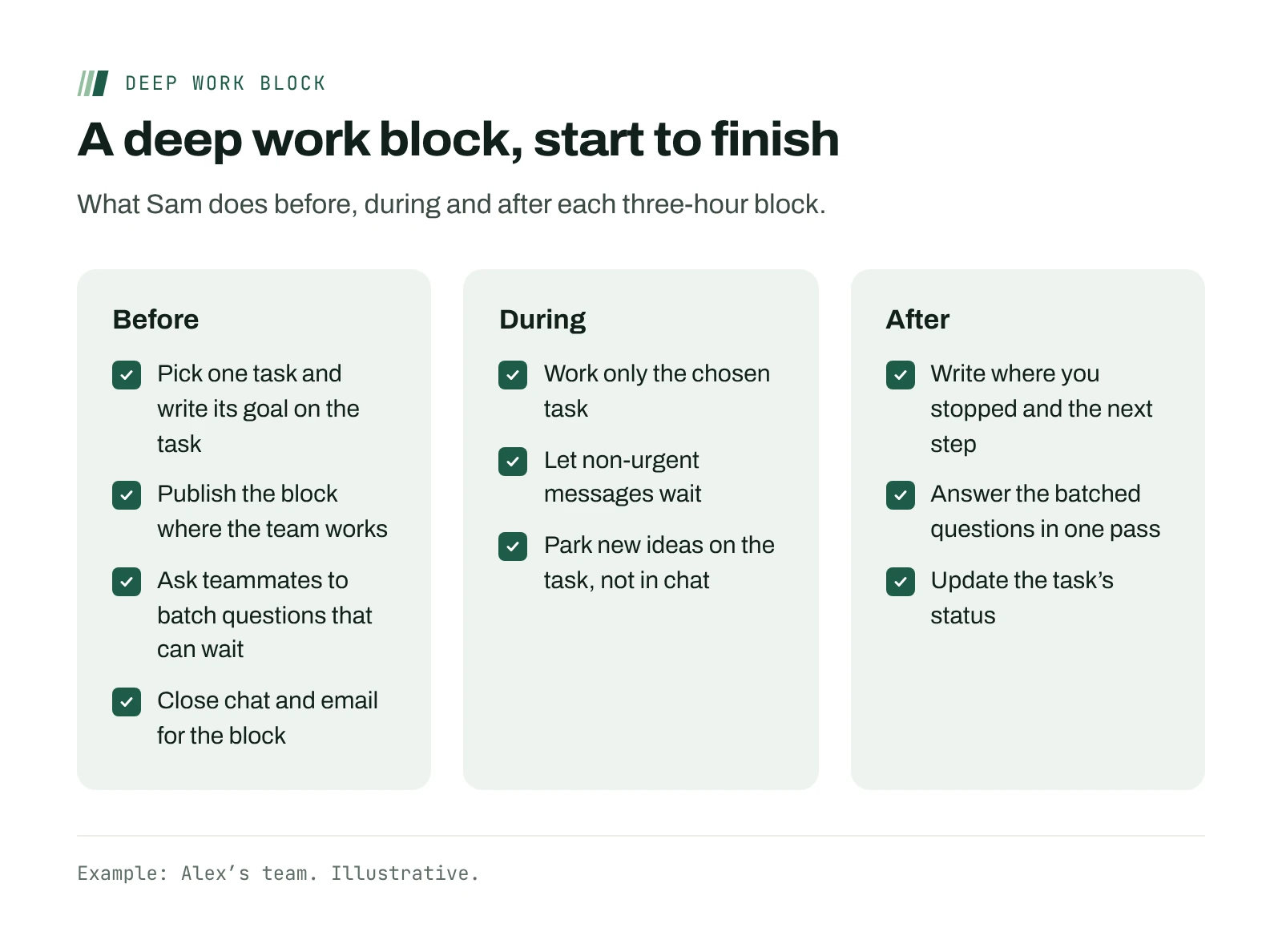
Example: Sam, the designer on Alex’s nine-person delivery team, needs to redesign Northwind’s onboarding screens, and the work keeps slipping because Sam’s mornings fill with quick questions from Priya and Jordan. Alex and Sam agree on two deep work blocks a week, Tuesday and Thursday from 09:00 to 12:00 in Sam’s time zone. Before each block, Sam writes the goal on the task: “Finish the three empty-state screens.” Priya collects her Northwind questions into one message that Sam reads at noon. Jordan leaves QA notes as comments on the task. Only items Alex marks urgent reach Sam during a block. After each block, Sam notes where the work stopped and the next step, so Thursday starts where Tuesday ended.
Related terms
Time blocking: a way to plan the day so deep work blocks are on the calendar before meetings and messages fill it.
Maker’s schedule, manager’s schedule: why a single meeting can cost someone doing deep work far more than the meeting’s length.
Context switching: what each switch away from a task costs, and why the cost lingers.
Focus time for remote teams: the team rules that keep focus hours protected across time zones.
Where ActionOrder fits
ActionOrder, an efficiency and accountability tool for managers of remote teams, is built so one task can hold someone’s attention. Starting a card holds focus. New cards queue behind it, and only items a manager marks urgent and items due today get through, as a small bar. Each card arrives already prepped with context, analysis, research and a first draft, so a deep work block starts on the work itself.
Join the waitlist. ActionOrder is in pre-launch.
Sources
- Deep Work: Rules for Focused Success in a Distracted WorldCal Newport, calnewport.com, November 20, 2015
- Deep Work by Cal NewportGrand Central Publishing, Hachette Book Group, checked November 22, 2026