Task Prioritization: Six Methods and How to Use Them on a Team
Task prioritization made practical: compare six methods, from Eisenhower to RICE, set P1 to P4 priority levels, and use a team scoring sheet to agree on one ranked list.
Task prioritization is the practice of deciding which work gets done first, based on its value, urgency and effort. For a single person it means ranking a to-do list. For a remote team it means turning many people's lists into one shared order, so everyone knows what matters most today without asking.

What is task prioritization?
Task prioritization is the process of putting work in order so the most valuable or time-sensitive task is done first. It answers one question for each person: what should I work on next?
A prioritization framework is a repeatable rule for producing that order. Some frameworks sort work into groups, such as "must have" and "could have". Others give each task a score, so the order falls out of the numbers.
On a remote team that works asynchronously, prioritization carries extra weight. Nobody can lean over a desk to ask what comes next, so the ranking has to be written down where everyone can read it. In a survey of over 2,000 professionals by Reclaim.ai, which sells scheduling software, published March 29, 2022, "the average manager spends 5 hours/week assigning, prioritizing, and reprioritizing work". A clear method is how you get some of that time back.
What are the most common task prioritization methods?
The six most common task prioritization methods are the Eisenhower matrix, MoSCoW, RICE, ICE, value vs. effort and weighted shortest job first (WSJF). Two sort work into groups, three score it, and one plots it on two axes.
| Method | Best for | Inputs | Watch out for |
|---|---|---|---|
| Eisenhower matrix | Daily triage for a person or a small team | Urgent (yes/no), important (yes/no) | Everything gets labeled urgent unless urgent is defined in writing |
| MoSCoW | Fixing the scope of a project or release with a deadline | Must, Should, Could, Won't have this time | Too many Must Haves; the DSDM guidance caps them at about 60% of effort |
| RICE | Comparing product or process requests with different reach | Reach, Impact, Confidence, Effort | Reach estimates that are guesses dressed as numbers |
| ICE | Ranking quick experiments or small improvements | Impact, Confidence, Ease, each 1 to 10 | Scores drift between scorers without shared definitions |
| Value vs. effort | A fast first sort of a long backlog | Value (high/low), effort (high/low) | Big, valuable work stays parked in "high effort" forever |
| WSJF | Sequencing larger jobs where delay is expensive | Cost of delay, job duration or size | Cost of delay is hard to estimate without practice |
The Eisenhower matrix
The Eisenhower matrix sorts tasks by two questions: is it urgent, and is it important? It is named for Dwight D. Eisenhower. In his address to the World Council of Churches on August 19, 1954, he quoted a former college president: "I have two kinds of problems, the urgent and the important." Urgent and important work comes first. Important but not urgent work gets a date. Urgent but less important work goes to someone else. The rest is dropped or batched.
MoSCoW
MoSCoW sorts requirements into Must Have, Should Have, Could Have and Won't Have this time. In the Agile Business Consortium’s MoSCoW guidance, Must Haves "provide the Minimum Usable SubseT (MUST) of requirements which the project guarantees to deliver". The same guidance recommends "typically no more than 60% Must Have effort" and a pool of Could Haves of "typically around 20% Could Have effort", so there is room to drop work when estimates slip.
RICE
RICE scores each request on Reach, Impact, Confidence and Effort. Sean McBride described it on the Intercom blog on January 5, 2018. Reach is "measured in number of people/events per time period". Impact uses a fixed scale: "3 for 'massive impact', 2 for 'high', 1 for 'medium', 0.5 for 'low', and finally 0.25 for 'minimal'." Confidence is a percentage: "100% is 'high confidence', 80% is 'medium', 50% is 'low'." Effort is "estimated as a number of 'person-months'", and because more effort is a bad thing, it divides the total.
\text{RICE score} = \frac{\text{Reach} \times \text{Impact} \times \text{Confidence}}{\text{Effort}}
ICE
ICE scores ideas on Impact, Confidence and Ease, each from 1 to 10. Growth Method, a growth marketing site, credits the method to Sean Ellis and describes the factors as three questions: how much will this move your target metric, how sure are you it will work, and how quickly can you ship it? ICE is lighter than RICE because it drops reach, which makes it a good fit for small experiments.
Value vs. effort
Value vs. effort places each task on a two-by-two grid: high or low value, high or low effort. High-value, low-effort tasks are quick wins and go first. Low-value, high-effort tasks are dropped. It is the fastest way to cut a long backlog down before a finer method takes over.
Weighted shortest job first
Weighted shortest job first is a model that puts jobs with the highest cost of delay per unit of time first. The Scaled Agile Framework defines WSJF as "a prioritization model used to sequence work for maximum economic benefit" and says it "is estimated as the relative cost of delay divided by the relative job duration." Its inputs are relative user and business value, time criticality, risk reduction or opportunity enablement, and job size.
How do you prioritize when everything is urgent?
When everything is urgent, nothing is, so the first fix is a written definition of urgent. Agree as a team that urgent means one of a short list: a client deadline inside 48 hours, a person blocked with no other work, or a production problem. Anything else waits for the next ranking.
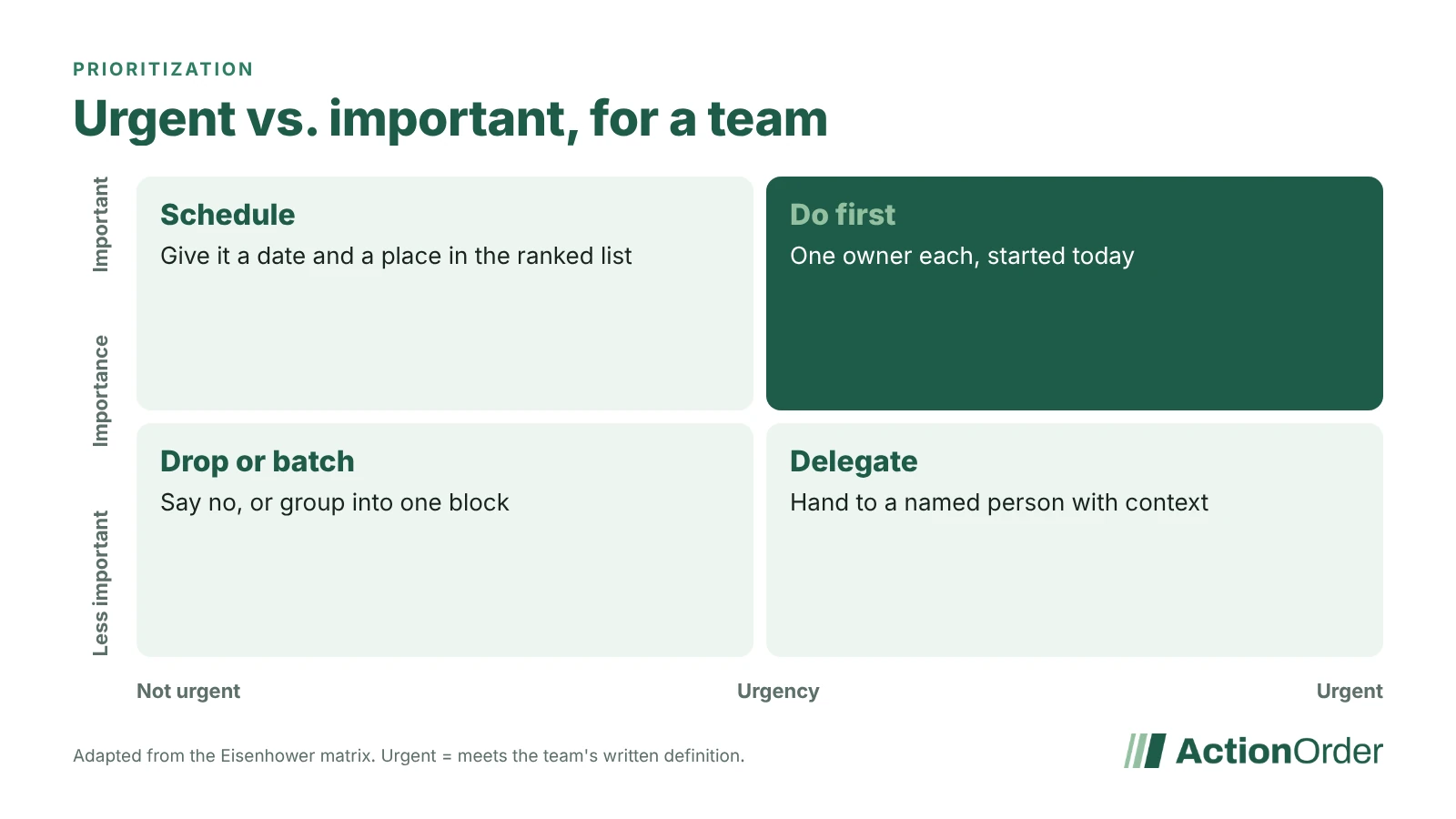
Then sort the pile with the Eisenhower matrix, adapted for a team:
Do first: urgent and important. One owner each, started today.
Schedule: important, not urgent. Give each a date and a place in the ranked list.
Delegate: urgent, less important. Hand it to a named person with the context they need.
Drop or batch: neither. Say no, or group these into one block later in the week.
If the "do first" box still holds more than one item per person, the definition of urgent is too loose. Tighten it before you add hours.
Task priority levels (P1 to P4): what each one means
Task priority levels sort work into four fixed bands. P1 is critical and starts today, P2 is high and gets done this week, P3 is normal and waits its turn in the ranked list, and P4 is low and may never get done. Each level needs a written meaning and a start time, or every task drifts up to P1.
| Level | Means | Starts | Example |
|---|---|---|---|
| P1, critical | Meets the written definition of urgent: a client deadline inside 48 hours, a person blocked with no other work, or a production problem | Today, before anything else | Northwind's checkout is down |
| P2, high | Important, due this week or unblocking someone soon | This week, in ranked order | The QA plan Northwind needs by Thursday |
| P3, normal | Planned work that matters but has no near date | When P1 and P2 work is clear | Rewrite the onboarding checklist |
| P4, low | Nice to have, with no date and nobody waiting | Only when nothing above it is open | Tidy up old project folders |
Four rules keep the levels honest:
At most one P1 per person. A second P1 means the ranking owner must choose.
Anyone can propose P1; the ranking owner sets it. That keeps P1 rare enough to mean something.
Levels group, the list orders. Within a level the work is still ranked, so each person still has one top item.
Review P4 once a month. Drop anything that has sat at P4 for a quarter.
The levels line up with the Eisenhower matrix above: P1 is "do first", P2 and P3 split "schedule" by date, and P4 is "drop or batch". Tools label the same bands differently. Jira, for example, "comes with a set of default priorities: Highest, High, Medium, Low, Lowest," and admins can change them or add new ones (Atlassian, Jira Data Center 11.3 documentation).
How do you prioritize tasks for a team, not just yourself?
To prioritize for a team, turn many personal lists into one ranking that has a single owner. A method gives you scores; these four rules make the scores stick across time zones.
One owner of the ranking. One person, usually the manager or a lead, has the final say on order. Others propose; the owner decides and writes the reason down.
One top item per person. Each person has exactly one thing at the top of their list. Two "top priorities" means the ranking hasn't been done.
A written definition of urgent. Keep it short and visible. Urgent work skips the queue; everything else waits for the next re-rank.
A set re-ranking cadence. Re-rank at a fixed time, such as Monday morning in the earliest time zone, so people aren't pulled off work mid-task.
If you are the person every request runs through, read Stop Being the Router for Your Remote Team next. For setting the team's priorities without a weekly meeting, see How to Set Priorities for a Remote Team Without a Weekly Meeting.
Team scoring sheet: a worked example
A team scoring sheet is a shared table where each request gets the same inputs, a score and an owner. Copy the columns below into a doc or spreadsheet and fill one row per request.
| Request | Requested by | Reach (per quarter) | Impact (0.25 to 3) | Confidence | Effort (person-months) | RICE score | Rank | Owner |
|---|---|---|---|---|---|---|---|---|
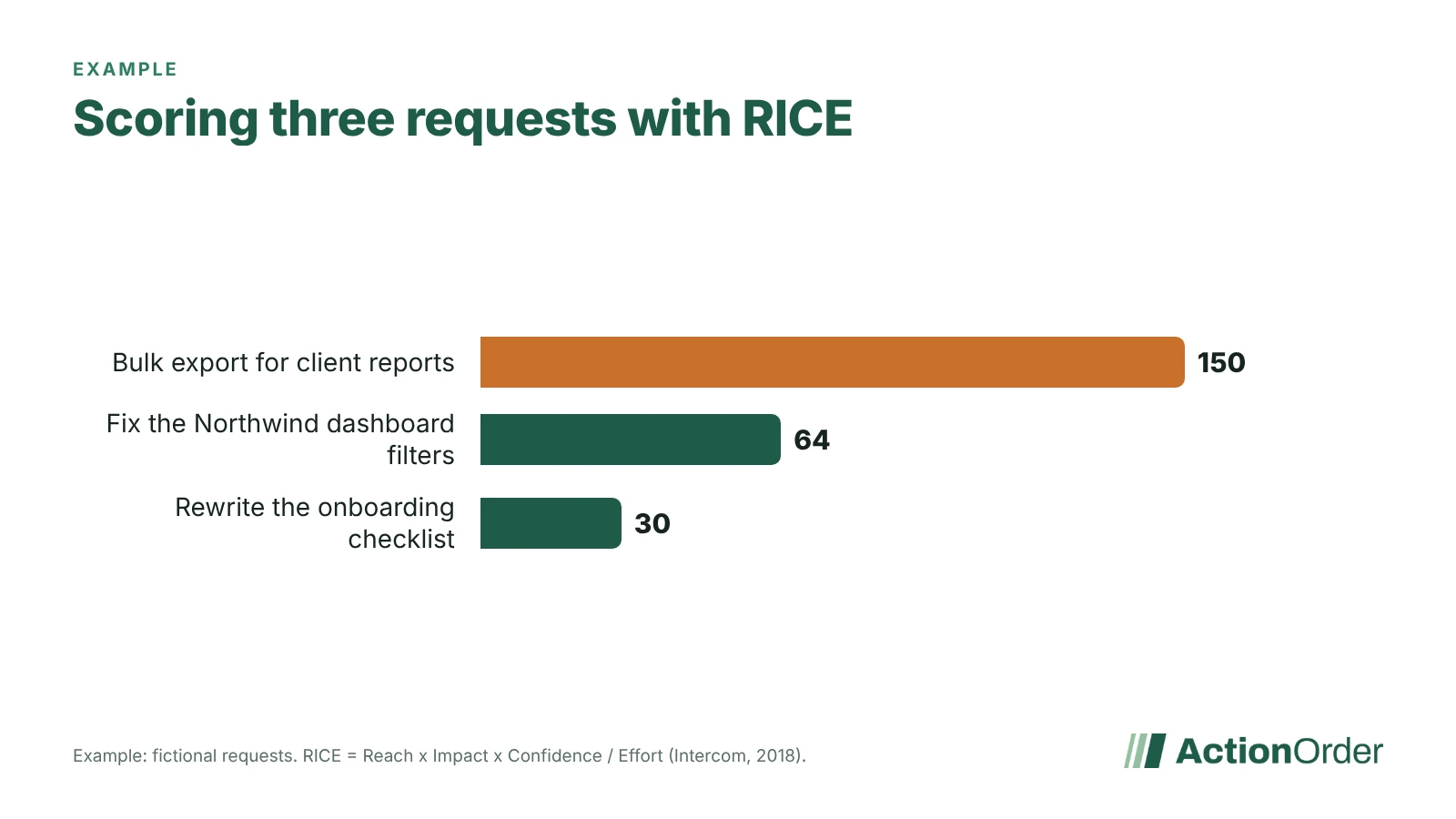
| Bulk export for client reports | Priya | 25 | 3 | 100% | 0.5 | 150 | 1 | Jordan |
| Fix the Northwind dashboard filters | Northwind | 40 | 2 | 80% | 1 | 64 | 2 | Sam |
| Rewrite the onboarding checklist | Taylor | 120 | 1 | 50% | 2 | 30 | 3 | Morgan |
Example: Alex manages a 9-person delivery team and has three requests on the table. The onboarding checklist reaches the most people, 120 a quarter, but Alex is only 50% confident it will change anything and it takes two person-months: 120 × 1 × 0.5 ÷ 2 = 30. The bulk export reaches only 25 people, but it has massive impact, full confidence and takes half a month: 25 × 3 × 1.0 ÷ 0.5 = 150. It goes first, and Jordan owns it.
Two habits keep the sheet honest. Score as a group once, then let the ranking owner settle ties. And write down where each reach number came from, so next quarter's scores can be checked against what happened.
How often should priorities change?
Priorities should change on a set schedule, not whenever someone asks. For most remote teams a weekly re-rank works: the order is fixed for the week, and only work that meets the written definition of urgent can jump the queue.
Changing the order more often has a cost. Each time someone drops a task mid-way, they lose time getting back into it. Our guide to context switching and attention residue explains what the research measured. Shorter cycles make sense for support queues; longer ones, such as a monthly MoSCoW review, suit projects with a fixed release.
How ActionOrder handles this
ActionOrder, an efficiency and accountability tool for managers of remote teams, gives each person one card at a time from a run feed. The feed is ranked across the team's tools by urgency, impact, shared priorities, effort and what it unblocks. Each person can Act, Delegate or Skip, and skipped cards come back. Starting a card holds focus: new cards queue behind it, and only items a manager marks urgent, and items due today, get through as a small bar. Every card has one owner and a status (done, in progress, waiting or stuck), so the ranking and its owner are visible without a meeting. Join the waitlist. ActionOrder is in pre-launch.
Questions people ask
What is the best task prioritization method?
There is no single best method; the right one depends on the decision. Use the Eisenhower matrix for daily triage, MoSCoW to fix the scope of a deadline-bound project, and RICE or WSJF to compare larger requests. Most teams do well with one sorting method for the day and one scoring method for the backlog.
What is the difference between RICE and ICE?
RICE scores reach, impact, confidence and effort, and divides by effort, so it rewards work that helps many people for little cost. ICE scores impact, confidence and ease on a 1 to 10 scale and leaves reach out. ICE is faster to fill in, which suits small experiments; RICE is better when requests affect very different numbers of people.
What is a prioritization framework?
A prioritization framework is a repeatable rule for deciding the order of work. It names the inputs to judge each task on, such as urgency, value, reach or effort, and how to combine them into a group or a score. Using the same framework every time makes the ranking easier to explain and easier to challenge.
What is the difference between priority and severity?
Severity is how bad a problem is; priority is how soon you'll work on it. A severe bug in a feature almost nobody uses can be P3, while a small bug that blocks a client launch tomorrow is P1.
How many priorities should a person have at once?
One at the top. A person can have a ranked list of many tasks, but only one should be first. When two items share the top spot, the person has to choose, and on an async team they often choose without the context the manager has. Naming one top item per person removes that guess.
How do you prioritize work when your manager isn't online?
Work from the written ranking and the written definition of urgent. If a new request arrives, check it against the definition: if it qualifies, start it and leave a note for the ranking owner; if not, add it to the list for the next re-rank. That way nobody waits hours for an answer, and the owner still sees every change.
Sources
- Address at the Second Assembly of the World Council of Churches, Evanston, IllinoisDwight D. Eisenhower, August 19, 1954. The American Presidency Project
- What is MoSCoW Prioritization?Agile Business Consortium, checked November 15, 2026
- RICE: Simple prioritization for product managersSean McBride, Intercom, January 5, 2018
- ICE Framework: The original prioritisation framework for marketersStuart Brameld, Growth Method, updated June 26, 2026
- Weighted Shortest Job FirstScaled Agile Framework, Scaled Agile, Inc., no date shown (accessed Nov 11, 2026)
- Task Management Trends Report: +200 Stats on Managers vs. Individual ContributorsReclaim.ai (vendor survey), March 29, 2022
- Defining priority field valuesAdministering Jira applications Data Center 11.3, Atlassian, last modified September 27, 2023 (checked November 22, 2026)