WIP Limits: Definition, Origin and How to Set Them
What WIP limits are, where work in progress limits come from in Kanban, and how a remote team can set them per person and per stage.
WIP limits are caps on how many work items a person, a team or a stage of a workflow may have started but not finished at one time, so new work starts only when something finishes.
WIP stands for work in progress; some teams say work in process. A WIP limit is a number the team agrees and writes down, such as two items in review or one active task per person. When a stage reaches its limit, people finish or unblock something before pulling anything new. Work in progress limits are not targets for staying busy; they exist to get work finished.
Where the term comes from
WIP limits come from kanban. The Agile Alliance glossary says the term’s meaning in agile work “is borrowed from the Toyota Production System” and dates the first experience reports from teams using kanban to 2007, “including reports from Corbis (David Anderson) and BueTech (Arlo Belshee).” It describes a board where each column can carry a WIP limit: if manual testing has a limit of 2, the team “may not” start testing a third story while two are in progress. The same entry is direct: “It is from these limits that the kanban approach derives its effectiveness.”
The Kanban Guide, updated May 1, 2025, calls the practice controlling WIP: “Kanban system members must explicitly control the number of work items in a workflow from started to finished.” It adds that “Controlling WIP helps flow and often improves the Kanban system members’ collective focus, commitment, and collaboration.”
Setting WIP limits on a remote team
Across time zones, unfinished work hides well: items wait overnight for a review or an answer, and people start something new meanwhile.
Start with one active item per person. It is easy to explain and to check in an async standup.
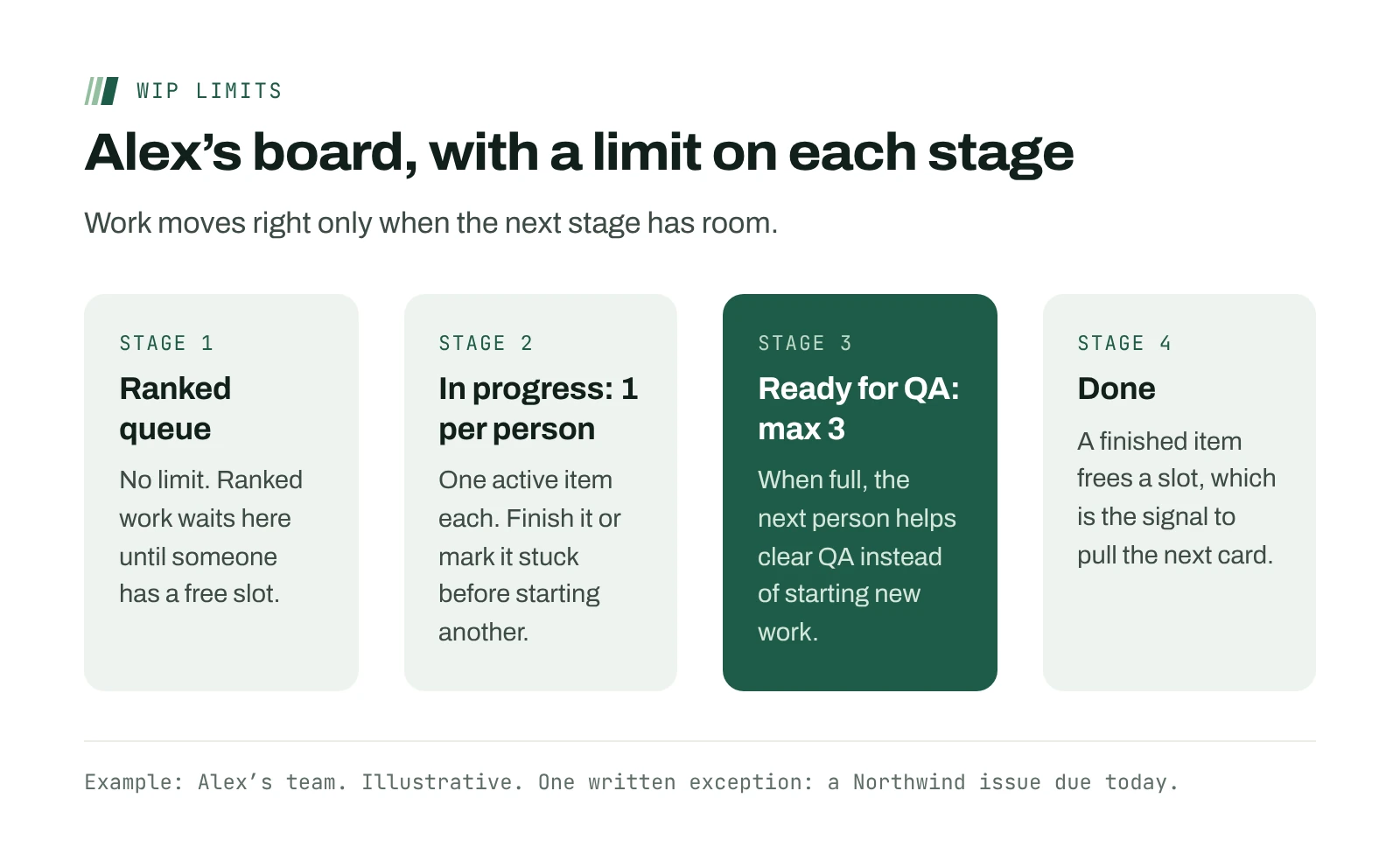
Limit the waiting stages. Cap “ready for review” or “ready for QA,” where work crosses time zones. When it is full, the next person helps clear it before starting new work.
Write the exceptions down. The guide says “Any acceptable exceptions to controlling WIP should be made explicit as part of the DoW,” its Definition of Workflow. Name yours, such as a client deadline today.
Let the limit hand out the work. In the guide’s words, “When WIP drops below the control set in the DoW, that can be a signal to select new work.” Nobody waits for you to wake up.
For why fewer open items protect attention, read focus time for remote teams and protect focus without going dark; for the wider model, see how to manage a remote team.
Example: a QA queue that stopped growing
Example: Alex’s 9-person delivery team works across three time zones, and finished work kept piling up overnight in “ready for QA” for Jordan. Alex writes two limits into the team’s working agreement: one active item per person, and at most three items waiting for QA, with one exception, a Northwind issue due today. On Tuesday, Sam finishes a design and finds QA full. Instead of starting the next screen, Sam does the visual check on one waiting item so Jordan can close it. The queue drops to two, Sam’s design moves in, and Sam pulls the next card.
Related terms
Capacity planning: sets how much the team takes on over weeks; WIP limits cap what is open at once.
Context switching: the cost people pay when they jump between too many open items.
Timeboxing: limits work by time rather than by count.
Working agreement: a template for writing down your limits and their exceptions.
Where ActionOrder fits
ActionOrder, an efficiency and accountability tool for managers of remote teams, builds a limit of one into each person’s day. The Run feed shows one card at a time. Starting a card holds focus: new cards queue behind it, and only items a manager marks urgent and items due today get through, as a small bar. Every card has one owner and a status, and people set “stuck” themselves.
Join the waitlist. ActionOrder is in pre-launch.
Sources
- The Kanban Guide (May 2025)Kanban Guides, updated May 1, 2025
- What is a Kanban Board?Agile Alliance, checked November 22, 2026