Handover Document Template for Async Handoffs
Use this handover document template and handoff email to pass work to a teammate who can act without a call: seven parts, a ten-point checklist and worked examples.
A handover document is a written record that lets the next person take over a piece of work without a call. It states the goal, the current status, links to the work, decisions already made, open questions with owners, the next step and the people involved. If the new owner has to ask how to start, the handover isn't finished.

What is a handover document?
A handover document is a short, structured note that transfers ownership of work from one person to another. It is written for someone who will read it alone, often hours later and in another time zone.
The test is simple: can the new owner start the next step without asking anything? On an async team, every question that can't be answered from the page waits a full day for a reply.
Handovers matter more than they look. In Atlassian's State of Teams 2025 survey of 12,000 knowledge workers and 200 executives, the company reports that "leaders and teams waste 25% of their time just searching for answers." A good handover puts the answers where the next person will look.
What should a handover document include?
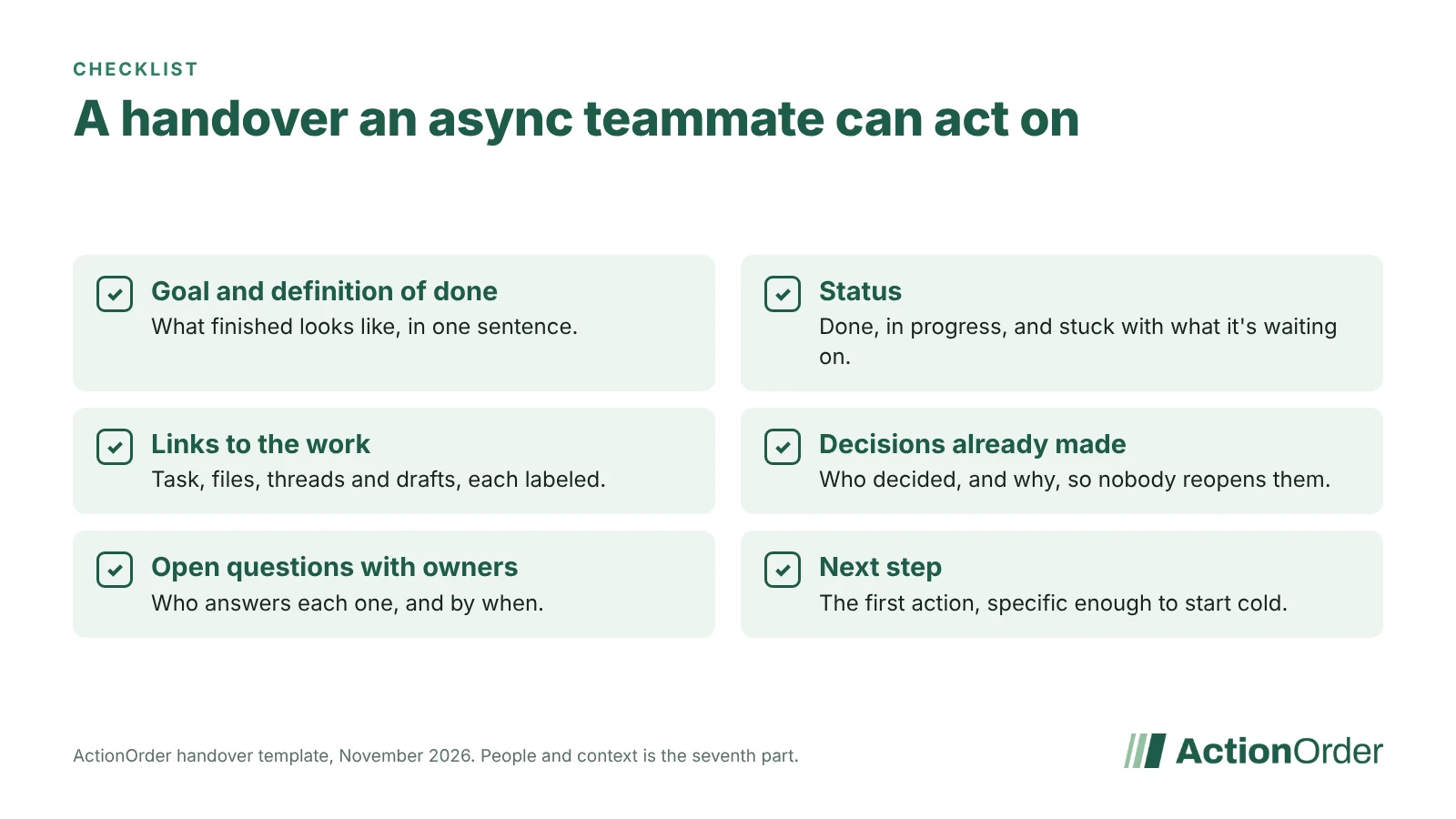
A handover document should include seven parts, in this order. Each one answers a question the new owner would otherwise have to ask.
Goal and definition of done. What finished looks like, in one sentence.
Status. What's done, what's in progress and what's stuck.
Links. The task, files, threads and drafts, each with a word on what it is.
Decisions already made. What was decided, by whom and why, so nobody reopens it.
Open questions. Each with the person who can answer it and a date.
Next step. The very first action for the new owner, specific enough to start cold.
People and context. Who to talk to, who is waiting on the work, and anything sensitive about the client or stakeholder.
Handover document template
Copy this into the task or a shared doc. Fill every field; write "none" rather than leaving a field blank, so the reader knows you didn't skip it.
| Field | What to write |
|---|---|
| Work | Name of the project or task, with a link |
| From / to | Current owner, new owner, and the date ownership moves |
| Goal and done | One sentence on the outcome; one on how you'll know it's done |
| Status | Done, in progress, stuck (with what it's waiting on) |
| Links | Task, files, threads, drafts, each labeled |
| Decisions made | Decision, who made it, date, one-line reason |
| Open questions | Question, who answers, by when |
| Next step | The first action for the new owner |
| People and context | Stakeholders, who's waiting, sensitivities |
| Hand-back | When and how the work returns, if it does |
A copyable version is also in The Async Manager’s Playbook: the handover document template.
Handoff email template (copy this)
A handoff email tells the new owner that the work is theirs, from which date, and where the handover document is. Send it on the day ownership moves and keep it short. The detail stays in the linked document, with the work, instead of in one inbox.
Handoff email
Send on the day ownership moves. Replace every bracket.
Subject: Handoff: [work] is yours from [date]
Hi [name],
From [date], you own [work]: [link to the task]. The handover document is here: [link].
Status: [done, in progress and stuck, one line each].
Next step: [the first thing to do, specific enough to start cold].
Open questions: [question, who answers, by when] or "None."
Decided already: [decision, who made it] or "None."
I can answer questions until [date] in [channel]. From [date], the decisions are yours.
Hand-back: [when and how the work comes back] or "This work won't come back to me."
Please reply "Got it" once you've read the handover document.
[Your name]
Example: Priya's handoff email before a week off
From Priya, an account lead, to Alex, who covers the Northwind account.
Subject: Handoff: the Northwind account is yours from Monday, Nov 23
Hi Alex,
From Monday, Nov 23, you own the Northwind account for the week. The handover document is linked on the account task.
Status: homepage done; QA plan in progress (draft linked); product page copy stuck, waiting on Northwind's legal review.
Next step: send Northwind the revised QA plan Monday morning.
Open questions: Jordan confirms the test accounts by Wednesday.
Decided already: Northwind approved the March timeline.
Hand-back: I'm back Monday, Nov 30. Please send me a hand-back note on Friday.
Please reply "Got it" once you've read the handover document. Priya
Three habits make the email work:
One email per handoff. Updates after that go on the task, not into a reply chain.
Ask for a reply. "Got it" confirms the new owner has read the document, which is when ownership really moves.
Add scope for clients and other teams. Say what's included, how long you'll answer questions and when the handoff is complete, as in handing off a project below. The project handoff template has the longer version.
How do you hand over work before a vacation?
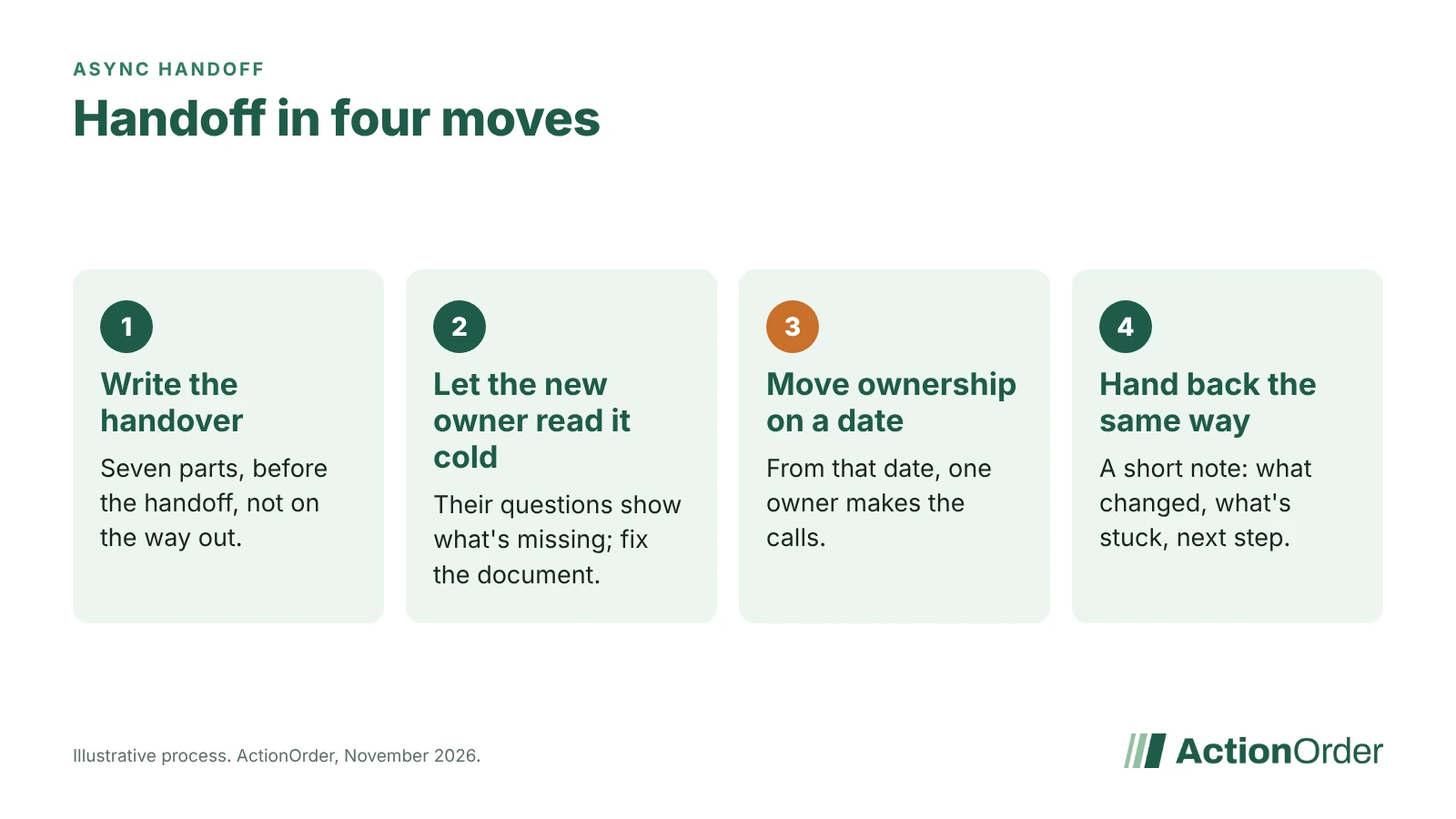
To hand over work before a vacation, write the handover two working days before you leave and let the cover person read it cold, without a walkthrough. If they have questions, the document is missing something; fix the document, not just the answer.
Example: Priya, an account lead, is off for a week. Her handover for the Northwind account names Alex as cover from Monday, lists the three live tasks with their status, records that Northwind already approved the March timeline, and flags one open question for Jordan with a Wednesday deadline. The next step reads: "Send Northwind the revised QA plan Monday morning; the draft is linked."
Keep vacation handovers small. Hand over only work that can't wait a week, and say so for everything else, so the cover person doesn't inherit a backlog.
How do you hand off work across time zones?
You hand off work across time zones by ending your day with a handover the next person can act on as their day starts. The document is the meeting.
A daily time-zone handoff is shorter than a vacation handover: status, what changed today, the next step and anything stuck. Our end-of-day report template covers that daily format. For the habits of delegating across time zones, read How to Delegate Across Time Zones Without Losing Context; this article doesn't repeat it.
The gap between handoffs is where work stalls. A clear stuck flag, with what's needed and from whom, lets the next person act on it instead of rediscovering the problem.
How do you hand off a project to another team or a client?
To hand off a project to another team or a client, add three things to the seven parts: a list of what is and isn't included, the support you'll give after the handoff, and a date when the handoff is complete.
Scope. List what's being handed over and what isn't, so the receiving team doesn't assume you still own part of it.
Support window. Say how long you'll answer questions and through which channel, such as two weeks in the shared project thread.
Acceptance. Agree a date when the receiving owner confirms they have what they need. After that date, the work is theirs.
Medicine shows how much structure helps. In a study of a resident handoff-improvement program in nine hospitals, published in the New England Journal of Medicine on November 6, 2014, covering 10,740 patient admissions, "the medical-error rate decreased by 23% from the preintervention period to the postintervention period" and "the rate of preventable adverse events decreased by 30%." Office handoffs carry lower stakes, but the lesson holds: a standard format beats memory.
Who owns the work after the handoff?
After the handoff, the new owner owns the work, starting on the date written in the document. One task, one owner: the previous owner answers questions but no longer makes decisions or changes the plan.
Two habits keep ownership clear:
Name the date. "From Monday, Alex owns this" removes the gray zone where both people assume the other is acting.
Hand back the same way. When the work returns, the cover person writes a short hand-back note: what changed, what was decided, what's new or stuck, and the next step. It uses the same fields, so the original owner can read it in two minutes.
Handovers also reduce key-person risk, where only one person can keep a piece of work moving. Software research gives this a name: a project's truck factor. Avelino, Passos, Hora and Valente (2016) define it as "the minimal number of developers that have to be hit by a truck (or quit) before a project is incapacitated," and found that 65% of the 133 popular GitHub projects they studied had a truck factor of two or less. For a manager's view of the same problem, see Key-Person Risk on Remote Teams.
Ten-point handoff checklist
Run through this list before you send a handover. Every "no" is a question the new owner will have to ask you later.
The goal fits in one sentence.
"Done" is defined so someone else could check it.
Status shows what's done, in progress and stuck.
Every stuck item says what it's waiting on and from whom.
Every link opens for the new owner (check access).
Decisions already made are listed with who made them.
Each open question has a named person and a date.
The next step is specific enough to start without a call.
The ownership date is written down.
The hand-back plan is written down, or the handover says the work won't come back.
If you find yourself checking in on the new owner every day after the handoff, the checklist missed something, or the trust needs a plan. Our guide on how to stop micromanaging a remote team covers agreed signals instead of check-ins.
How ActionOrder handles this
ActionOrder, an efficiency and accountability tool for managers of remote teams, treats every handoff as a card with a single owner. A person can delegate a card to a teammate with its prep (context, analysis, research and a first draft) and a note, and the card comes back when it's done or handed back. Every card has a status: done, in progress, waiting or stuck, and people set "stuck" themselves, so the next owner sees what's blocked without asking. Integrations are read-only, so ActionOrder never sends, posts or changes anything in the tools it reads. Join the waitlist. ActionOrder is in pre-launch.
Questions people ask
What is the difference between a handover and a handoff?
They mean the same thing: passing ownership of work from one person to another. "Handover" is more common in British English and in clinical settings; "handoff" is more common in US workplaces and software teams. Either way, the document that goes with it should let the next person act without a call.
How long should a handover document be?
As short as it can be while the new owner can still act alone. A daily time-zone handoff often fits in five lines. A vacation or project handover usually fits on one page. If it runs longer, move detail into the linked files and keep the document to the seven parts.
When should you write a handover document?
Write it before the handoff, not on the way out the door. For a vacation, two working days ahead gives the cover person time to read it and ask questions. For a daily time-zone handoff, write it in the last 15 minutes of your day, while the details are fresh.
What is a handoff checklist?
A handoff checklist is a short list of yes/no checks you run before sending a handover document. It catches the gaps that cause follow-up questions: missing links, undefined "done", open questions without owners and no stated ownership date. The ten-point checklist above is one you can copy.
Should a handoff go in an email or in the task?
Both, with different jobs. The task or a shared document holds the handover itself, so the detail stays with the work and anyone can find it later. The email is the notice: it tells the new owner the work is theirs from a date and links to the document. On a team that works in chat, a direct message with the same lines does the job.
Who should review a handover document?
The person receiving the work should review it, ideally alone and before the handoff date. Their questions show what the document is missing. A manager only needs to review handovers that change scope, move work between teams or affect a client.
Sources
- State of Teams 2025Atlassian, Inside Atlassian blog, no date shown
- Changes in medical errors after implementation of a handoff programNew England Journal of Medicine, vol. 371, no. 19, pp. 1803-12, November 6, 2014 (PubMed record)
- A Novel Approach for Estimating Truck FactorsGuilherme Avelino, Leonardo Passos, Andre Hora and Marco Tulio Valente, ICPC 2016 (arXiv, April 22, 2016)