Follow-the-Sun Model: How 24-Hour Handoffs Work
The follow the sun model passes work between time zones so it keeps moving for 24 hours: a full handoff schedule, a note template and where it breaks.
The follow the sun model is a way of organizing work so that a team in one time zone hands its open work to a team several time zones west at the end of each day. With three offices spread around the globe, work moves for 24 hours and nobody works nights. It depends on written handoffs.
What is the follow the sun model?
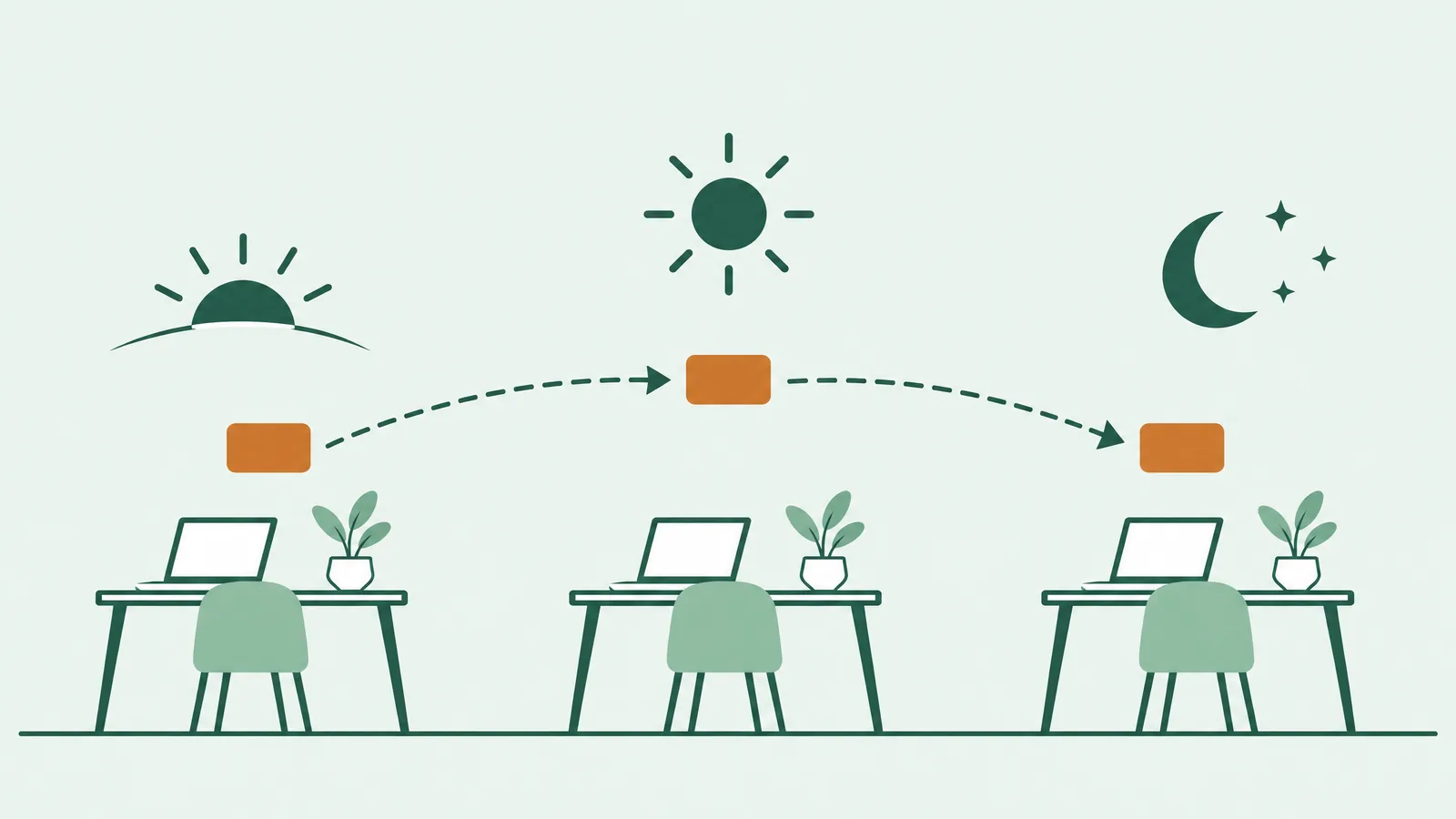
The follow the sun model is a workflow where each office works normal daytime hours and, at the end of its day, hands unfinished work to an office several time zones west. The work keeps moving. The people don’t work nights.
In software research it is treated as a special case of global software development. Erran Carmel, Yael Dubinsky and J. Alberto Espinosa described it in a 2009 conference paper: “software work is handed off every day from one development site to the next.” Salesforce, which sells customer service software, defines it in an April 15, 2026 guide as “a customer service delivery model where companies shift support among teams around the world.”
Where is the follow the sun model used?
It is used where work arrives around the clock or where finishing sooner matters: support queues, software development and on-call operations.
- Customer and IT support. A ticket opened in Manila’s afternoon is answered in Lisbon’s morning, not the next day.
- Software development. A 2013 research review by Josiane Kroll and colleagues calls it “a strategy used to reduce the length of software projects.”
- On-call operations. Google’s SRE book chapter on being on-call says “a multi-site ‘follow the sun’ rotation allows teams to avoid night shifts altogether.”
What are the benefits and problems of follow the sun?
The benefit is coverage without night work. The problem is the handoff: each time work changes hands, some context is lost.
- Benefit: no night shifts. The SRE chapter notes that “night shifts have detrimental effects on people’s health.”
- Benefit: less waiting. Work moves while its first owner sleeps, and no one person holds the queue, which lowers key-person risk.
- Problem: handoff loss. Kroll and colleagues, citing earlier work, note that “FTS efficiency is determined by the quality of knowledge transfer and the duration it involves.”
- Problem: coordination. Salesforce, from the vendor side, names “coordination complexity and poor handoff quality” as the main challenges.
- Problem: more shift changes. Will Larson, writing on his blog in July 2019, notes that moving a week-long on-call rotation to two 12-hour shifts “transitions you from one shift per week to fourteen shifts.”
The research view is blunt. Carmel, Espinosa and Dubinsky wrote in the Journal of Management Information Systems in 2010 that follow the sun “has enjoyed few documented industry successes because it is acknowledged to be extremely difficult to implement.” Kroll’s review of 27 studies from 1990 to 2012 found 36 best practices, 17 challenges and “very few successful cases of FTS.” That research covers software teams passing half-finished code; a support ticket is a smaller, easier unit to hand over. More figures are on our research page.
What does a 24-hour follow-the-sun schedule look like?
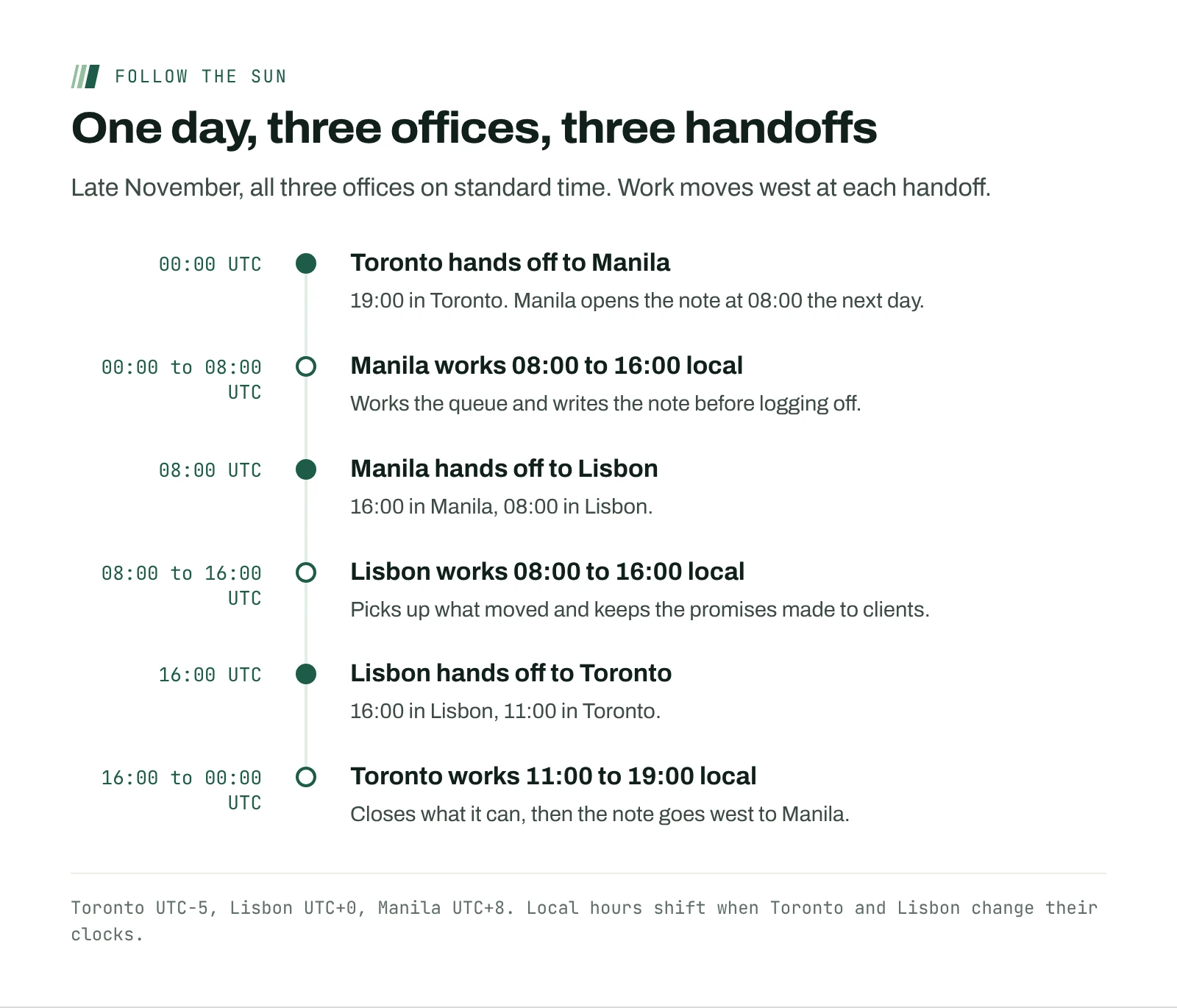
A 24-hour schedule needs three offices, each working an eight-hour day, with a handoff at the end of each. Offices exactly eight hours apart could all work 08:00 to 16:00. Real cities rarely line up: going west, Manila, Lisbon and Toronto are 8, 5 and 11 hours apart, so Toronto works 11:00 to 19:00. Here is a complete schedule for late November, when all three are on standard time.
Handoff timeline across Toronto, Lisbon and Manila
| Office | Time zone in late November | Local working hours | Same hours in UTC | Hands off to | Handoff time |
|---|---|---|---|---|---|
| Manila | Philippine Standard Time, UTC+8, no daylight saving | 08:00 to 16:00 | 00:00 to 08:00 | Lisbon | 08:00 UTC (16:00 Manila, 08:00 Lisbon) |
| Lisbon | Western European Time, UTC+0 | 08:00 to 16:00 | 08:00 to 16:00 | Toronto | 16:00 UTC (16:00 Lisbon, 11:00 Toronto) |
| Toronto | Eastern Standard Time, UTC-5 | 11:00 to 19:00 | 16:00 to 00:00 | Manila | 00:00 UTC (19:00 Toronto, 08:00 next day in Manila) |
Handoffs land at 08:00, 16:00 and 00:00 UTC, and work always moves west: from Toronto it crosses the Pacific to Manila, where it is already the next morning. The trade-off is one late shift in Toronto.
timeanddate.com lists Toronto on Eastern Time, UTC-5 in winter and UTC-4 in summer, and Ontario’s Time Act sets standard time east of the 90th meridian at “five hours behind Greenwich time.” Mainland Portugal uses Western European Time, UTC+0, and UTC+1 in summer. Manila is UTC+8 with no daylight saving time.
How the schedule moves when clocks change
Toronto and Lisbon change their clocks on different days, and Manila doesn’t change at all.
- Toronto. The Time Act runs daylight saving time “between 2 a.m. standard time on the second Sunday in March and 2 a.m. daylight saving time on the first Sunday in November.” In 2027 that’s March 14 to November 7.
- Lisbon. EU Directive 2000/84/EC starts summer time in every member state “at 1.00 a.m., Greenwich Mean Time, on the last Sunday in March” and ends it on the last Sunday in October. timeanddate.com lists the 2027 changes in Portugal as March 28 and October 31.
If handoffs stay fixed in UTC, Toronto and Lisbon each shift their hours by one on the day their own clocks change. Manila never moves.
| Period | Toronto | Lisbon | Manila |
|---|---|---|---|
| Nov 1, 2026 to Mar 13, 2027 | 11:00 to 19:00 (UTC-5) | 08:00 to 16:00 (UTC+0) | 08:00 to 16:00 (UTC+8) |
| Mar 14 to Mar 27, 2027 | 12:00 to 20:00 (UTC-4) | 08:00 to 16:00 (UTC+0) | 08:00 to 16:00 |
| Mar 28 to Oct 30, 2027 | 12:00 to 20:00 (UTC-4) | 09:00 to 17:00 (UTC+1) | 08:00 to 16:00 |
| Oct 31 to Nov 6, 2027 | 12:00 to 20:00 (UTC-4) | 08:00 to 16:00 (UTC+0) | 08:00 to 16:00 |
| From Nov 7, 2027 | 11:00 to 19:00 (UTC-5) | 08:00 to 16:00 (UTC+0) | 08:00 to 16:00 |
The other workable rule keeps Toronto and Lisbon on steady hours and moves Manila to 07:00 to 15:00 while both are on summer time, so handoffs fall at 07:00, 15:00 and 23:00 UTC. In the two short stretches when only Toronto has changed, Toronto then finishes an hour before Manila starts. Pick one rule, write it on the schedule and put the change dates on the team calendar. Check your own cities with our free time zone overlap finder.
Clock rules vary by country, province and state, and they change: Ontario has passed a Time Act amendment (2020, c. 28) that would keep one time all year, four hours behind Greenwich in the east; e-Laws marks it as not in force. Check official sources each year. This is general information, not legal advice.
What work fits the follow the sun model?
Work fits when it comes in pieces a colleague can pick up from a written note. It fits badly when the next step depends on what is in one person’s head.
| Fits well | Fits badly |
|---|---|
| Support tickets with a clear next action | Design and writing, where judgment carries between sessions |
| Testing against a written spec | Deep debugging, where the theory lives in one head |
| Incident follow-up once the first fix is in | Client relationships that need one familiar voice |
| Reviews that follow a checklist | Decisions that need several people in one conversation |
A quick test: if the next owner could start within ten minutes of reading the note, the work can move. If they’d need an hour to rebuild the context, it stays with its owner, and the note says so.
How do you run follow-the-sun handoffs async?
Run them at fixed times, with one owner per item and a note the next office can act on without a reply. The note is the meeting. The habits that help you manage a remote team without chasing it apply:
One owner per item. Every item that moves gets a new named owner.
Handoff times in UTC. Publish them with local times beside them.
Read before you work. The incoming shift reads the note first and replies only when blocked.
Review the notes weekly. Find items that came back with a question the note should have answered, and fix the template.
Set reply times between offices with a response-time agreement. For writing to someone who can’t ask you anything, see How to Delegate Across Time Zones Without Losing Context and playbook chapter 4, Hand off work, and get out of the middle.
What goes in each handoff note
A shift note is shorter than a handover document because it covers one shift. Copy these fields, in order. To transfer a whole project, use the project handoff template.
| Field | What to write | Example: Manila to Lisbon |
|---|---|---|
| Handoff | From, to, time in UTC | Manila to Lisbon, Tuesday 08:00 UTC |
| Moving to you | Each item that changes owner, with a link and status | Northwind export ticket, in progress, now Morgan’s |
| Done so far | What was tried and ruled out | Fails only on files over 10 MB; not permissions |
| Next step | The first action, specific enough to start cold | Send the split-file workaround; draft linked |
| Promised to the client | What they were told, and when the next update is due | Update by 10:00 UTC (10:00 Lisbon) |
| Stuck or waiting | What it needs, from whom, by when | Root cause needs engineering in Toronto today |
| Staying with me | Items this shift keeps | Northwind billing question, back tomorrow |
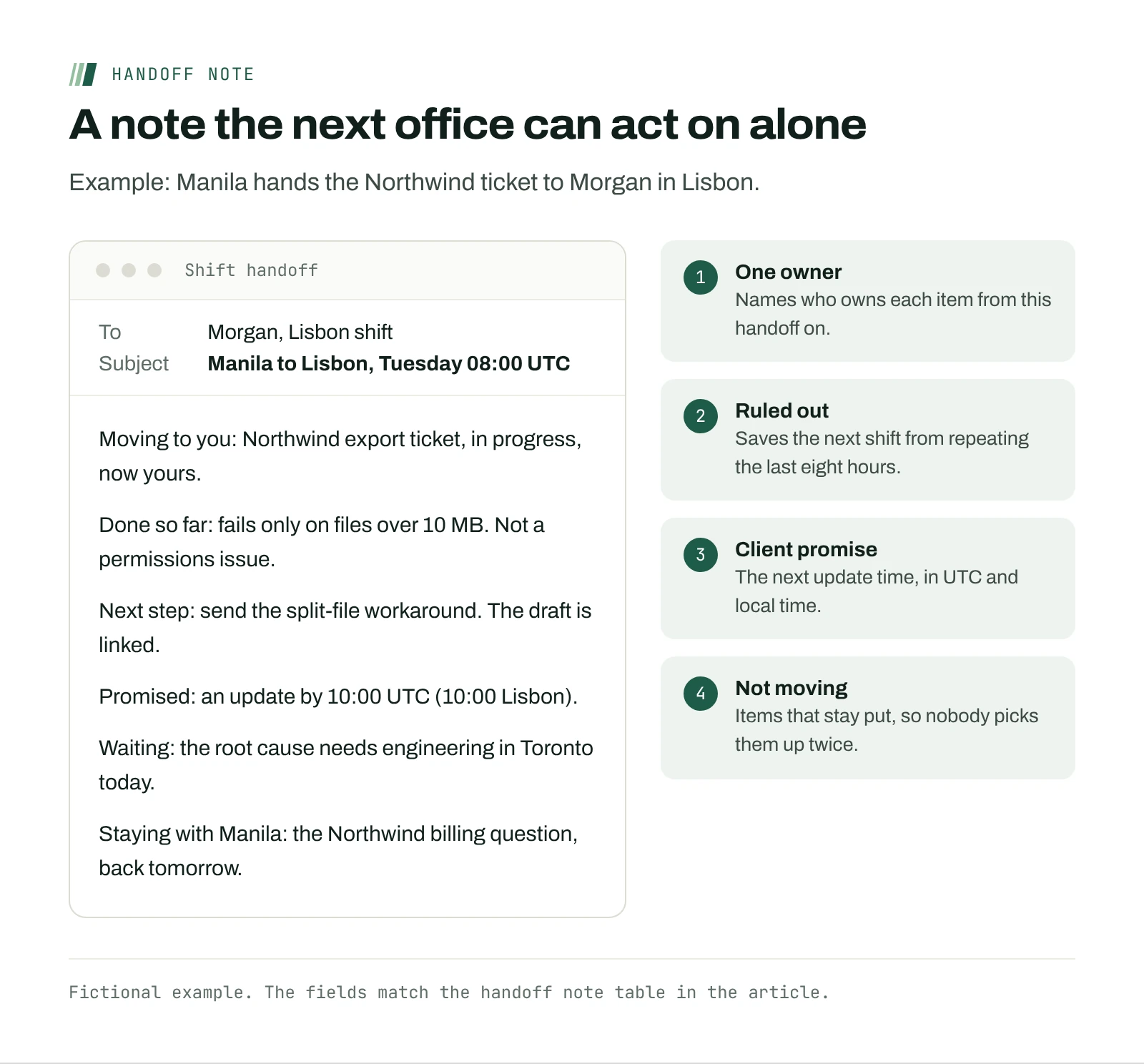
Example: Taylor, head of support and operations, runs support shifts in Manila, Lisbon and Toronto. Morgan, the support lead, works in Lisbon. At 15:30 Tuesday in Manila, Northwind reports a failing export. Manila narrows it to large files but can’t fix it by 16:00, so the note above goes to Morgan. Morgan sends the workaround before the promised update and marks the ticket waiting on engineering. At 16:00 UTC it moves to Toronto, the fix ships, and Toronto closes it before 19:00. On Friday, Taylor counts the items that came back with a question. That count shows whether the handoffs work.
How is follow the sun different from 24/7 shifts and on-call?
Follow the sun covers the clock with daytime work in several places. 24/7 shifts use night work in one place, and on-call uses one person who answers when paged.
| Model | Who covers the night | Best for | Main risk |
|---|---|---|---|
| Follow the sun | The next office | A steady queue: tickets, tests, reviews | Context lost at each handoff |
| 24/7 shifts at one site | A night shift | Work tied to one site | Night work and its toll on health |
| On-call rotation | One person, if paged | Rare, urgent exceptions | Broken sleep and slow replies |
Many teams combine them: follow the sun for the queue, a small on-call rotation for emergencies. Larson, who argues against follow-the-sun on-call for engineers, calls customer service across time zones “a noble and just use” of it. His test: on-call “should be used to handle exceptions, not to provide services.”
How ActionOrder handles this
ActionOrder, an efficiency and accountability tool for managers of remote teams, gives each person one clear next step at a time. At the end of a shift, a person can delegate a card to a teammate in the next office with its prep (context, analysis, research and a first draft) and a note, and it comes back when done or handed back. Every card has one owner and a status: done, in progress, waiting or stuck. People set “stuck” themselves. Integrations are read-only: ActionOrder never sends, posts, pays or changes anything in them. Join the waitlist. ActionOrder is in pre-launch.
Questions people ask
What is a 24/7 follow the sun model?
It is a follow the sun model with enough offices to cover all 24 hours, usually three, each working a normal eight-hour day at staggered hours. Each works a normal day and hands open work west at a fixed time.
How many locations do you need for follow the sun?
Three offices with staggered eight-hour days cover 24 hours. Two offices can split the day into 12-hour shifts, the on-call shift length the Google SRE chapter works with. Two offices on normal days leave a daily gap.
Is follow the sun the same as having a team in several time zones?
No. Many remote teams span time zones, but each person keeps their own work. Follow the sun means the same piece of work changes hands every day at a set time.
Can a small team use the follow the sun model?
Yes, with people in at least two distant time zones and work that can move on a note. One person per region can pass a support queue along. Start with one queue and one handoff a day.
Sources
- Follow the sun software development: New perspectives, conceptual foundation, and exploratory field studyCarmel, Dubinsky and Espinosa, Hawaii International Conference on System Sciences, January 2009
- Follow the Sun Model: A Complete GuideChristina Keohane, Salesforce (vendor guide), April 15, 2026
- A Systematic Literature Review of Best Practices and Challenges in Follow-the-Sun Software DevelopmentKroll, Hashmi, Richardson and Audy, IEEE ICGSE Workshops, 2013
- Being On-CallAndrea Spadaccini, Site Reliability Engineering, Google, checked November 22, 2026
- Don’t follow the sunWill Larson, Irrational Exuberance, July 3, 2019
- “Follow the Sun” Workflow in Global Software DevelopmentCarmel, Espinosa and Dubinsky, Journal of Management Information Systems 27(1), July 1, 2010
- Time Zones in Ontario, Canadatimeanddate.com, checked November 22, 2026
- Time Act, R.S.O. 1990, c. T.9Government of Ontario, e-Laws, checked November 22, 2026
- Time Zones in Portugaltimeanddate.com, checked November 22, 2026
- Current local time in Manila, Philippinestimeanddate.com, checked November 22, 2026
- Directive 2000/84/EC on summer-time arrangementsEUR-Lex, published February 2, 2001
- Directive 2000/84/EC, adopted textOfficial Journal L 31, February 2, 2001, p. 21 (copy on legislation.gov.uk)
- Daylight Saving Time 2027 in Portugaltimeanddate.com, checked November 22, 2026