Knowledge Transfer Plan: Steps, Checklist and Template
A knowledge transfer plan for remote teams: sort explicit from tacit knowledge, move it across time zones in three weeks, and copy a template with a filled example.
A knowledge transfer plan is a written schedule for moving what one person knows to another before it's needed. It lists each task, system and relationship, who gives and receives it, how it moves and how you'll check it worked. On a remote team, write it down first, record walkthroughs, and verify by doing real work.

What is a knowledge transfer plan?
A knowledge transfer plan is a document that lists what one person knows that someone else will need, and sets out how and by when it will move. Each item gets a giver, a receiver, a method, a target date and a way to prove it moved.
The BC Public Service Agency's knowledge transfer key terms define knowledge transfer as "The process of sharing and distributing knowledge to one or more specific individuals and/or to other parts of the organization." Its knowledge transfer process has four phases: identify, prioritize, capture and transfer, then share and store. A plan turns those phases into names and dates.
What is the difference between explicit and tacit knowledge?
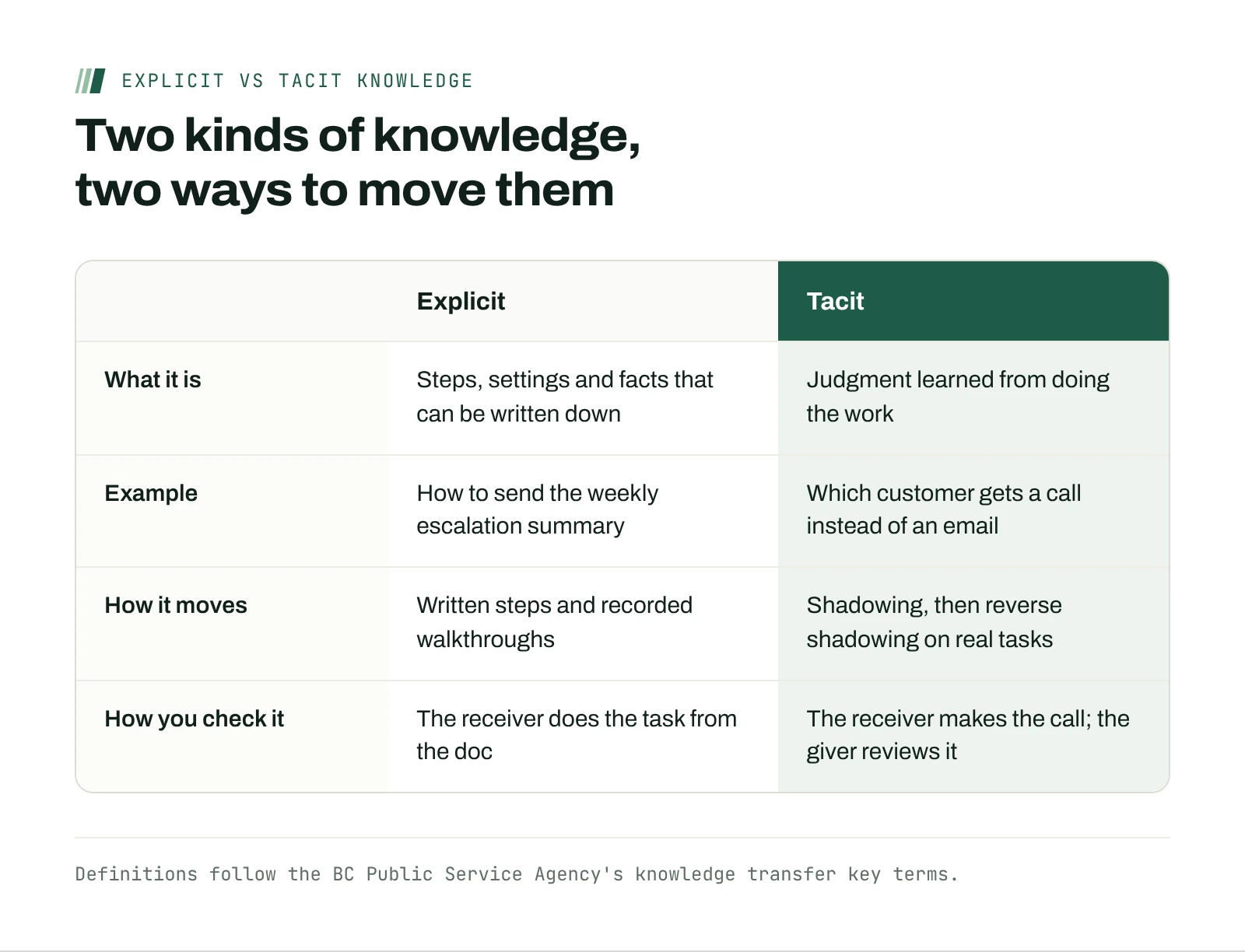
Explicit knowledge is what can be written down: steps, settings, policies and where files live. Tacit knowledge comes from experience and is hard to put into words, such as which customer gets a call instead of an email.
The same BC glossary describes explicit knowledge as "Knowledge that's easy to articulate, communicate, and store" and tacit knowledge as "Knowledge that's hard to articulate, communicate, and store because it's usually not written down or captured." The idea comes from the philosopher Michael Polanyi, who wrote in The Tacit Dimension that "we can know more than we can tell," as Mark K. Smith sets out in his overview of Polanyi on infed.org.
The two kinds move differently. Explicit knowledge moves by reading. Tacit knowledge moves by doing the work while someone who knows it reviews. Most plans stall here. For each recurring task, ask the giver: "What do you do here that isn't written anywhere?"
When do you need a knowledge transfer plan?
You need a knowledge transfer plan whenever someone who holds critical knowledge is about to stop doing the work, and whenever a new hire has to learn work that lives in one person's head.
Departure. Start the day notice arrives. Cal Poly's offboarding knowledge transfer plan tells supervisors to collect documentation "Immediately after receiving notification of employee's intent to exit the university" and to hold a knowledge transfer interview "Within one week." It adds: "this is not an exit interview."
Role change. The giver is still around, so the plan is easy to skip. Write it anyway; a new role means slower replies.
Leave or vacation. Transfer only what can't wait.
New hire. The inventory becomes the onboarding list.
People move often. The U.S. Bureau of Labor Statistics reported on September 24, 2026 that "The median number of years that wage and salary workers had been with their current employer was 4.1 years in January 2026." Key-Person Risk on Remote Teams shows how to find work that depends on one person before anyone leaves.
How is a knowledge transfer plan different from a handover or a project handoff?
A knowledge transfer plan moves what someone knows how to do, over weeks, with practice. A handover document passes one piece of active work; a project handoff passes a whole project. A departure often needs all three.
| Document | What moves | How long it takes | Done when |
|---|---|---|---|
| Knowledge transfer plan | Skills, judgment, access and relationships | Two to four weeks, with practice | The receiver has done the work alone |
| Handover document | One piece of active work | One pass, read in minutes | The new owner can take the next step without a call |
| Project handoff | A whole project, with its open work and risks | About a week on each side | The new owner confirms they have what they need |
Only the plan checks whether the receiver can actually do the work. Chapter 4 of the playbook, Hand off work, and get out of the middle, covers the everyday handoffs around it.
How do you make a knowledge transfer plan?
You make a knowledge transfer plan in six steps. The last two add practice and proof to the BC phases.
List what has to move. Tasks, systems, accounts, recurring decisions and people, taken from the giver's calendar, task history and threads. Record past decisions in a decision log so nobody reopens them.
Sort and rank. Mark each item explicit, tacit or both. Items that would stall work within a week go first.
Assign. One giver, one receiver and a method per item: documents and recordings for explicit knowledge, shadowing for tacit.
Capture it in writing first. The giver writes the steps and records short walkthroughs of real tasks. The BC guide to capturing and transferring knowledge lists video and audio recordings of experienced workers among its methods.
Practice on real work. The receiver shadows live tasks, then does them while the giver reviews.
Verify and sign off. Each item is verified by a real task the receiver does alone.
What goes in a knowledge transfer plan template?
A knowledge transfer plan template has seven parts: who and why, a knowledge inventory, judgment calls, access, people to introduce, a schedule and sign-off criteria. Copy it into a shared doc next to the work.
Knowledge transfer plan
The giver drafts it, the receiver edits it, the reviewer signs it off.
Knowledge transfer plan: [role, process or system]
Giver: [name, role] · Receiver: [name, role] · Reviewer: [manager or lead]
Why: [departure, role change, leave or new hire] · Starts: [date] · Sign-off by: [date]
Questions: [one thread], answered within [one working day]
Knowledge inventory (one line per task or system)
• [Task or system] · [explicit, tacit or both] · Giver: [name] · Receiver: [name] · Method: [doc, recording, shadow, reverse shadow] · Due: [date] · Status: [not started, in progress, verified] · Verified by: [real task done alone]
Judgment calls and exceptions
• When [situation], I [action], because [reason]. Check with [person] if [condition].
Access and accounts
• [Tool or account] · Granted by [person] by [date] · Giver's access changes on [date]
People to introduce
• [Name, role] · Expects: [what, how often] · Introduced by [date] in [channel]
Where things live
Runbook: [link] · Recordings: [link] · Decision log: [link]
Schedule
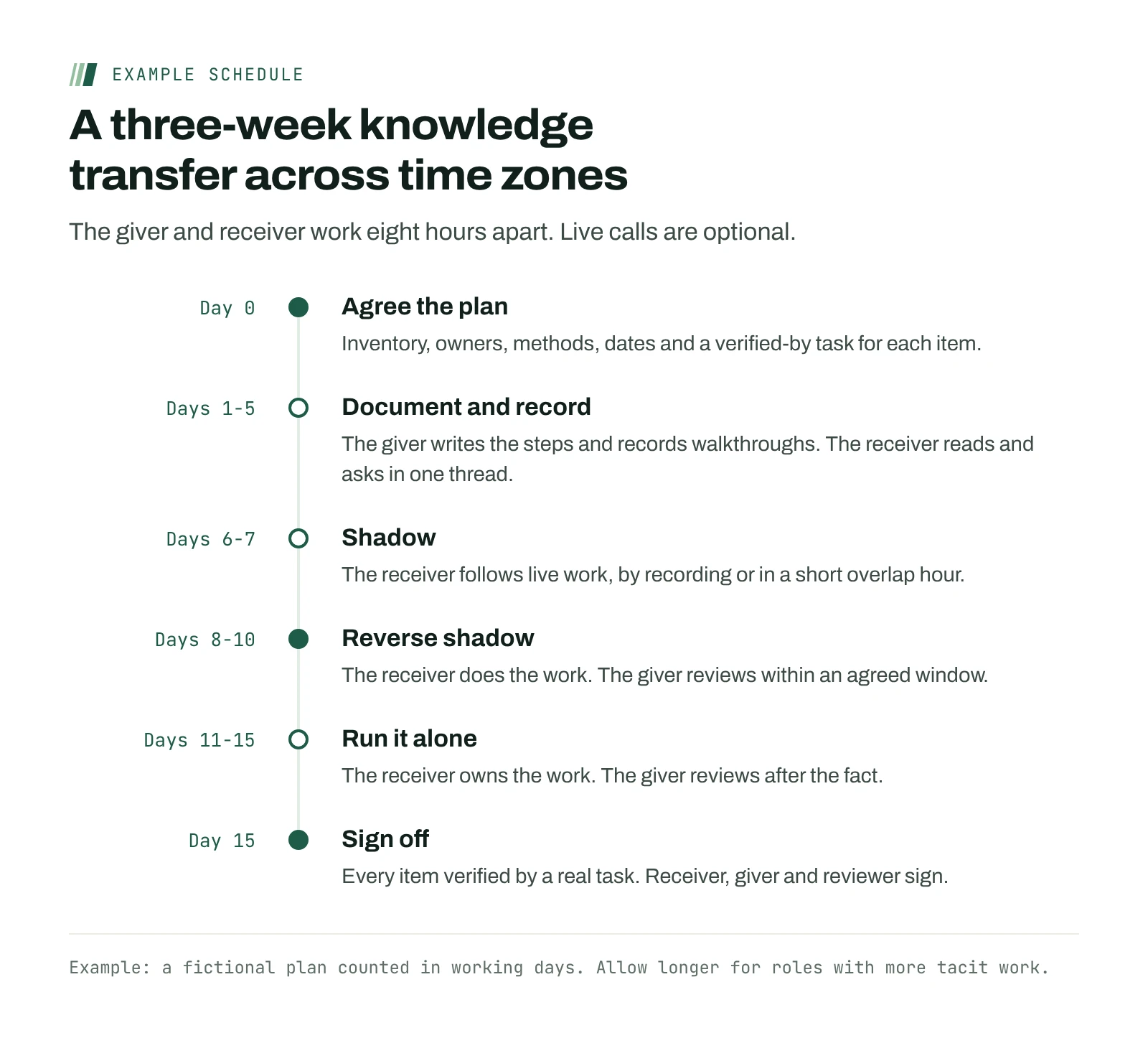
• Week 1, document and record: giver writes steps and records walkthroughs; receiver reads and asks in the thread.
• Week 2, shadow then reverse shadow: receiver follows [number] live tasks, then does them with review within [hours].
• Week 3, run it alone: receiver owns the work; giver reviews after the fact.
Sign-off criteria
• Every inventory line is verified by its real task.
• Each recurring task run alone at least once.
• One exception handled, and the runbook updated by the receiver.
• Everyone on the people list introduced.
• Access works for the receiver.
• Every question in the thread has an answer or an owner.
Signed off: [receiver], [giver], [reviewer] on [date]
Example: Morgan, the support lead, is moving to a new role. A support specialist on Taylor's team, eight hours away, is taking over support escalations, and Taylor reviews the plan. Here it is one week in.
Example: Support escalations
Morgan hands escalations to a specialist on Taylor's team. Status on December 7.
Knowledge transfer plan: Support escalations
Giver: Morgan, support lead · Receiver: support specialist · Reviewer: Taylor
Why: role change · Starts: November 30 · Sign-off by: December 18
Knowledge inventory
• Friday escalation summary · explicit · doc and one recording · verified · Verified by: the December 4 summary, sent alone
• Escalation triage · both · doc, two recordings, reverse shadow · in progress · Verified by: five live escalations triaged alone, none re-prioritized on review
• Northwind escalations · tacit · three shadowed tickets · in progress · Verified by: the next Northwind escalation, with Priya copied
Judgment calls and exceptions
• When a customer reports the same bug twice in a week, I escalate it, because a repeat usually means a workaround broke. Check with Jordan, the QA lead, first.
Access and accounts
• Help desk admin role · Granted by Taylor by December 1 · Morgan's removed December 18
People to introduce
• Priya, account lead for Northwind · Expects: a same-day note on Northwind escalations · Introduced December 2
Schedule
• November 30 to December 4: runbook, two recordings, 14 questions answered in the thread.
• December 7 to 11: two days of shadowing, three of reverse shadowing, Morgan reviewing within four hours.
• December 14 to 18: the specialist owns escalations; Morgan reviews each morning.
The Verified by column does most of the work. Nothing counts as moved just because a document exists.
How do you transfer knowledge across time zones?
You transfer knowledge across time zones by writing first, recording walkthroughs, keeping questions in one thread and moving from shadowing to reverse shadowing on real work.
Write first. The receiver reads before any call. Each gap they find is a gap in the doc.
Record real tasks. Short screen-and-voice walkthroughs of live work, saying why each step happens.
Keep one question thread. No direct messages; copy each answer into the doc. Our guide to asynchronous communication covers the team rules.
Shadow, then reverse shadow. In job shadowing, the BC guide says, "The employee follows their job shadow partner through their normal work." Across time zones, use a recording or a short overlap hour. In reverse shadowing, the receiver does the work and the giver reviews it within an agreed window.
Write the decision limits. How to Delegate Across Time Zones Without Losing Context shows how.
Reverse shadowing is where tacit knowledge moves. IMD's guide to knowledge transfer in leadership transitions notes that shadowing "allows the new leader to see how the outgoing leader approaches critical tasks." Reverse shadowing runs it the other way: each correction surfaces an unwritten judgment call.
How do you know the knowledge transfer worked?
You know the knowledge transfer worked when the receiver has done each critical task alone, on real work, and the giver has reviewed it without major corrections.
The BC guidance sets the question to answer before you start: "How will we know when knowledge is transferred? What are our measures of success?" Answer it per item, in the Verified by column. The strongest tests: doing the task alone, handling an exception and explaining a past judgment call.
Knowledge transfer checklist
Every recurring task, system and account is on the inventory.
Each item is marked explicit, tacit or both.
Each item has a giver, a receiver, a method, a date and a Verified by task.
Every explicit item has written steps or a recording.
Every tacit item was reverse-shadowed on live work.
Questions sit in one thread, with answers copied into the doc.
Everyone on the people list has met the receiver.
Access works for the receiver.
Receiver, giver and reviewer have signed off.
For how this fits into running a remote team, start with How to Manage a Remote Team Without Chasing It.
How ActionOrder handles this
ActionOrder, an efficiency and accountability tool for managers of remote teams, keeps context on the work. Each person gets one clear next step at a time, already prepped with context, analysis, research and a first draft. Delegation hands a card to a teammate with its prep and a note, and the card comes back when it's done or handed back. Every card has one owner and a status (done, in progress, waiting or stuck), and people set "stuck" themselves. On Pro, the team view shows each card's owner and status, so a reviewer can see which handed-over work is moving. See how a handoff travels in the delegation use case. Join the waitlist. ActionOrder is in pre-launch.
Questions people ask
What is a KT checklist?
A KT (knowledge transfer) checklist is a short list of yes/no checks you run before signing off a transfer: everything is on the inventory, each item has an owner and a test, access works and introductions are done.
What is the purpose of knowledge transfer?
Knowledge transfer keeps work running when people move, leave or join. The BC government's knowledge transfer guidance states the risk: "Tacit knowledge is lost when the knowledge holder leaves the organization unless an effort is made to capture and transfer this knowledge."
How long should a knowledge transfer take?
For a role or a complex process, plan on two to four weeks: record, practice, then run it alone with review. The more tacit the work, the longer the practice.
How do you transfer knowledge to a new employee?
Use the same plan, with the new hire as the receiver and whoever does the work today as the giver. Start with explicit items, move to reverse shadowing early, and have the new hire fix the runbook where it left them guessing.
Sources
- Knowledge transfer key termsBC Public Service Agency, Province of British Columbia, last updated January 24, 2024
- Knowledge transfer processBC Public Service Agency, Province of British Columbia, last updated October 26, 2026
- Capturing and transferring knowledge in the knowledge transfer processBC Public Service Agency, Province of British Columbia, last updated October 28, 2026
- Knowledge transferBC Public Service Agency, Province of British Columbia, last updated April 23, 2025
- Michael Polanyi and tacit knowledgeMark K. Smith, infed.org, 2003, updated August 9, 2025
- Offboarding Knowledge Transfer PlanCal Poly Administration and Finance, no date shown, checked November 22, 2026
- Employee Tenure in 2026U.S. Bureau of Labor Statistics, USDL-26-1532, September 24, 2026
- 8 knowledge transfer strategies for a successful leadership transitionIMD Business School, November 19, 2024