Bus Factor: What It Means and How to Raise It
What bus factor means, where the idea came from, and how to raise it on a remote team before one person’s absence stalls the work.
Bus factor is the smallest number of people who would have to leave a team or project suddenly, as if hit by a bus, before its work stalls because nobody left knows how to keep it going.
A bus factor of one means a single person holds knowledge nobody else has. The bus is a grim image; in practice the cause is more often a resignation, an illness, parental leave or a vacation with no signal. You can count it per project or per system, and the lowest number is the one to watch.
Where the term comes from
The idea comes from agile software development. In a 2016 paper, Avelino, Passos, Hora and Valente describe truck factor as “a metric proposed by the agile community as a tool to identify concentration of knowledge in software development environments.” They quote a definition from Williams and Kessler’s 2003 book Pair Programming Illuminated: “the number of people on your team that have to be hit by a truck (or quit) before the project is in serious trouble.” Across 133 popular GitHub projects, they found that 65% had a truck factor of two or less.
Bus Factor In Practice, a paper by researchers at Bilkent University and JetBrains Research, uses the phrase “Bus factor (also known as truck factor, bus number, lottery factor, etc.)” and credits the definition to Coplien, citing James Coplien and Neil Harrison’s 2004 book Organizational Patterns of Agile Software Development.
How to raise bus factor on a remote async team
Remote work hides a low bus factor: questions reach one person in direct messages, and you find out when that person is out. For the full audit, see key-person risk on remote teams; for the wider system, how to manage a remote team. The short version:
Count per system: for each account, system and recurring process, ask who could run it tomorrow without help.
Write it where the work lives: respondents in Bus Factor In Practice suggested knowledge sharing “by writing documentation, organizing talks by key developers, doing code reviews.” Keep those notes on the task, not in chat.
Give the second person real work: a backup who has never done the task is a name on a list. Have them run it once while the owner reviews.
Plan the transfer: anything with one name gets a knowledge transfer plan.
Example: who can run each of Alex’s systems
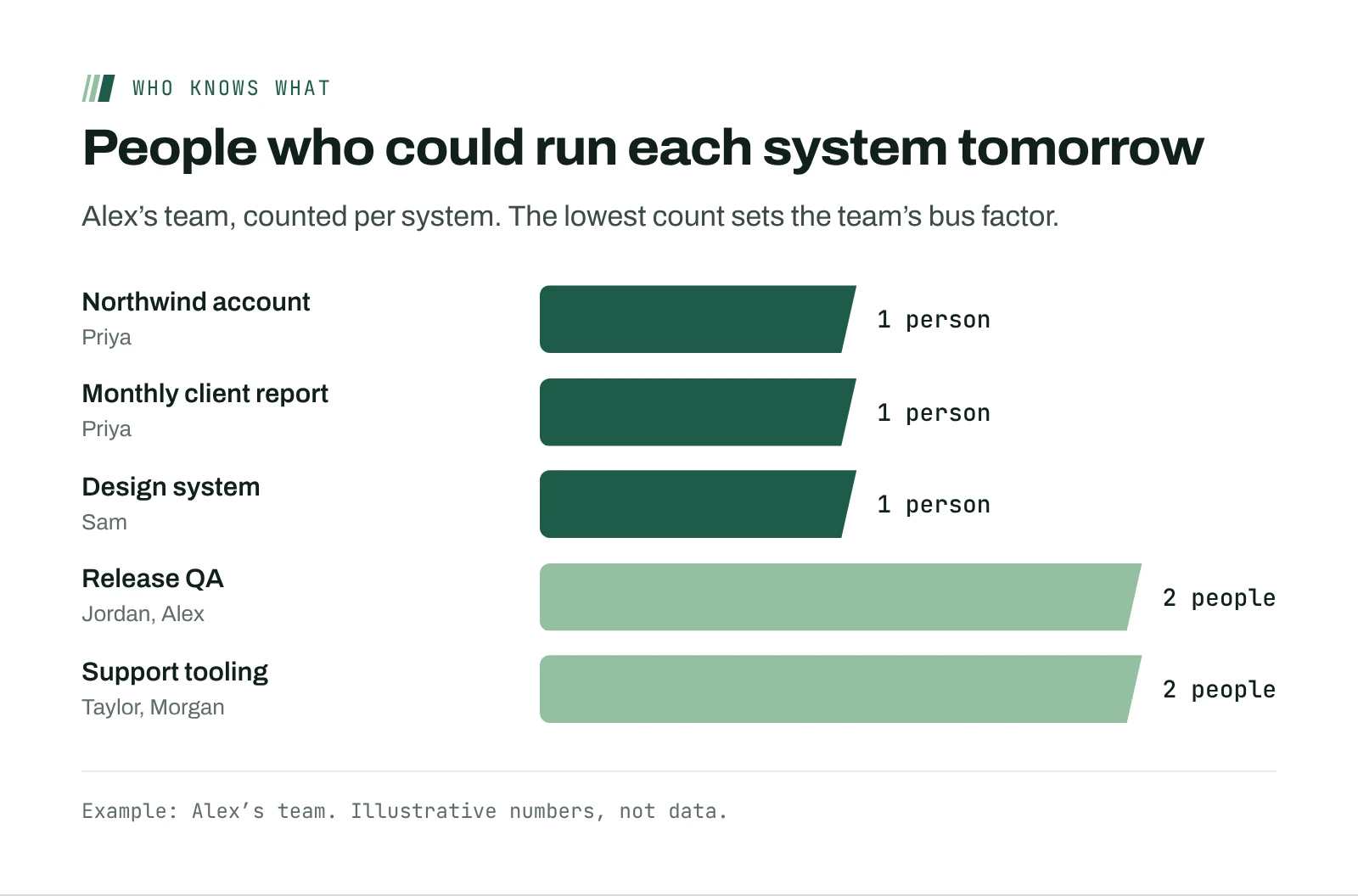
Example: Alex lists five things the team can’t do without and asks who could run each one tomorrow without help. Release QA has two names, Jordan and Alex, and support tooling has two, Taylor and Morgan. The design system has one, Sam. The Northwind account and the monthly client report have only Priya. The team’s bus factor is one, and two weak spots rest on Priya. Alex makes Jordan the second person on the monthly report: Jordan builds the next one while Priya reviews, noting every question it raised. Sam writes a one-page guide to the design system so Alex can make the next small change.
Related terms
Key-person risk on remote teams: the full guide, including a 30-minute audit.
Knowledge transfer plan: moving what one person knows to a second person.
Handover document template: what to write down so someone else can pick up the work.
Directly responsible individual: owning the outcome is different from being the only person who knows the work.
RACI: a RACI chart where one name fills most of the R column points to a low bus factor.
Where ActionOrder fits
ActionOrder, an efficiency and accountability tool for managers of remote teams, keeps context with the work instead of only in one person’s head. Every card arrives prepped with context, analysis, research and a first draft. When someone delegates a card, the teammate gets that prep and a note, and the card comes back when done or handed back. The second person starts from the card’s context instead of a message to the one person who knows.
Join the waitlist. ActionOrder is in pre-launch.
Sources
- A Novel Approach for Estimating Truck FactorsGuilherme Avelino, Leonardo Passos, Andre Hora and Marco Tulio Valente, arXiv 1604.06766, submitted April 22, 2016
- Bus Factor In PracticeElgun Jabrayilzade, Mikhail Evtikhiev, Eray Tüzün and Vladimir Kovalenko, arXiv 2202.01523, checked November 22, 2026