How to Stop Micromanaging a Remote Team
How to stop micromanaging a remote team: replace checking with agreed signals, use a trust ladder for new hires, and run a five-question self-check.
How to stop micromanaging a remote team: replace checking with agreed signals. Define done before work starts, set check-in points by risk, delegate outcomes instead of steps, and let the person doing the work flag stuck work. On remote teams, micromanagement is usually an information problem: fix what you can see, and the urge to check fades.
What are the signs you're micromanaging?
You're micromanaging when you hold decisions, steps or updates that the person doing the work could own. Gallup's guide to micromanagers lists nine signs on a team, including these four: people are "boss-obsessed rather than customer-obsessed," "every decision must be approved by the manager," "employees are afraid to share their opinions," and there's a "quick turnover of talented experts" (Wigert and Pendell, Gallup, 2020).
On a remote team the signs look more specific. Run this five-question self-check on your last two weeks:
Did you ask "any update on this?" about work that had a written status?
Did you approve a step that the owner could have decided alone?
Did you rewrite work that met the brief because it wasn't done your way?
Did someone learn about a change in priority from you in a direct message instead of the shared list?
Did you find out a task was stuck at its deadline instead of when it stalled?
Two or more "yes" answers mean the system is pushing you to check. The sections below change the system.
Why do managers micromanage remote teams?
Most remote managers micromanage because they can't see the work, and checking feels like the only way to find out. Gallup puts the root cause plainly: "Micromanaging occurs when there is no relationship of trust and support between a manager and an employee" (Wigert and Pendell, Gallup, 2020).
Distance makes that trust harder to build, because expectations blur. In Gallup's surveys of U.S. employees in remote-ready jobs, the share of fully remote workers who strongly agreed they knew what was expected of them fell from 59% in 2020 to 47% in 2023, and for hybrid workers from 54% to 41% (Gallup, Jan 22, 2024). By August 2026, across 21,648 U.S. adults surveyed, only 46% of employees strongly agreed they knew what was expected (Gallup, Oct 28, 2026).
Managers feel the same gap from the other side. In Microsoft's survey of 20,006 workers in 11 countries in July and August 2022, 85% of leaders said hybrid work made it challenging to have confidence their employees were productive (Microsoft Work Trend Index, 2022). When you can't see progress, every quiet day looks like a problem.
How do you stop micromanaging without losing control?
You keep control by agreeing the signals up front, then reading them instead of asking. Six practices do most of the work:
Define done. Before work starts, write one sentence on what finished looks like and who accepts it.
Agree check-in points by risk. A routine task gets one check at the end. A new client deliverable gets a check at the draft stage. Put the dates on the task.
Delegate outcomes, not steps. Hand over the goal, the constraints and the deadline. Leave the method to the owner.
Let the person doing the work flag stuck work. Agree that "stuck" means "I need something from someone," and that raising it early is expected, not a failure.
Read status instead of asking. Status lives on the task: owner, status, next step. Read it before you message anyone.
Use a trust ladder. Give new people and new kinds of work less autonomy at first, and raise it on a schedule you both know.
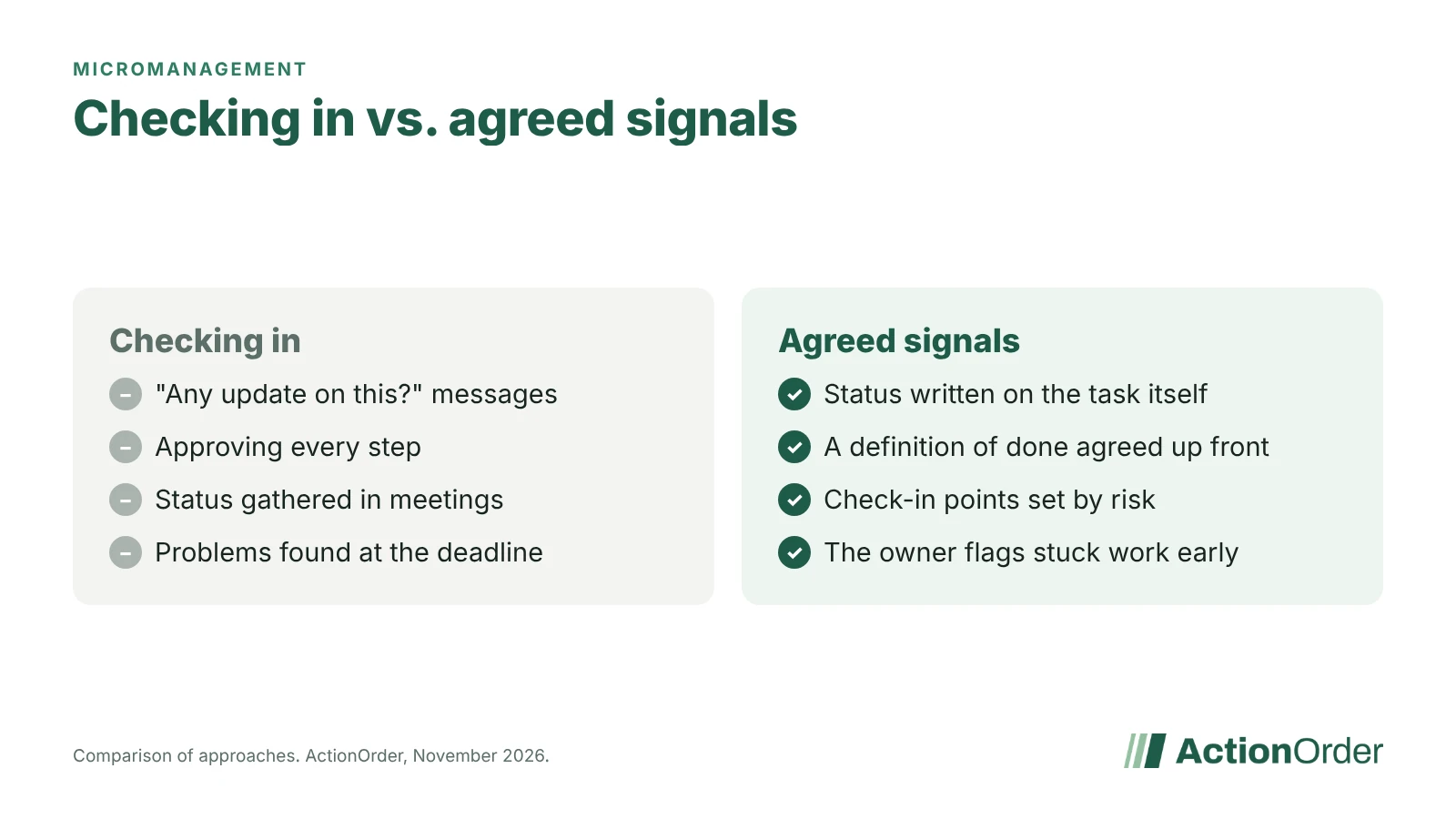
Control comes from the agreements, not from your attention. If the signals are clear, you'll know about a problem sooner than a daily check-in would tell you. For the routing habits that keep managers in the middle of every request, see stop being the router for your remote team.
What should you do instead of checking in?
Swap each checking habit for a signal the team agreed on. This table covers eight common checking habits.
| Instead of this | Do this |
|---|---|
| Asking "any update?" in a direct message | Read the status on the task, then ask only about what's missing |
| A daily status call | A written update where the work lives, plus a weekly recap |
| Approving every step | Agree check-in points by risk and approve only at those points |
| Rewriting work that met the brief | Give feedback against the definition of done, and let the owner revise |
| Being copied on every thread | Ask to be tagged only when a decision or a stuck item needs you |
| Assigning tasks with step-by-step instructions | State the outcome, constraints and deadline; ask for the plan back |
| Finding problems at the deadline | Make "stuck" a normal status the owner sets as soon as work stalls |
| Changing priorities in private messages | Keep one ranked list everyone can see, and change it there |
The right column takes more setup and less effort each week. It also gives people a reason to raise problems early, because the system asks for it.
How do you give a new remote hire autonomy?
Give a new hire autonomy in steps, per kind of work, with clear rules for moving up. A trust ladder makes the steps explicit so neither of you has to guess.
Use four levels:
Propose, then act. They suggest a plan and you agree it before work starts.
Act, then report at checkpoints. They own the steps and you review at agreed points.
Act, flag only exceptions. You hear when work is stuck or the plan changes.
Own the outcome. They decide and deliver, and you read the weekly recap.
Example: Alex, who manages a 9-person delivery team, hires Sam as a designer. For client presentations, Sam starts at level 1 for the first two projects. For internal design reviews, Sam starts at level 3 from week one, because the risk is low. After two client projects delivered on time with no surprises, Alex moves Sam to level 2 for client work and says so in writing.
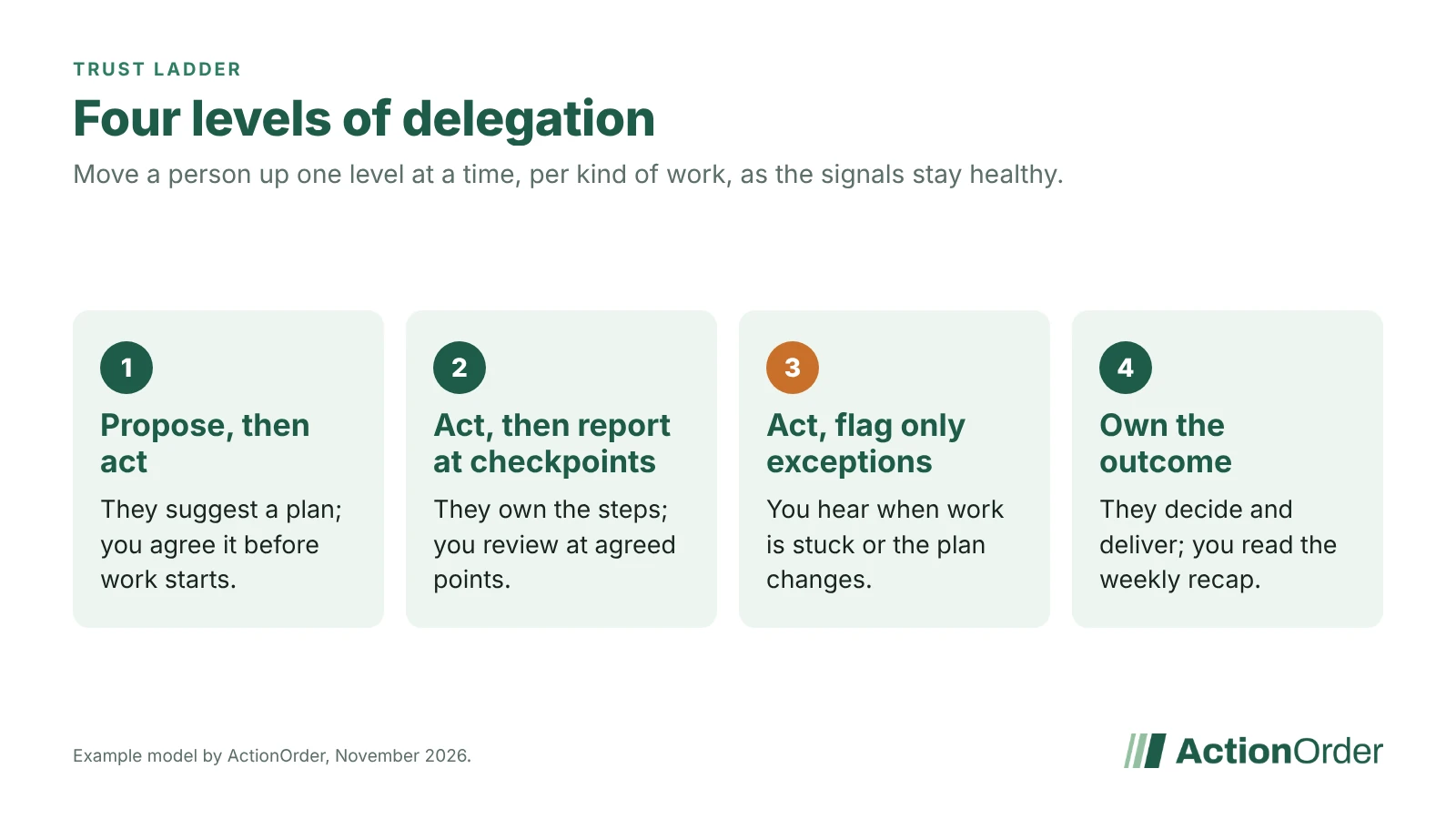
Write the level next to each kind of work and review it monthly. Moving up should be the default when the signals stay healthy, not a reward someone has to ask for. For handing work across time zones without losing context, see how to delegate across time zones.
What if the work really is late?
If the work really is late, have one direct conversation about the signals, not a new round of checking. Late work usually means the definition of done, the check-in points or the stuck signal failed, and you can fix each one.
Use this short script:
Name the gap. "The Northwind draft was due Tuesday and it isn't in review yet."
Ask what happened. "What got in the way?" Then listen.
Find the broken signal. Was done unclear, was the check-in too late, or was the work stuck without a flag?
Agree one change. "Let's add a check at the outline stage for client drafts."
Set the next checkpoint. Put the date on the task and read the status then.
If the same work slips again after the signals are fixed, move that kind of work down one level on the trust ladder for a set period. That keeps the response specific and temporary. It also avoids the slide back into checking everything.
How ActionOrder handles this
ActionOrder, an efficiency and accountability tool for managers of remote teams, is built to answer "where is this?" without asking. It reads the tools your team already uses and gives each person one clear next step at a time, already prepped. Every card has one owner and a status: done, in progress, waiting or stuck, and people set "stuck" themselves. When you delegate, you hand a card to a teammate with its prep and a note, and it comes back when it's done or handed back. On Pro, the team view shows each card's owner, status and how long it waited in the queue, plus a Friday recap of what moved, what's stuck and what needs you. Nothing runs in the background.
Join the waitlist. ActionOrder is in pre-launch.
Questions people ask
Is micromanagement ever necessary?
Short periods of close oversight can make sense for a new hire's first project, a high-risk client deadline or after a serious error. Set an end date and agree it with the person. Without an end date, close oversight becomes the default, and people stop making decisions you need them to make.
How do I know if I'm a micromanager or just detail-oriented?
Being detail-oriented means you care about the quality of the result. Micromanaging means you control how others reach it. If you rewrite work that met the agreed definition of done, or need to approve steps the owner could decide, the detail has become control. The five-question self-check above gives a quick answer.
How often should I check in with remote employees?
Set check-ins by risk, not by habit. Routine work needs one check at the end. New or high-stakes work needs a check at the draft or midpoint stage. Add a weekly one-to-one for the relationship and a written weekly recap for status. Daily check-ins usually signal that status isn't written down anywhere.
What do I say to an employee who feels micromanaged?
Thank them for saying so, then ask which specific habits feel like checking. Agree on the signals that would replace each one: a definition of done, check-in points and a stuck flag. Set a date two weeks out to review how it's going, and keep to the new agreement in the meantime.
Can remote work make micromanagement worse?
It can, because managers see less of the work and expectations blur at a distance. Gallup's data show remote and hybrid workers lost more clarity on what was expected of them than on-site workers between 2020 and 2023. Written status, agreed check-in points and a shared priority list close most of that gap.
Sources
- The Ultimate Guide to Micromanagers: Signs, Causes, SolutionsBen Wigert and Ryan Pendell, Gallup, July 17, 2020 (updated May 13, 2025)
- In New Workplace, U.S. Employee Engagement StagnatesJim Harter, Gallup, January 22, 2024
- U.S. Employee Engagement Below 30% for First Time in 15 YearsJim Harter, Gallup, October 28, 2026
- Hybrid Work Is Just Work. Are We Doing It Wrong?Microsoft WorkLab, Work Trend Index, September 22, 2022