Skip-Level Meeting Questions: 30 to Ask and How to Run Them Remotely
Thirty skip-level meeting questions grouped by purpose, what to avoid, and how to run the meeting across time zones while keeping the direct manager in the loop.
Skip-level meeting questions are what a senior manager asks the people who report to their managers, in a conversation that skips the layer in between. The best ones are open and about the work: what slows people down, what is unclear, and what leadership should change. They are never a review of anyone’s direct manager.

What is a skip-level meeting?
A skip-level meeting is a one-on-one or small-group conversation between a senior manager and the people who report to that manager’s direct reports. The manager in the middle is skipped for that one conversation. They are not cut out of the loop.
Paul Falcone, writing for SHRM, describes senior leaders holding meetings “where they have an opportunity to bypass their midlevel managers and speak directly with members of their extended (nonmanagerial) teams.” He notes the senior leader “can hold one-on-one meetings with the manager and supervisor and small group meetings with the rest of the team”. Yale’s IT department puts the purpose plainly in its guide to skip-level meetings: “One of the benefits of conducting skip-level meetings is to build trust within teams.”
On a remote team that works asynchronously, a senior manager rarely runs into people two levels down. Most of what reaches them is written and has passed through a lead first. A skip-level meeting lets them hear the work described by the person doing it, and spot problems no report shows, such as a handoff that always arrives half-finished.
Example: Taylor is head of support and operations, and Morgan, the support lead, reports to Taylor. When Taylor meets someone on Morgan’s team, that is a skip-level meeting. Morgan knows it is happening and why.
What are the best skip-level meeting questions?
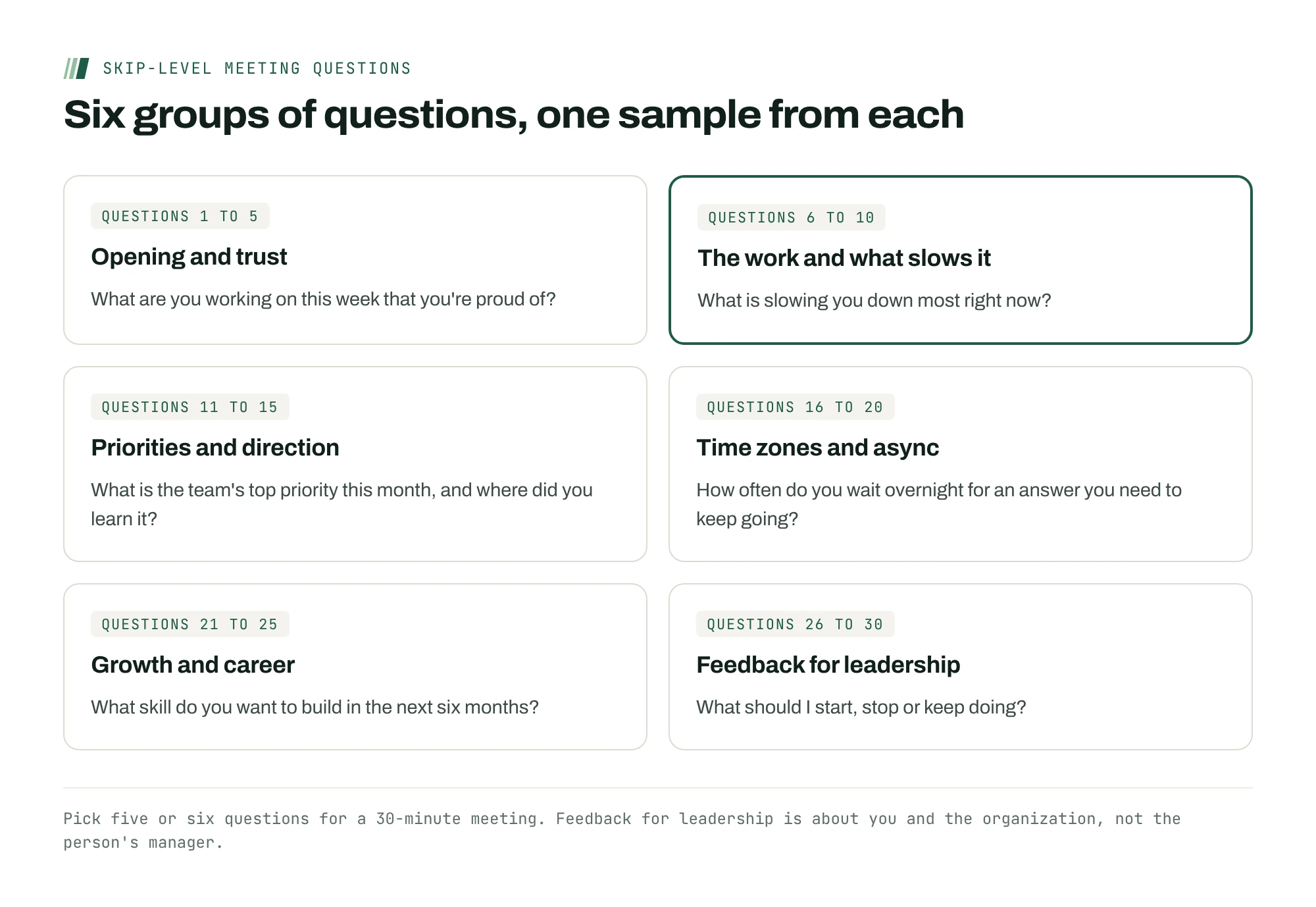
The best skip-level meeting questions are open, specific and about the work rather than about people, so they are easy to answer honestly in front of someone two levels up. Pick five or six for a 30-minute meeting. Running through all 30 turns a conversation into a survey.
The groups run from easy to harder. Open with the first group and save the last until trust is there.
Opening and trust
Use these in a first meeting, or with someone who has joined since the last round.
What are you working on this week that you’re proud of?
“What projects or initiatives at work have you most enjoyed working on (now or in the past)?” (from Yale’s question list)
What does a good week look like for you here?
What do you wish people further up knew about your job?
How would you like to hear from me between these meetings?
The work and what slows it down
Use these to find friction in the process, not fault in a person.
What is slowing you down most right now?
Where do you lose time each week that you think could be saved?
Which tool, step or approval would you remove if you could?
When you get stuck, how long does it usually take to get unstuck, and who helps?
What work do you end up redoing, and why?
Priorities and direction
Use these to check whether the team’s priorities reach the people doing the work.
What is the team’s top priority this month, and where did you learn it?
When two requests compete, how do you decide which comes first?
Which of your current tasks feels least connected to what the company is trying to do?
Is there a decision you’re waiting on from someone above your manager?
If you could change one priority for the team, which would it be?
Working across time zones and async
Use these on distributed teams, where handoffs and waiting cost more than they appear to.
How often do you wait overnight for an answer you need to keep going?
When work is handed to you from another time zone, what is usually missing?
Which written updates do you read, and which do you skip?
Do our overlap hours fall inside your working day, or do they land in your evening or early morning?
What would you change about how decisions get written down?
Growth and career
Use these once the person is comfortable, and pass what you learn to their manager with their permission.
What skill do you want to build in the next six months?
What work would you like more of, and what would you like less of?
Who outside your team would you like to learn from?
Is there a project you would want to lead if you had the chance?
What would make you want to still be here two years from now?
Feedback for leadership
Use these to hear about you and the organization. They are not questions about the person’s direct manager.
What should I start, stop or keep doing?
Which decision from leadership this year made the least sense to you?
Where do you hear about changes first, and is that the right place?
What is one thing that would make this a better place to work?
“How can I be of assistance to you/your team?” (from Yale’s question list)
Questions to ask your boss’s boss
If you are the employee, bring two or three questions of your own about direction and context.
What are the biggest priorities for the next quarter, and how does our team’s work fit into them?
What does good work from our team look like from where you sit?
What do you notice about people who grow here?
Is there something our team could do that would help with your goals?
What is changing in the company that we should prepare for?
Bring one specific blocker too, with a fix you would suggest. A problem with a proposed fix is easier to act on than a complaint.
What should you avoid in a skip-level meeting?
Avoid anything that turns the meeting into a review of the direct manager, a complaint about named colleagues or a status update. Each one damages the trust the meeting is meant to build.
Falcone acknowledges that “staff members may feel a bit uncomfortable sharing their feedback with their boss's boss.” The way to lower that discomfort is to keep the questions away from judging people.
If you are the senior manager, avoid:
Asking for a rating of the person’s manager (“How is your manager doing?”). Ask about the work and the process instead.
Promising a fix on the spot. Say when you will come back with an answer.
Making decisions that belong to the direct manager, such as changing someone’s priorities or assignments.
Repeating what one person said with their name attached.
Spending the time on status. If you need the meeting to learn where work stands, status isn’t written down anywhere.
If you are the employee, avoid:
Raising a problem about your team that you haven’t raised with your manager first.
Venting about named colleagues. Describe the pattern and its effect on the work.
How do you run a skip-level meeting remotely?
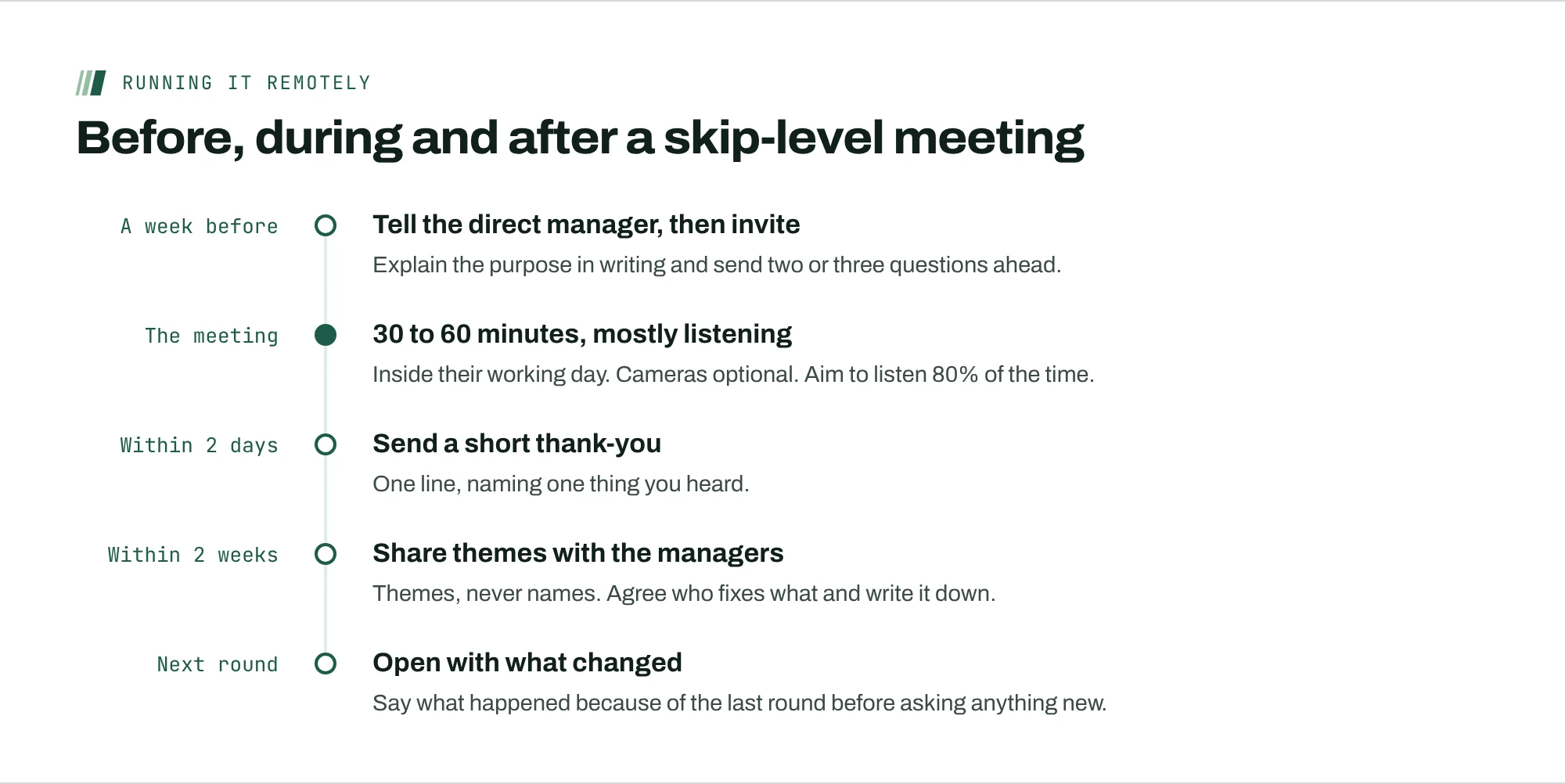
Run a remote skip-level meeting on video or by phone for 30 minutes to an hour, with its purpose and two or three questions sent a few days ahead. Hold it inside the other person’s working day, and offer a written option to anyone with little overlap.
Explain the purpose in writing first. Say why you are meeting, that it is not about anyone’s performance, and how notes will be used. Falcone’s advice: “It's best to be fully transparent about this”.
Send two or three questions ahead. People on async teams think in writing, so a day with the questions gets better answers than a cold start.
Pick a time in their day, not yours. A skip-level that lands at 9 p.m. for the other person tells them where they rank. Use the time zone overlap finder to see shared hours.
Keep it to 30 minutes to an hour. That is the range Yale’s invitation template sets aside. Make cameras optional.
Listen far more than you talk. Yale’s guide says: “Aim for an 80/20 listen-to-talk ratio.” Ask one follow-up question before moving on.
Take notes on themes, not quotes. Tell people what stays between you. Yale’s template tells staff “(confidentiality will be honored)”, and you have to mean it.
Offer a written version. Send the same questions as a short doc to anyone who prefers writing or has little overlap with you.
Small groups of three to five suit a first round on a large team. One-on-one meetings get more candid answers.
How often should you hold skip-level meetings?
Hold a skip-level meeting with each person at least once a year, and more often if the team is growing, changing or spread across many time zones. Yale’s guide sets the floor: “Skip-level meetings should be conducted at least once annually.” It adds: “Conducting skip-levels on a more frequent basis is at the manager’s discretion.” Falcone argues they “should be ongoing to ensure full transparency and access to senior management.”
A rolling schedule is easier to keep than a burst. Example: Taylor has 18 people across three leads. One or two meetings a week covers everyone about once a quarter, and a shared calendar means nobody feels singled out.
How do you keep the direct manager in the loop?
Tell the direct manager before the meetings start, explain what you will and won’t discuss, and bring the themes back to them first. Yale’s guide says: “Managers conducting skip-levels should share their intent with their direct reports for the skip level meetings.”
The bigger risk comes after, when problems start arriving at the wrong desk. Send them back: “Have you raised this with Morgan? Let’s get Morgan’s view first.” Otherwise you become the router for a team that isn’t yours. Our guide to getting out of the middle covers that trap, and how to stop micromanaging covers the habit of reaching past a lead to fix things yourself.
What should happen after a skip-level meeting?
After a skip-level meeting, thank the person within two days, share themes (never names) with the managers within two weeks, and say at the next round what changed. Yale’s guide tells managers to “check in with your direct reports to share and discuss the themes (remember confidentiality)”.
Thank them in writing. One line, naming one thing you heard.
Group what you heard into themes. Three people describing slow approvals is a theme. One person’s frustration with a colleague is not, and it stays with you.
Agree on owners with the managers. Decide who fixes what, and write it down. A decision log keeps the answer findable.
Close the loop. At the next round, open with what changed because of the last one.
Skip-level meetings add to regular one-on-ones with each person’s own manager; they don’t replace them. The one-on-one meeting agenda template covers those. For the wider habits, see how to manage a remote team without chasing it and chapter 6 of the playbook, Hold the team accountable without watching it.
How ActionOrder handles this
Skip-level meetings go better when nobody needs them for status. In ActionOrder, an efficiency and accountability tool for managers of remote teams, every card has one owner and a status: done, in progress, waiting or stuck. People set “stuck” themselves. The team view, on Pro, shows each card’s owner and status, queue time, how long a priority has sat at the top, and a Friday recap. It never shows screens, keystrokes, clicks or a ranking of people. With status already written down, a skip-level meeting can stay on people, blockers and direction. Join the waitlist. ActionOrder is in pre-launch.
Questions people ask
What is a skip-level meeting?
A skip-level meeting is a conversation between a senior manager and someone who reports to one of that manager’s direct reports, without the manager in between. It can be one-on-one or a small group, and its purpose is to listen, build trust and spot problems early.
What are good questions to ask my boss’s boss in a skip-level meeting?
Ask about direction and context: the biggest priorities for the next quarter and how your team’s work fits, what good work from your team looks like from their seat, and what is changing that you should prepare for. Bring one specific blocker with a suggested fix.
What should you not say in a skip-level meeting?
Don’t complain about your manager or named colleagues, and don’t raise anything you haven’t raised with your manager first. Describe patterns and their effect on the work instead of blaming people. Saying everything is fine when it isn’t also wastes the meeting.
How do you prepare for a skip-level meeting as an employee?
Read any questions sent ahead and note one or two answers for each. Pick one blocker that slows your work and a fix you would suggest. Prepare two or three questions about priorities and direction. If the time falls outside your working day, ask for another slot or a written option.
Is a skip-level meeting a bad sign?
Usually not. Skip-level meetings are a routine way for senior managers to build trust and hear about problems early; Yale’s IT department, for one, asks managers to hold them at least once a year. A well-run one is announced to the whole team and has nothing to do with performance. If you are unsure why you were invited, ask what it is for.
Sources
- Engaging With Our Teams Through Skip-Level MeetingsIT at Yale, Yale University, no date shown, checked November 22, 2026
- Why Senior Managers Should Hold Skip-Level MeetingsPaul Falcone, SHRM (a membership association that sells HR training and certification), May 31, 2018