Levels of Delegation: A Delegation Matrix for Remote Managers
Levels of delegation tell people how much of a decision is theirs. Use the five-level matrix with async examples, and write the level into every handoff.
Levels of delegation are named steps that say how much of a decision you hand to someone, from following your exact instructions to owning the outcome outright. On a remote team, stating the level in writing with each task tells people when to act on their own and when to check in, without waiting a day for a reply.

What are the levels of delegation?
Levels of delegation are a shared scale for how much authority goes with a piece of work. Each level answers two questions: who makes the call, and when does the manager hear about it?
Without a named level, people guess. One waits for an approval you never meant to require; another makes a call you wanted to see first. On a remote team, each wrong guess costs a round trip across time zones.
The fix is a word, not a meeting. When you hand over work, say which level it is. An article in ATD’s Talent Development Leader sums up the shift a manager has to make: “I'm not sharing tasks. I'm transferring ownership.” The level tells the other person how much ownership is moving.
Delegation also shows up in research on company leaders. In a 2014 Gallup study of 143 CEOs on the Inc. 500 list, reported in the Gallup Business Journal, CEOs with high “Delegator talent” had an average three-year growth rate of 1,751%, “112 percentage points greater” than CEOs with limited or low Delegator talent. Gallup sells the assessment it used, and the study shows an association, not proof that delegating caused the growth. More figures on how remote teams work are on our research page.
What are the five levels of delegation?
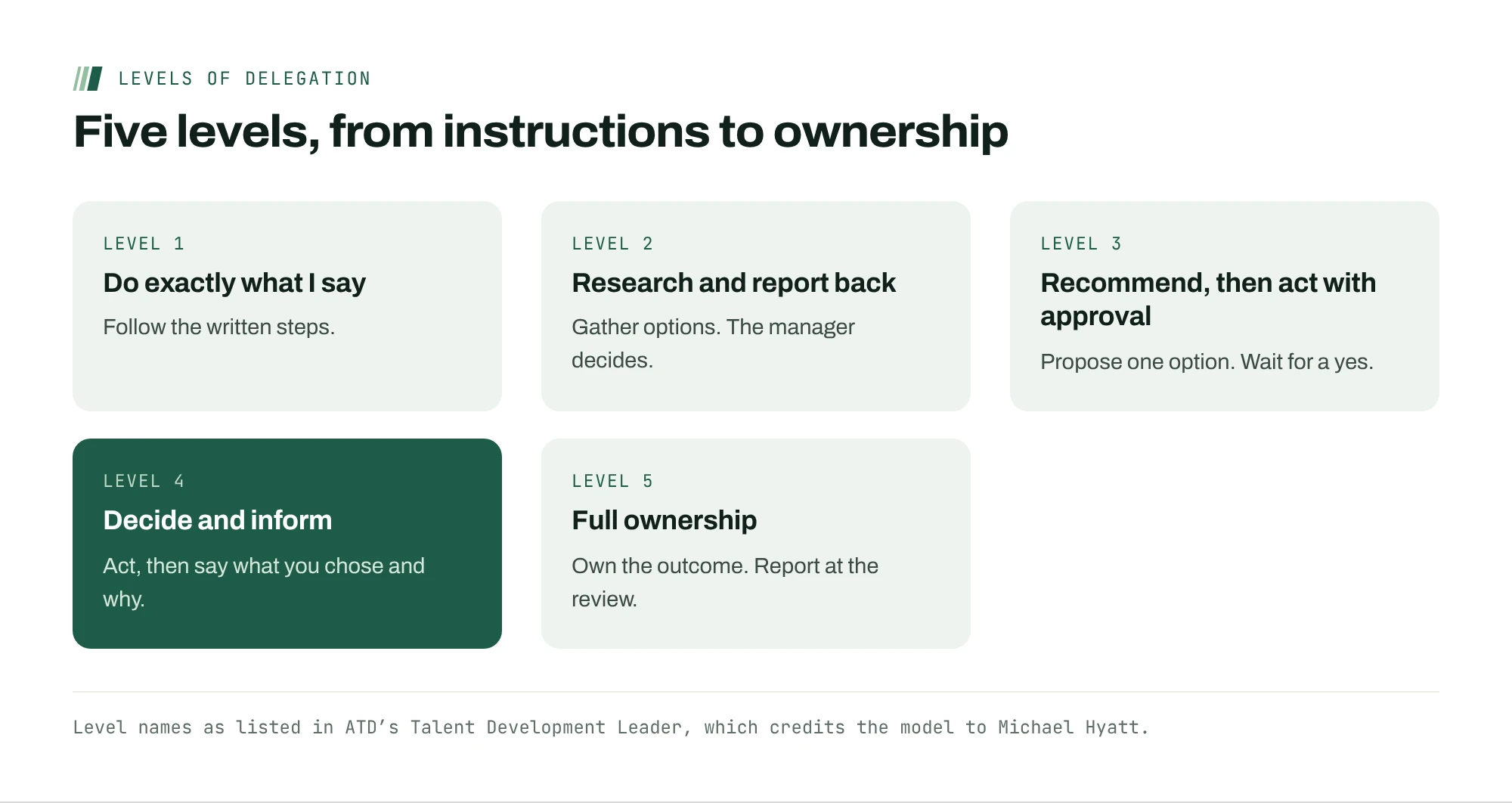
The five levels of delegation run from following instructions to full ownership. ATD’s Talent Development Leader says the model was “Developed by Michael Hyatt in his book Free to Focus” and lists the levels this way:
Level 1: Do exactly what I say. The person follows your steps as written.
Level 2: Research and report back. The person gathers facts and options. You make the call.
Level 3: Recommend, then act with approval. The person proposes one option with reasons and waits for your yes before acting.
Level 4: Decide and inform. The person decides and acts, then tells you what they chose and why.
Level 5: Full ownership. The person owns the outcome. You hear about it at the regular review, not call by call.
The top level depends on the person as much as the task. The same article says of level five: “This level of delegation is only suitable for tasks that the team member is highly skilled at.”
Most remote work sits at levels 3 and 4. Level 3 is safe but slow across time zones, because every approval waits for your morning. Level 4 keeps work moving: the person acts, and you read the decision when you come online.
What are the seven levels of delegation?
The seven levels of delegation are Jurgen Appelo’s model: Tell, Sell, Consult, Agree, Advise, Inquire and Delegate. They run from the manager deciding alone to the team deciding without reporting back.
| Level | Who decides | In plain terms |
|---|---|---|
| 1. Tell | The manager | You decide and may explain why. |
| 2. Sell | The manager | You decide, then try to win people over. |
| 3. Consult | The manager, after input | You ask for input first, then decide. |
| 4. Agree | Everyone together | The group reaches consensus. |
| 5. Advise | The team | You give your opinion; they decide. |
| 6. Inquire | The team | They decide, then explain it to you. |
| 7. Delegate | The team | They decide, and you don’t need the details. |
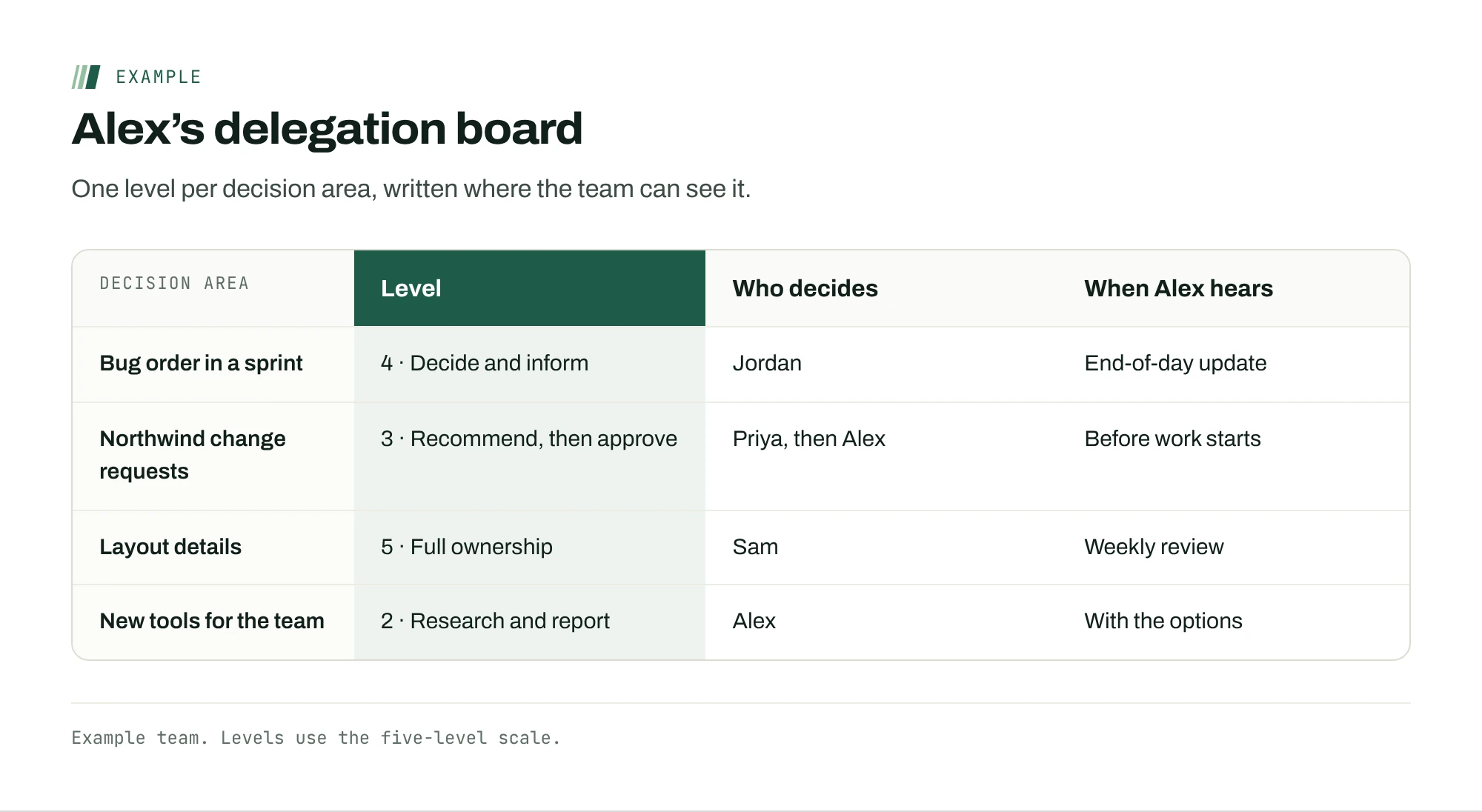
In his article on the model, Appelo is clear about where it belongs: “The seven levels of delegation should not be applied to individual tasks and deliverables.” He adds: “Instead, they should be applied to key decision areas.” On a delivery team, decision areas might be the order of bugs in a sprint, how releases are scheduled, which tools the team adopts, or how a client’s change request gets accepted.
Two practices come with the model. A delegation board puts decision areas and levels on one grid. Management 3.0, which sells workshops and cards for the method, describes it “With Key Decision Areas on the Vertical and the seven levels of delegation on the horizontal axis”. Delegation poker is how a team fills the board in. In its write-up, “Each player chose one of the seven delegation cards privately”, and then “The players with the highest and lowest cards explained the reasoning behind their selection.”
The point is the conversation: a gap between the manager’s card and the team’s shows a mismatch before it shows up in the work. A remote team can play the round in writing. Everyone posts a level in a thread before reading the others, then the highest and lowest explain.
The delegation matrix: five levels with async examples
A delegation matrix sets each level beside what the person does, when they report back and when to use it. Copy the table into your team’s working agreement so everyone reads the levels the same way.
| Level | What the person does | When they report back | Async example | Use it when |
|---|---|---|---|---|
| 1. Do exactly what I say | Follows the written steps; asks before changing anything | When it’s done | Example: Jordan runs the release checklist for Northwind as written and posts “done” with a link to the completed list. | The steps carry risk or a client requirement, or the person is new to the work |
| 2. Research and report back | Gathers facts and options; makes no choice | With the findings, by an agreed time | Example: Priya collects three ways to meet Northwind’s reporting request and posts them, with pros and cons, before Alex’s morning. | You need the facts, but the call stays with you |
| 3. Recommend, then act with approval | Proposes one option with reasons; waits for a yes | Before acting | Example: Sam recommends a layout for a new dashboard, with mockups, and starts building once Alex approves in the thread. | A wrong call is costly to undo and you want to check the reasoning |
| 4. Decide and inform | Decides and acts, then says what was decided and why | After acting, in that day’s update | Example: Jordan decides which two bugs to hold back from Friday’s release and posts the list and the reason in the end-of-day update. | The person knows the work and a wrong call can be fixed |
| 5. Full ownership | Owns the outcome and every call along the way | At the regular review, such as the weekly update | Example: Priya owns the weekly Northwind status report. Alex reads it when the rest of the team does. | The person is highly skilled at the work and it’s routine for them |
A delegation note to paste into any task
The matrix only works if the level travels with the work. Put five parts at the top of the task:
Outcome: what done looks like, in one sentence.
Level: the number and its name, such as “Level 4: decide and inform”.
Deadline: a day and time in the other person’s time zone.
Check-in point: when you want to hear from them before the deadline, or “none”.
Who to ask: the person to go to if they’re stuck while you’re offline.
Example: “Outcome: Northwind’s monthly report drafted and ready for Priya to review. Level 4: decide and inform. Due Thursday, 5:00 p.m. Sam’s time. Check in Wednesday with a first draft. If stuck, ask Jordan.”
For decisions that recur, record the level once in a decision log.
How do you choose the right level of delegation?
Choose the level from two things: how well the person knows this kind of work, and how costly a wrong call would be. Appelo puts it briefly: “Finding the right level of delegation is a balancing act.” He goes on: “It depends on a team's maturity level and the impact of its decisions.”
New to the work, costly to undo: level 1 or 2.
Knows the work, costly to undo: level 3.
Knows the work, easy to fix: level 4.
Has done it many times, routine: level 5.
Time zones add a third factor. With an hour of shared working time, every level 3 approval can cost a full day. Consider level 4 with firmer limits instead: a budget, a few things not to change, and a line in the day’s update. The time zone overlap finder shows how many hours you share.
How to delegate tasks across time zones
To delegate tasks across time zones, put everything the person needs into one written handoff, including the level. They should be able to finish without waiting for you to wake up.
Describe the outcome, not the steps. Give steps only at level 1. Gallup’s article describes the opposite habit: “Non-Delegators micromanage and fail to set clear expectations, leaving employees confused and frustrated in their work.”
State the level in writing. Use the delegation note above, so the level is in the task and not in your head.
Attach the context. Links, past decisions and the client’s own words. The handover document template and the project handoff template list what to include.
Set a check-in point inside their working day. Your 9:00 a.m. may be their evening.
Name who to ask while you’re offline. A second person with the context saves a day of waiting.
For a full walkthrough, read How to Delegate Across Time Zones Without Losing Context. If every question still lands on you, Stop Being the Router for Your Remote Team shows how to move them elsewhere.
How do you move someone up a level?
Move someone up one level at a time, after they’ve handled the current level well several times. Put the change in writing, so the new limits are clear.
The ATD article gives a simple rule for the transition: “One rule is to check in more frequently early on, and then taper off as confidence and capability increase.” In practice:
Watch for the signal. At level 3, their recommendations keep matching what you would have chosen. Offer level 4.
Raise one kind of work at a time. Sam might move up to level 5 on layout details while client-facing copy stays at level 3.
Keep the review inside the work. At level 4, read their updates instead of adding a meeting.
Step down without drama. If a call goes wrong, drop one level for that kind of work, say why, and set a date to try again.
If you keep rechecking work you’ve handed over, How to Stop Micromanaging a Remote Team has a trust ladder for new hires. Chapter 4 of the playbook, Hand off work, and get out of the middle, covers decision limits in writing. For the wider system, start with how to manage a remote team without chasing it.
How ActionOrder handles this
ActionOrder, an efficiency and accountability tool for managers of remote teams, gives each person one clear next step at a time, already prepped with context, analysis, research and a first draft. Delegation hands a card to a teammate with its prep and a note, so the context and your delegation note travel with the work. The card comes back when it’s done or handed back. Every card has one owner and a status: done, in progress, waiting or stuck, and people set “stuck” themselves. On Pro, the team view shows each card’s owner and status, so you can see who has the work without asking. Join the waitlist. ActionOrder is in pre-launch.
Questions people ask
What are the 7 levels of delegation?
The seven levels of delegation are Jurgen Appelo’s model: Tell, Sell, Consult, Agree, Advise, Inquire and Delegate. They run from the manager deciding alone to the team deciding without reporting back. Appelo applies them to key decision areas, such as release scheduling, rather than to single tasks.
What are the five levels of delegation?
The five levels are: do exactly what I say; research and report back; recommend, then act with approval; decide and inform; and full ownership. ATD credits the model to Michael Hyatt’s book Free to Focus. The higher the level, the less often the person checks in.
What are the four levels of delegation?
There is no single four-level standard. The models cited most often have five levels and seven, and shorter scales merge neighboring steps, such as research and recommend. The count matters less than the habit: name the level each time you hand over work.
What are the six levels of delegation?
A six-level scale is another variation on the same idea, splitting or merging steps between “follow my instructions” and “it’s yours”. No count is official. Pick one scale, write it into your team’s working agreement, and use the same words in every handoff.
What is a delegation matrix?
A delegation matrix is a table that sets each level of delegation beside what the person does, when they report back and when to use it. Some teams add a grid of decision areas with the level for each. Either way, an unspoken expectation becomes something anyone can check before acting.
Sources
- How to Delegate Outcomes, Not TasksTalent Development Leader, ATD (Association for Talent Development), August 10, 2026
- The 7 Levels of DelegationJurgen Appelo, Medium, February 25, 2015
- How to make the Delegation Board work for your teamSarika Kharbanda, Management 3.0 (sells workshops and Delegation Poker cards), April 5, 2017
- Delegating: A Huge Management Challenge for EntrepreneursSangeeta Bharadwaj Badal and Bryant Ott, Gallup Business Journal, April 14, 2015 (Gallup sells the assessment used in the study)