Results-only work environment (ROWE): what it is and how it works remotely
What a results-only work environment is, who created it, what research at Best Buy found, and how to run one on a remote async team.
Results-only work environment, or ROWE, is a way of managing in which people are measured only by the results they deliver and choose when, where and how they work, as long as agreed outcomes are met.
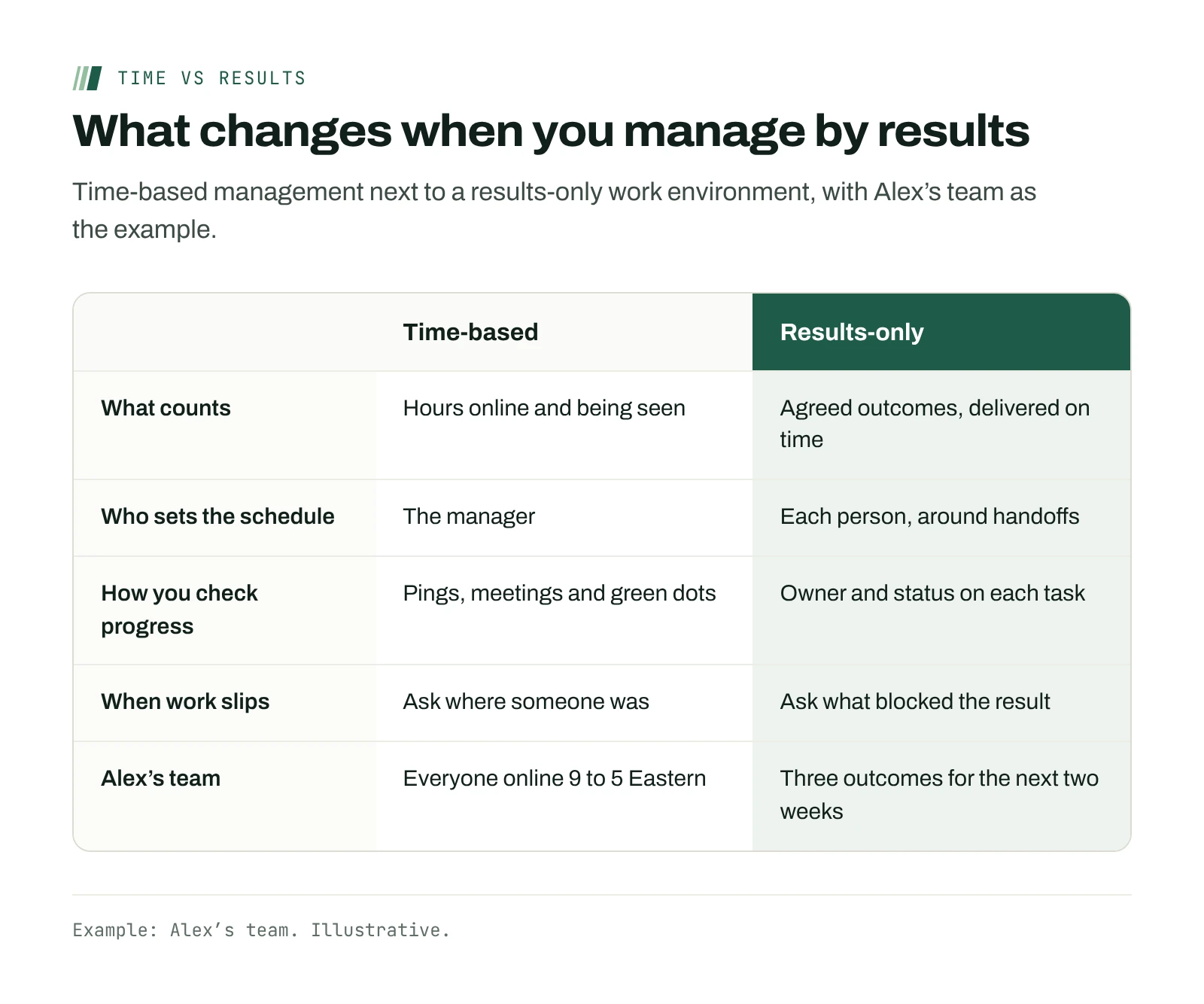
In a ROWE, hours, attendance and visible effort stop counting. People agree on measurable outcomes and deadlines, and the manager sets goals and checks results. It isn’t flexibility without accountability: when a result slips, the conversation is about the work, not where or when it was done. It also goes further than flextime, which changes when people work but still counts the hours.
Where the term comes from
ROWE dates to the early 2000s. Jody Thompson’s biography on GoROWE says that “In 2003 Thompson co-created the Results-Only Work Environment™ (ROWE™) system” and that she founded CultureRx, a professional services firm, with Cali Ressler. The publisher’s page for their book, Why Work Sucks and How to Fix It, says they implemented it at Best Buy and sums up the idea: “employees can do whatever they want whenever they want, as long as the work gets done.”
According to the University of Minnesota’s Flexible Work and Well-Being Center, “In 2006, Dr. Moen and Dr. Kelly partnered with Best Buy and CultureRx” to study ROWE. In a 2011 paper in Social Problems, Phyllis Moen, Erin Kelly and Rachelle Hill described ROWE as a move “to focus on results rather than time spent at work” and reported that “the odds of turnover are indeed lower for employees participating in the ROWE initiative,” regardless of gender, age or family life stage.
How a ROWE works on a remote async team
A remote team across time zones is halfway to a ROWE already: you can’t see anyone work, so hours are a weak signal anyway. The hard half is making results specific enough to judge.
Write outcomes, not hours: For each piece of work, agree what done looks like, who owns it and by when. “Ship the Northwind export with tests passing by Thursday” can be judged. “Work on the export” can’t.
Size outcomes to real hours: A ROWE breaks down when outcomes need more time than people have. Capacity planning tells you what fits.
Let status come from the work: Ask people to mark each task done, in progress, waiting or stuck, so you can stop chasing status updates.
Keep only the time rules handoffs need: If two people must overlap, agree on core hours for that and drop the rest.
Treat misses as work problems: Ask what blocked the result, not where the person was. See how to stop micromanaging.
Example: Alex drops the 9-to-5 rule
Example: Northwind complains about slow fixes, and Alex’s first instinct is to require everyone online from 9 to 5 Eastern. Instead, Alex writes three outcomes for the next two weeks: Sam delivers the new onboarding screens by Wednesday, Jordan finishes the export test pass by Friday, and Priya sends Northwind a written update every Monday. Hours and locations are left to each person. Jordan, who likes early starts, finishes testing before Sam’s day begins, and Sam picks up the review notes without a meeting. At the retrospective, the team judges the two weeks by those three outcomes, not by who was online.
Related terms
Presenteeism: being present without being productive, the habit a ROWE stops rewarding.
Directly responsible individual: one named owner per outcome, which a ROWE depends on.
Accountability without surveillance: holding people to results without watching activity.
How to manage a remote team: the wider routine a ROWE fits into.
Where ActionOrder fits
ActionOrder, an efficiency and accountability tool for managers of remote teams, supports managing by results by taking status from the work. Every card has one owner and a status: done, in progress, waiting or stuck. The team view, on Pro, shows each card’s owner and status, how long a priority has sat at the top, and a Friday recap. It never shows screens, keystrokes or app activity. Nothing runs in the background.
Join the waitlist. ActionOrder is in pre-launch.
Sources
- Jody’s StoryGoROWE, checked November 22, 2026
- Why Work Sucks and How to Fix ItCali Ressler and Jody Thompson, Portfolio, Penguin Random House, 2008
- Flexible Work and Well-Being Study: publicationsFlexible Work and Well-Being Center, University of Minnesota, checked November 22, 2026
- Does Enhancing Work-Time Control and Flexibility Reduce Turnover? A Naturally Occurring ExperimentPhyllis Moen, Erin L. Kelly and Rachelle Hill, Social Problems, 2011 (Minnesota Population Center record)