Time Estimation: Techniques That Get Closer to Actuals
Time estimation gets closer to actuals when you pick a technique that fits the work, give a range and check it against what similar work really took. Eight techniques compared, with a worked PERT example.
Time estimation is predicting how long a task or project will take before the work starts, best given as a range rather than one number. The main techniques are expert judgment, analogous, parametric, three-point (PERT), bottom-up, group estimating, relative sizing and reference class forecasting. Each gets closer when you check it against actual time on similar work.
What is time estimation?
Time estimation is predicting how long work will take before you start it, in hours of effort or in calendar days. Those are different numbers. Effort is the hours someone spends on the work. Duration runs from start to finish and includes waiting for a review, a client or a teammate in another time zone. Estimate the effort first, then add the waiting you expect.
Expect early estimates to be rough. Construx, which sells software development training and consulting, describes the cone of uncertainty in software projects: "Estimates created at Initial Concept time can be inaccurate by a factor of 4x on the high side or 4x on the low side." Its point applies to any team: "The only way to reduce the variability in the estimate is to reduce the variability in the project itself."
How do you estimate time for a task?
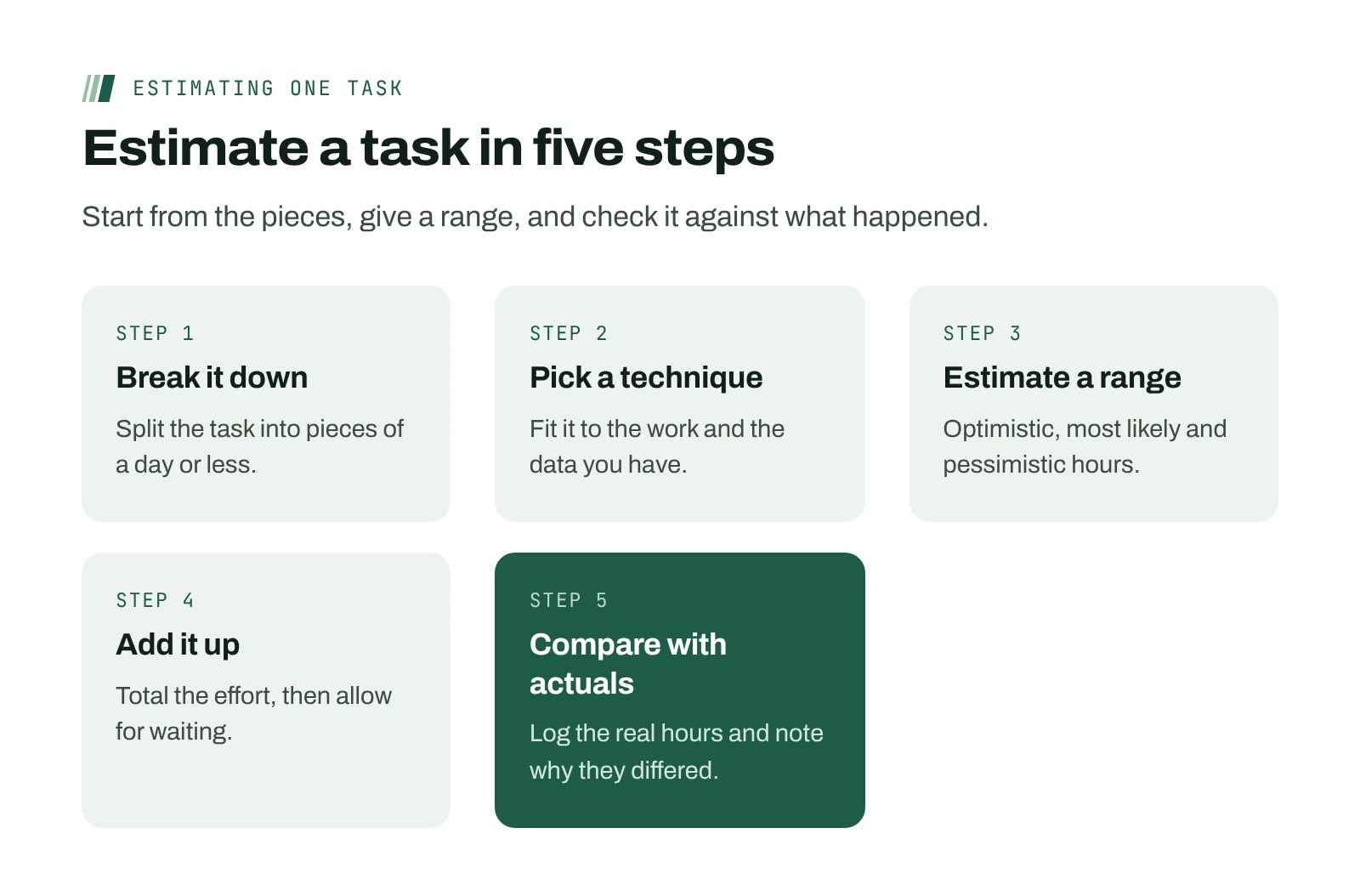
To estimate time for a task, break it into pieces, pick a technique, estimate each piece as a range, add them up, and compare the result with actual time when the work is done.
Break it down. Split the work into pieces of a day or less, and write down what "done" includes, such as review.
Pick a technique. Use the table below.
Estimate a range. Optimistic, most likely and pessimistic hours, set by the person doing the work.
Add it up. Total the effort. For a finish date, allow for pieces that wait on each other.
Compare with actuals. Log the real hours on the task and note why they differed. Our time audit guide shows a one-week version of the habit.
What are the main project estimation techniques?
The main project estimation techniques are expert judgment, analogous, parametric, three-point, bottom-up, group estimating, relative sizing and reference class forecasting. They differ in what they start from and what they need.
| Technique | How it works | Best for | What you need | Time it takes | Main weakness |
|---|---|---|---|---|---|
| Expert judgment | Someone who has done the work gives a number from experience. | Small, familiar tasks | One experienced person | Minutes | Optimistic memory, and no record of where the number came from. |
| Analogous (top-down) | Adjust one similar past job's actual time for differences. | Early quotes, before a breakdown exists | One comparable finished job | Minutes | One data point. If that job was unusual, so is the estimate. |
| Parametric | Multiply a count by a rate from past work: screens × hours per screen. | Repeatable work with a countable unit | A reliable rate per unit | Minutes, once the rate exists | Only as good as the rate. Breaks when the work changes. |
| Three-point, triangular | Estimate optimistic (O), most likely (M) and pessimistic (P); average them: (O + M + P) / 3. | Quick ranges for uncertain tasks | Three numbers from the person doing the work | Minutes per task | Pessimistic cases are often not pessimistic enough. |
| Three-point, PERT | Weight the most likely case four times: (O + 4M + P) / 6. Spread: (P − O) / 6. | A planning number plus a spread | The same three numbers | Minutes per task | Same inputs problem; assumes a shape the work may not follow. |
| Bottom-up (work breakdown) | Estimate every listed piece of work and add them up. | Projects whose steps you can list | A task list in pieces of a day or less | Hours per project | Slow; misses unlisted work like review, rework and waiting. |
| Wideband Delphi and planning poker | People estimate privately, reveal together, discuss gaps, estimate again. | Unclear items where knowledge is spread out | Three or more people who know the work | Minutes per item, per person | Costs the most attention; a group can share a blind spot. |
| Relative sizing (story points, t-shirt sizes) | Size items against each other, then convert size to time from past cycles. | Ranking and planning a long backlog | A reference item and a few cycles of history | Fast, once calibrated | Sizes aren't hours and differ by team. T-shirt sizes can't be added up. |
| Reference class forecasting (your own history) | Place this task among similar finished tasks and how long they really took. | Recurring work, and checking any other estimate | Logged actual time on similar tasks | Minutes, once the data exists | Needs clean history. New kinds of work have none. |
The GAO Cost Estimating and Assessment Guide, written for cost but using the same methods, says an analogy "relies on a single data point", an engineering build-up from the work breakdown "can be expensive to implement and it is time consuming", and expert opinion alone "is not very accurate or valid as a primary estimating method." Wideband Delphi (Boehm, 1981) "encouraged discussion among participants", according to a paper by MIT's Ricardo Valerdi. Mountain Goat Software, which sells agile training and coaching, describes planning poker: "Each estimator chooses a card privately. Everyone reveals at the same time." Of t-shirt sizes, it warns: "They aren't additive."
Which time estimation technique should you use?
Use the lightest technique that fits how uncertain the work is, and check it against history whenever history exists.
A small, familiar task: expert judgment, checked against the actual.
An early quote: analogous, as a wide range you narrow as questions get answered.
Repeatable work you can count: parametric, with the rate kept current from logged time.
One task with real uncertainty: three-point. Plan with the PERT number and share the spread.
A project with many parts: bottom-up, with three-point on the uncertain pieces.
Knowledge spread across people: planning poker. On an async team, collect estimates privately, post them together in one thread, and ask the highest and lowest to explain.
A backlog to rank: relative sizing. Effort then feeds your task prioritization.
Work your team does often: reference class forecasting from your own logged time. Better estimates from your team's own logged time is the deep dive.
How do you calculate a three-point (PERT) estimate?
To calculate a three-point estimate, take optimistic (O), most likely (M) and pessimistic (P) times, then use (O + 4M + P) / 6 for PERT or (O + M + P) / 3 for the triangular average.
An open project management textbook explains the weights: in the triangular version "all three duration estimates get the same weight", while "In a beta distribution, the realistic estimate gets four-sixths of the weight." Course notes from India's NPTEL program give the standard deviation as (b − a) / 6, with a the optimistic and b the pessimistic time.
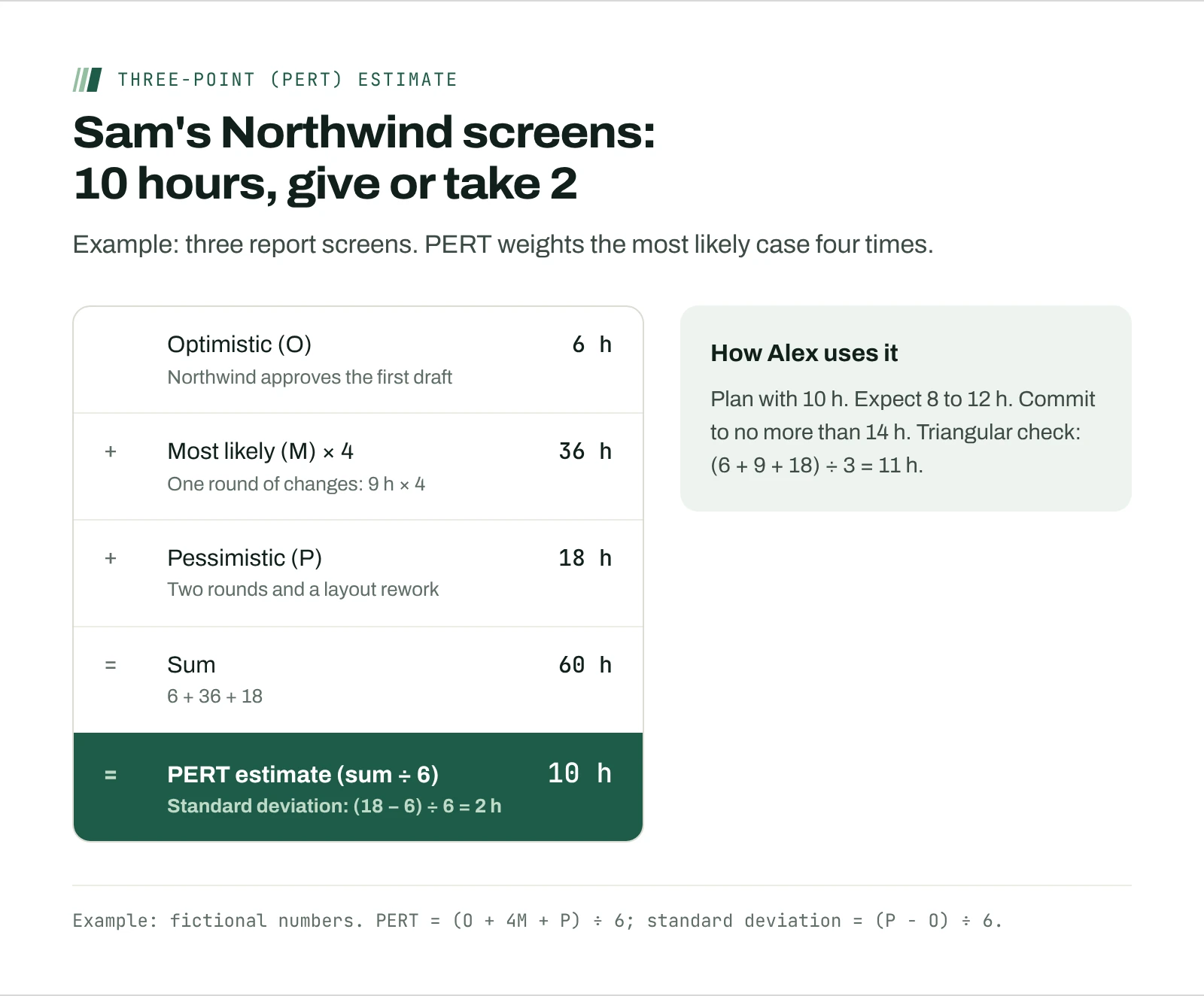
Example: Sam, the designer on Alex's 9-person delivery team, estimates three report screens for Northwind: 6 hours if the first draft is approved, 9 most likely (one round of changes), and 18 if there are two rounds and a layout rework.
PERT: (6 + 4 × 9 + 18) / 6 = 60 / 6 = 10 hours.
Triangular: (6 + 9 + 18) / 3 = 33 / 3 = 11 hours.
Standard deviation: (18 − 6) / 6 = 2 hours.
Both results sit above 9 because the bad case is 9 hours past M and the good case only 3 short. Alex plans with 10 hours, expects 8 to 12 (one standard deviation either side) and lets Priya, the account lead, commit to no more than 14 hours, two standard deviations above. The screens take 13 hours after a second round of changes: over the plan, inside the commitment. Sam notes why on the task, so the next estimate starts there.
Why do time estimates usually run short?
Estimates run short because people picture how the work should go, not how similar work went. Buehler, Griffin and Ross (1994) describe this planning fallacy as "The tendency to hold a confident belief that one's own project will proceed as planned, even while knowing that the vast majority of similar projects have run late", a term they credit to Kahneman and Tversky (1979).
In their second study, 104 undergraduate psychology students predicted when they would finish everyday school and home tasks. School projects took 10.7 days on average against 5.8 predicted; other tasks took 9.2 against 5.0. "Subjects finished 37.1% of the academic projects and 42.5% of the nonacademic projects within the predicted time." More figures like these are on our research page.
In a fourth study, the bias disappeared when participants were told to connect relevant past experiences with their predictions. Bent Flyvbjerg's paper for the Project Management Institute calls this the outside view, built from actual outcomes of similar projects, "while conventional forecasting takes an inside view." Your team's outside view is its own logged time. Our article on the planning fallacy covers the research and a simple way to correct for it.
How should a remote team share and check estimates?
On a remote team, write each estimate on the task as a range, let the person doing the work set it, and compare it with logged time when the task closes.
The owner estimates. The GAO Schedule Assessment Guide says: "Activity owners should be responsible for estimating durations for their activities." Question a number; don't overwrite it.
Show the range instead of padding. GAO says estimates made under most likely conditions "do not contain padding or margin for risk"; risk margin goes in separate contingency. A visible range does that job for a task.
Put estimate against actual in the status. Our weekly status report template has room for it, and Stop Chasing Status Updates covers when to flag an overrun. Chapter 3 of the playbook, Make status come from the work, explains the habit.
Add up estimates before you commit the week. The capacity planning template does the sum.
Compare kinds of work, not people. Once accuracy is used to rank people, estimates get padded and logs stop being true. More in our guide to managing a remote team.
How ActionOrder handles this
ActionOrder, an efficiency and accountability tool for managers of remote teams, gives each person one clear next step at a time, already prepped. Estimates are suggested from logged time on similar cards, and the person or manager can change them. People log their own time against the card they're working and can correct it; time logging is on Pro and Business. On Pro, the team view shows each card's owner and status with logged time against estimate, never a ranking of people. Nothing runs in the background. Join the waitlist. ActionOrder is in pre-launch.
Questions people ask
What is a time estimate?
A time estimate is a prediction of how long work will take, made before it starts. It can be effort, the hours someone spends, or duration, the calendar time including waiting. Good estimates are ranges, set by the person doing the work.
What are three methods of estimation?
Three common methods are analogous estimating, which adjusts the actual time of a similar past job; parametric estimating, which multiplies a unit count by a rate from past work; and three-point estimating, which combines optimistic, most likely and pessimistic cases.
How do you estimate time for a task?
Break the task into pieces of a day or less, estimate each as optimistic, most likely and pessimistic hours, and add them up. Check the total against how long similar tasks took. Afterwards, log the actual time and note why it differed.
What is the time estimation formula?
The most common is the PERT formula: (O + 4M + P) / 6, where O is optimistic, M most likely and P pessimistic. The triangular version is (O + M + P) / 3. The PERT standard deviation is (P − O) / 6, so 6, 9 and 18 hours give 10, give or take 2.
What is the easiest way to calculate time?
To calculate how long something took, subtract the start time from the end time and convert minutes to hours: 90 minutes is 1.5 hours. To estimate how long something will take, start from how long a similar task took last time, then adjust.
Sources
- Exploring the “Planning Fallacy”: Why People Underestimate Their Task Completion TimesRoger Buehler, Dale Griffin and Michael Ross, Journal of Personality and Social Psychology, vol. 67, no. 3, 1994
- From Nobel Prize to project management: getting risks rightBent Flyvbjerg, PMI Research Conference paper, Project Management Institute, July 19, 2006
- Cost Estimating MethodsU.S. Government Accountability Office, Cost Estimating and Assessment Guide (GAO-20-195G), no date shown, checked November 22, 2026
- Estimating DurationsU.S. Government Accountability Office, Schedule Assessment Guide (GAO-16-89G), no date shown, checked November 22, 2026
- 3.4: Estimating Activity DurationsTerri Brown, Northeast Wisconsin Technical College, Business LibreTexts (open textbook), last modified November 20, 2025
- Module 2: Project Planning, PERT Time EstimatesS. G. Deshmukh and Arun Kanda, NPTEL course notes, no date shown, checked November 22, 2026
- The Cone of UncertaintyConstrux (vendor; sells software development training and consulting), no date shown, checked November 22, 2026
- Convergence of Expert Opinion via the Wideband Delphi MethodRicardo Valerdi, Massachusetts Institute of Technology, published by INCOSE, 2011
- Planning Poker: How Agile Teams Estimate with Story PointsMountain Goat Software (vendor; sells agile training and coaching), last updated August 10, 2026
- Estimating with Tee Shirt SizesMountain Goat Software (vendor; sells agile training and coaching), last updated April 24, 2018