MoSCoW Prioritization: Definition, Origin and Example
What MoSCoW prioritization means, where it comes from, what each of the four groups holds and how to run it on a remote team, with an example.
MoSCoW prioritization is a method for sorting the work in a fixed timeframe into four groups, Must Have, Should Have, Could Have and Won’t Have this time, so a team knows what it guarantees and what can give way.
MoSCoW prioritization holds the deadline and flexes the scope. Must Haves are the minimum that makes the delivery worth doing. Should Haves hurt to lose but have a workaround. Could Haves are the first to drop when the deadline is at risk. Won’t Haves are agreed and written down for this timeframe only.
Where the term comes from
MoSCoW grew up alongside DSDM, an agile project framework. Its handbook, hosted by the Agile Business Consortium, says “DSDM was initially created in 1994 through collaboration of a large number of project practitioners” and gives MoSCoW Prioritisation its own chapter. Jennifer Stapleton’s book on DSDM, quoted in a book footnote on Pearson’s site, says the rules were “adopted by many organizations using DSDM” and calls them “the brainchild of Dai Clegg of Oracle UK, who was one of the early participants in the DSDM Consortium.”
The Agile Business Consortium’s MoSCoW guidance calls it “a prioritisation technique for helping to understand and manage priorities.” Must Haves “provide the Minimum Usable SubseT (MUST) of requirements which the project guarantees to deliver.” To protect the date, the guidance recommends “typically no more than 60% Must Have effort” and a contingency pool of “typically around 20% Could Have effort.”
Running MoSCoW with a remote team
MoSCoW fits async work because its output is a written list. Settle these points before the timeframe starts.
Sort in a shared doc first. Each person proposes a group for their own items with one line of reason. The list’s owner settles disagreements in writing, so other zones see the decision.
Publish the Won’t Haves. A visible “not this time” list stops someone in another zone from starting work that was cut. The guidance notes that recording them “avoids them being informally reintroduced at a later date.”
Agree who can drop a Could Have. Name one person who can cut from the Could pool when a date slips, so nobody loses a day waiting for an answer.
Re-sort at the start of each timeframe. Date the list so nobody works from an old one.
For how MoSCoW compares with other methods, read task prioritization. To make the list easy to find, see set priorities people can find and how to manage a remote team.
Example: a four-week Northwind release
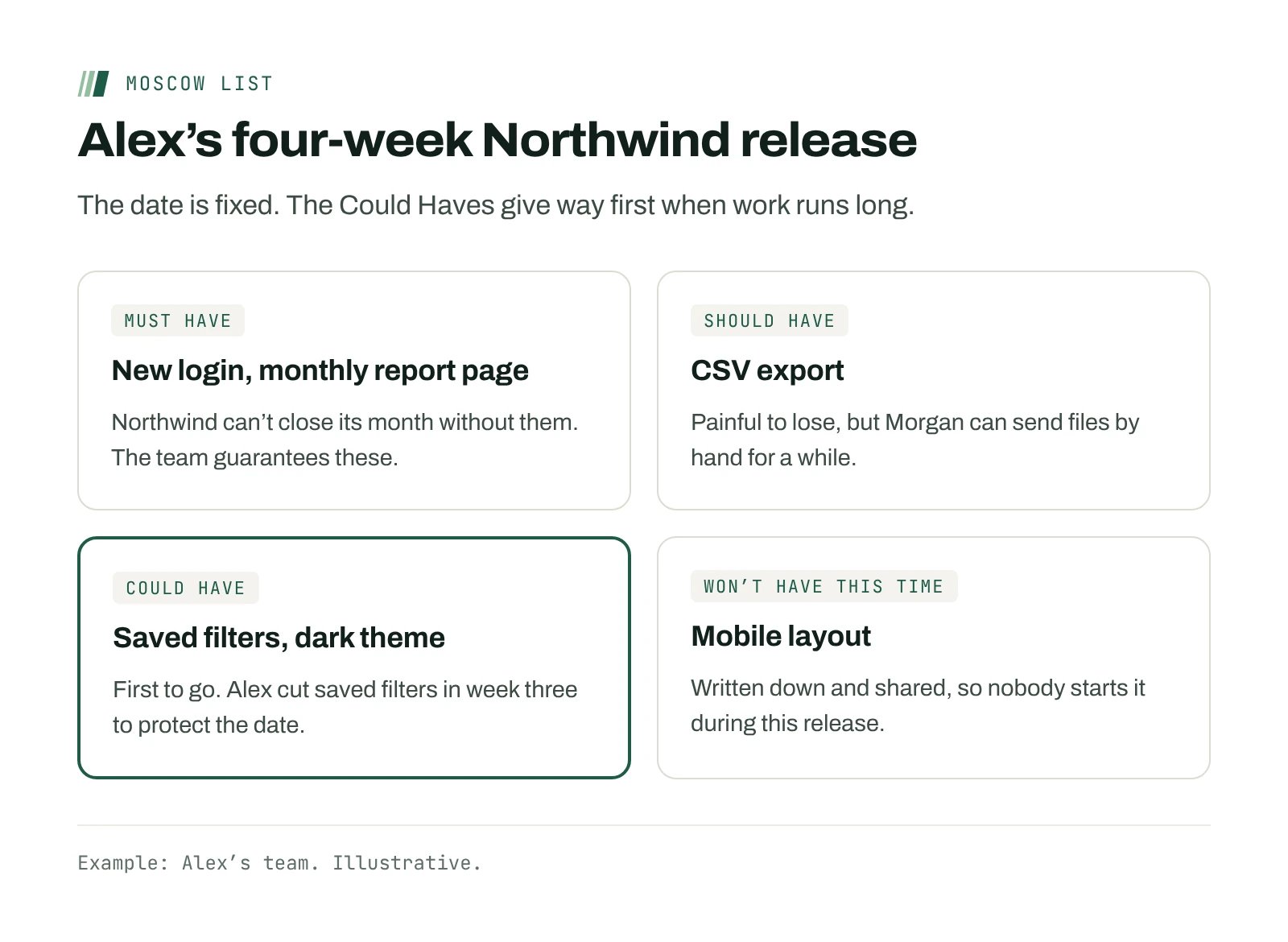
Example: Alex’s team has four weeks to ship an update to Northwind’s client portal, and Priya drafts the MoSCoW list with Northwind in a shared doc. Must Have: the new login and the monthly report page, without which Northwind can’t close its month. Should Have: CSV export, since Morgan can send files by hand. Could Have: saved filters and a dark theme. Won’t Have this time: a mobile layout. The team agrees up front that Alex can cut a Could Have without a meeting. In week three, Jordan’s testing shows the report page needs more work, so Alex drops saved filters and notes it in the list. Priya tells Northwind in her daily update, and the date holds.
Related terms
RICE scoring: scores items when one group needs its own order.
Eisenhower matrix: sorts daily tasks by urgency and importance rather than a release’s scope.
Timeboxing: fixes the time first, which is the condition MoSCoW needs.
Decision log: a template for recording why an item moved groups, so the reason outlives the thread.
Where ActionOrder fits
ActionOrder, an efficiency and accountability tool for managers of remote teams, ranks each person’s work across the team’s tools by urgency, impact, shared priorities, effort and what it unblocks, and shows one card at a time. Every card has one owner and a status: done, in progress, waiting or stuck. The team view, on Pro, shows how long a priority has sat at the top, so a stalled Must Have shows up early.
Join the waitlist. ActionOrder is in pre-launch.
Sources
- What is MoSCoW Prioritization?Agile Business Consortium, May 28, 2026
- The DSDM Agile Project Framework (Handbook)DSDM Consortium, 2014, hosted by the Agile Business Consortium
- Chapter 3, note 10: the MoSCoW rules (quoting Jennifer Stapleton)Pearson, checked November 22, 2026