RICE Scoring Model: Definition, Formula and Example
What the RICE scoring model is, where it came from, how to calculate a score and how to use it on a remote team, with a worked example.
RICE scoring is a prioritization method that rates each project or request on Reach, Impact, Confidence and Effort, then combines the four numbers into one score so unlike ideas can be compared on the same scale.
The RICE scoring model helps when options are hard to compare, such as a fix for every client against a feature a few people want badly. Reach is how many people the work affects in a set period, Impact how much it changes things for each, Confidence how sure you are of those estimates, and Effort the work it takes.
Where the term comes from
Sean McBride, a former product manager at Intercom, which sells customer service software, described the model on the Intercom blog on January 5, 2018, in “RICE: Simple prioritization for product managers.” He wrote that it was hard to find a framework “that allows you to usefully compare different ideas in a consistent way.”
The post sets fixed scales. Reach is counted per time period, such as customers per quarter. Impact runs from 3 for massive down to 0.25 for minimal. Confidence is a percentage: 100% for high, 80% for medium, 50% for low, and anything lower is “total moonshot.” Effort is in person-months, “the work that one team member can do in a month.” The post shows its formula as an image; its text says impact scores “get multiplied into the final score,” confidence is factored in, and effort “divides the total impact.” Written out:
RICE score = (Reach × Impact × Confidence) ÷ Effort
Effort divides because “more effort is a bad thing,” and the result measures “total impact per time worked.” McBride also wrote that “RICE scores shouldn’t be used as a hard and fast rule.”
Scoring RICE with a remote team
RICE suits async work: every number can be written down and checked later from another time zone. It breaks when scorers mean different things by the same number, so set the rules once, in writing.
Fix the units. One reach period and one effort unit for every row. Person-weeks work for smaller jobs, as long as nobody mixes units.
Write the basis next to each number. “Reach: 60, from Northwind’s user list” lets a reviewer in another zone agree or push back without a call.
Let the requester estimate and the owner settle. The person asking knows the reach; the person doing the work knows the effort.
Read low confidence as a to-do. A 50% row is a question to answer. Say what evidence would raise it.
For how RICE compares with ICE and other methods, read task prioritization; for getting the list to everyone, see how to set priorities for a remote team and how to manage a remote team.
Example: two requests, one slot
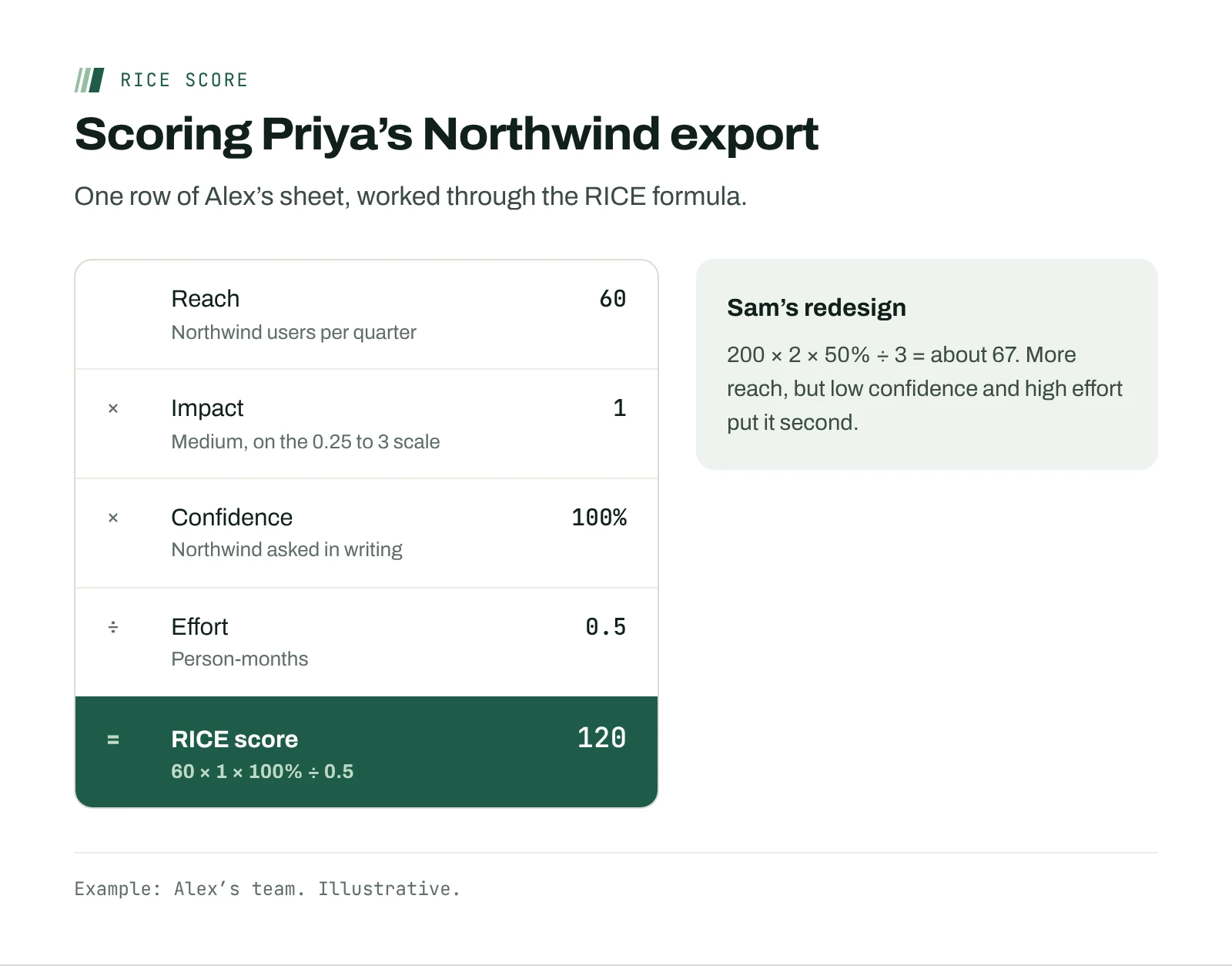
Example: Alex’s 9-person delivery team has room for one new piece of work this month. Priya brings a Northwind request for a weekly CSV export; Sam proposes redesigning the onboarding screens. Each fills in a RICE row in the shared sheet. The export reaches 60 Northwind users a quarter, has medium impact (1), 100% confidence because Northwind asked in writing, and takes half a person-month: 120. The redesign reaches 200 new users a quarter with high impact (2), but confidence is 50% with no user research yet, and effort is 3 person-months: about 67. The export goes first, and Sam knows what would move the redesign up: research that lifts the confidence.
Related terms
Eisenhower matrix: a quicker first sort by urgency and importance.
MoSCoW prioritization: groups a fixed scope into Must, Should, Could and Won’t Have instead of scoring it.
Estimates from logged time: grounds the Effort number in what similar work took.
Planning fallacy: why Effort estimates tend to come in low.
Where ActionOrder fits
ActionOrder, an efficiency and accountability tool for managers of remote teams, ranks work on inputs close to RICE’s. Its Run feed orders cards across the team’s tools by urgency, impact, shared priorities, effort and what it unblocks, and shows each person one card at a time. Estimates are suggested from logged time on similar cards, and the person or manager can change them. Time logging is on Pro and Business.
Join the waitlist. ActionOrder is in pre-launch.
Sources
- RICE: Simple prioritization for product managersSean McBride, Intercom, January 5, 2018
- Sean McBride, author pageIntercom, checked November 22, 2026