Decision-Making Framework for Teams: RACI, DACI and RAPID Compared
A decision-making framework settles who proposes, who gives input and who makes the call. Compare RACI, DACI and RAPID, then use the chooser table to pick one for each kind of decision.
A decision-making framework is an agreed way for a team to make a decision: who proposes, who gives input, who decides and who is told. RACI, DACI and RAPID are three common role frameworks, and each names one decider. Pick one for each kind of decision and record every outcome in writing.

What is a decision-making framework?
A decision-making framework is a repeatable way to reach and record a decision, so the same kind of choice is made the same way each time. There are two broad kinds: step frameworks, which set the order of thinking, and role frameworks, which set who does what.
Step frameworks walk a person or group through one choice. The University of Massachusetts Dartmouth’s decision-making process has seven steps, from “Identify the decision” to “Review your decision & its consequences”. Scoring tools such as the Eisenhower matrix and RICE, covered in our guide to task prioritization, help you compare the options.
Role frameworks solve a different problem: whose call it is, who weighs in and when the discussion is over. The summary of Paul Rogers and Marcia Blenko’s Harvard Business Review article “Who Has the D?” puts it plainly: “Decision-making bottlenecks can occur whenever there is ambiguity or tension over who gets to decide what.” On a remote team that works asynchronously, that ambiguity can cost a day per round of questions.
What is RACI?
RACI is a responsibility assignment matrix with four roles: Responsible, Accountable, Consulted and Informed. It works best for recurring work with stable owners.
The Project Management Institute defines RACI as “A matrix assigning Responsible, Accountable, Consulted, and Informed to tasks and decisions.” Its role definitions:
Responsible: “The person who performs the work. There may be multiple Responsible parties.”
Accountable: “The single person who owns the outcome and answers for it.”
Consulted: “People whose input is sought before work is completed.”
Informed: “People who are kept up to date after decisions or progress.”
The rule that holds RACI together is one Accountable per row. PMI puts it bluntly: “Having two names in the Accountable column sets up your next argument; having none sets up your next dropped ball.”
RACI’s weak spot is the one-off choice between options: the chart names an owner, but not how options get weighed or when input closes. To run it async, pin the chart in your working agreement and give the Consulted a fixed window to comment.
What is DACI?
DACI is a decision framework with four roles: Driver, Approver, Contributors and Informed. It suits one-off decisions that cross teams, because it separates who runs the decision from who makes it.
The Atlassian Team Playbook, published by a company that sells collaboration software, defines the roles this way:
Driver: “The person responsible for corralling stakeholders, collating all the necessary information,” setting the scope and “getting a decision made by the agreed date.”
Approver: “The one person (yes: one!) who makes the decision.”
Contributors: people with subject knowledge who can make recommendations: “they have a voice, but not a vote.”
Informed: people whose work may be affected, told once the decision is made: “no vote, no voice.”
Atlassian runs DACI as a 60-minute play for three to six people, with a meeting the Driver facilitates, and says to “document the final decision in your collaboration document.” On an async team, that document can carry the whole play: the Driver writes it, Contributors comment by a set date, and the Approver decides in the doc.
What is RAPID?
RAPID is Bain & Company’s decision tool, with five roles: Recommend, Agree, Perform, Input and Decide. It fits high-stakes decisions where a few people must be able to block.
Bain calls RAPID® “a proprietary decision-making tool created by Bain & Company”. Bain consultants Paul Rogers and Marcia Blenko described it in Harvard Business Review in January 2006. Bain’s page defines the roles:
Recommend: “drives the process, gathering relevant input and developing a recommendation for the decider.”
Agree: “must agree that the final recommendation is feasible to bring forward to the decision maker.”
Perform: “identifies those accountable for implementing the decision once it is made.”
Input: “provides expertise, experience, or information that shapes the recommendation.”
Decide: “makes the final decision and commits the organization to action.”
The letters are not a sequence: “the roles aren’t carried out lockstep in that order,” the authors write in Bain’s web version of the article. Keep the Agree role rare: “only a few should have such veto power: legal counsel, for certain decisions, or the head of an affected unit.” Anyone who uses a veto “must offer an alternative or escalate the issue” to the decider. Bain’s RAPID page adds: “Ideally, there should only be one decider for each decision.” To run RAPID async, the Recommend role posts the recommendation, and the Input and Agree roles answer in writing by a deadline.
How do RACI, DACI and RAPID differ?
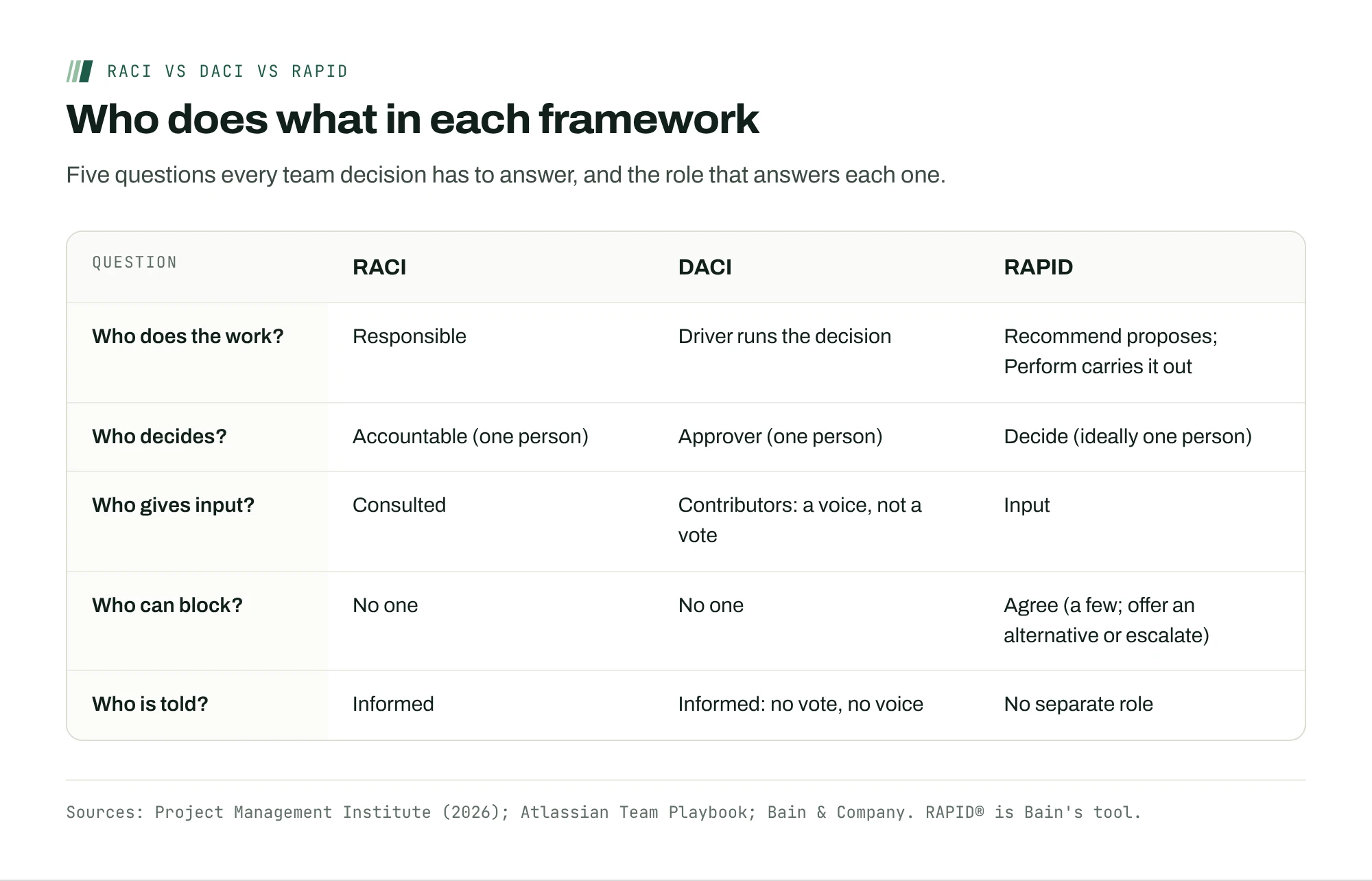
All three give the final call to one person. They differ in who runs the process and whether anyone can block.
RACI is built around work: Responsible does it and Accountable owns the outcome. DACI is built around one decision: the Driver runs it and the Approver decides. RAPID splits the roles further: Recommend proposes, Input advises, Agree can block, Decide makes the call and Perform carries it out. Only RAPID has a formal veto, and only RACI and DACI have an Informed role. Pick the lightest one that answers your open question: who owns the work (RACI), who chooses between options (DACI), or who can stop it (RAPID).
How much process does a decision need?
That depends on whether the decision can be undone. A hard-to-reverse decision deserves a full framework and a written proposal. A reversible one needs one owner and a short note.
Jeff Bezos drew this line in Amazon’s 2015 letter to shareholders. Type 1 decisions, which he called one-way doors, are “consequential and irreversible or nearly irreversible” and “must be made methodically, carefully, slowly, with great deliberation and consultation.” Most decisions are Type 2, or two-way doors: they “are changeable, reversible” and “can and should be made quickly by high judgment individuals or small groups.” He warned that as organizations get larger, there is “a tendency to use the heavy-weight Type 1 decision-making process on most decisions, including many Type 2 decisions.”
A practical test is whether you could undo the decision within a week. If you could, give it to the person closest to the work with a standing rule: decide, tell the team, proceed. Chapter 4 of the playbook, Hand off work, and get out of the middle, shows how to write these decision limits down, and our guide to levels of delegation covers how much authority to hand over.
Which framework fits which decision?
Find the row that matches your decision, then name the roles in the first message about it. Copy it into your working agreement so everyone uses the same rules.
| Kind of decision | Framework to use | Who decides | Who must be consulted | How to record it async |
|---|---|---|---|---|
| A reversible day-to-day call (a two-way door) | No formal framework: one owner, “decide and tell” | The person doing the work | Only people whose work it changes | One line in the task: what you chose and why |
| Recurring operational work with clear owners | RACI | The Accountable for that row | The Consulted on the chart | The chart pinned in the runbook; changes to it logged |
| A cross-team product decision with many stakeholders | DACI | One Approver | Contributors from each affected team | A DACI doc: problem, options, recommendation, input deadline, decision; tag the Informed at close |
| A high-stakes, hard-to-reverse decision (a one-way door) | RAPID | The Decide role | Input roles, plus one or two Agree roles, such as legal | The written recommendation with Agree sign-offs; a log entry with a revisit date |
| A decision stalled between two leads | RAPID’s escalation rule: one decider | The person both leads report to | Both leads, one paragraph each | A log entry, with the losing position under “Options we didn’t choose” |
| A decision across time zones that can’t wait for a meeting | DACI with a default: “stands unless someone objects by [time]” | The Approver; with no objection, the recommendation stands | Contributors in every affected time zone, with a full working day to reply | The proposal thread, deadline written in each time zone, closed with a log entry |
Example: Northwind asks Alex’s 9-person delivery team to move a release back a week. It is easy to reverse but touches QA, design and the client, so Alex uses a light DACI. Priya, the account lead, is the Driver and writes a one-page proposal. Alex is the Approver. Jordan, the QA lead, and Sam, the designer, are Contributors, with until Thursday at 5 p.m. in the westernmost time zone to comment. Taylor is Informed. Nobody objects, Alex approves on Friday morning, and Priya logs the decision and tells Northwind in writing.
How do you run a team decision asynchronously?
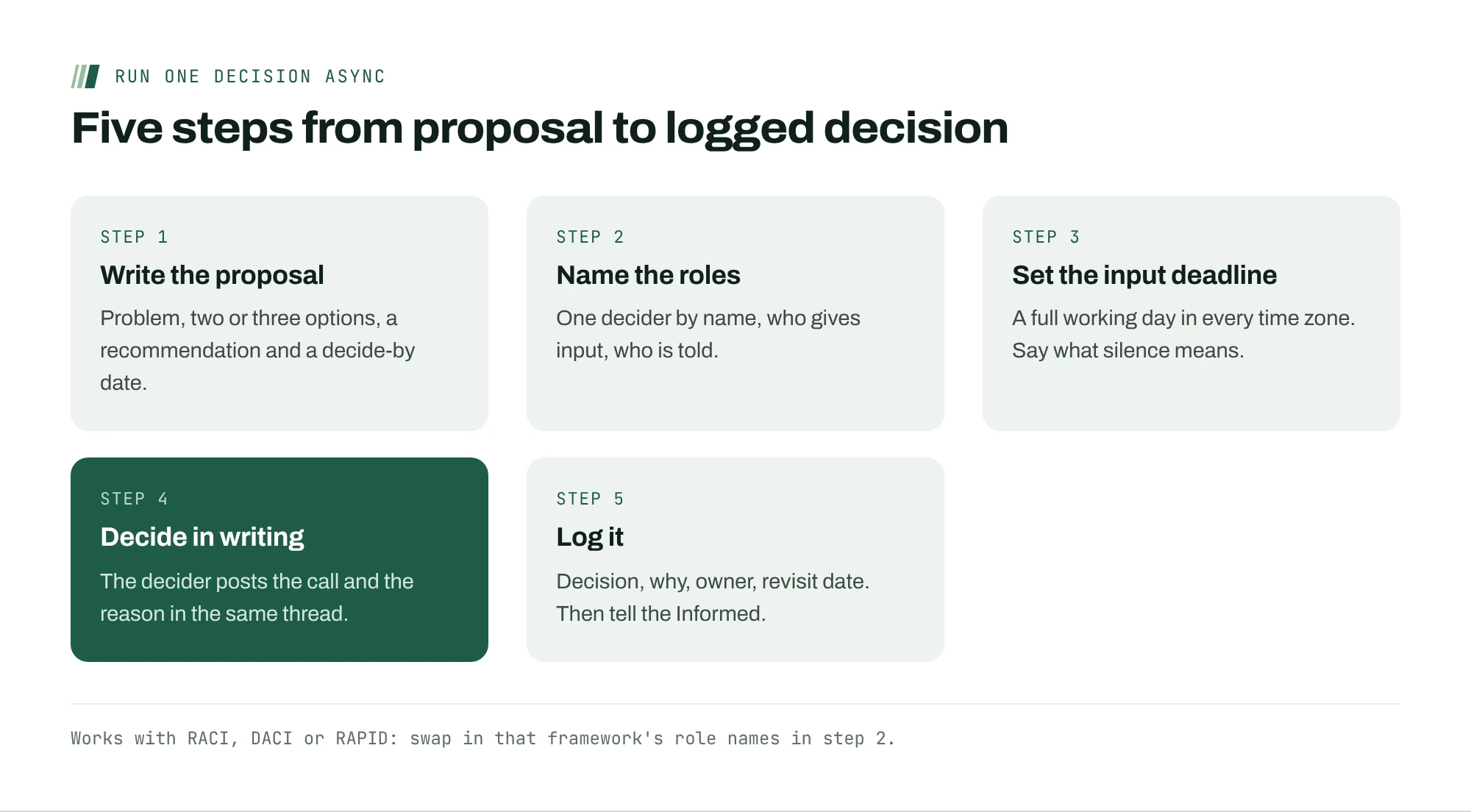
Run it in writing, in five steps: write the proposal, name the roles, set an input deadline, decide by the date and log the result. The deadline is what makes an async decision finish instead of drift.
Write the proposal. One document or thread: the problem, two or three options, a recommendation and the decide-by date.
Name the roles. One decider by name, the people whose input is needed and the people who only need to be told.
Set the input deadline. Give a full working day in every affected time zone, and say what silence means: “No reply by Thursday means the recommendation stands.”
Decide in writing. The decider posts the decision and the reason where the proposal lives, not in a direct message.
Log it. Add an entry to the team’s decision log: what was decided, why, who owns it and when to revisit it. Then tell the Informed.
The same pattern makes handoffs hold up, as our guide on how to delegate across time zones explains. If every decision still waits for you, read Stop Being the Router for Your Remote Team. For the wider system, see How to Manage a Remote Team Without Chasing It.
How ActionOrder handles this
ActionOrder, an efficiency and accountability tool for managers of remote teams, gives every card one owner and a status: done, in progress, waiting or stuck. People set “stuck” themselves. When a call belongs to someone else, Delegate hands the card to a teammate with its prep and a note, and it comes back when done or handed back. Each person works one card at a time from a run feed, ranked across the team’s tools by urgency, impact, shared priorities, effort and what it unblocks. Integrations are read-only. Join the waitlist. ActionOrder is in pre-launch.
Questions people ask
What is the 7-step decision-making model?
The 7-step decision-making model is a sequence for working through one choice. In the University of Massachusetts Dartmouth version, the steps are: identify the decision, gather relevant information, identify the alternatives, weigh the evidence, choose among alternatives, take action, and review the decision and its consequences. A role framework adds who makes the call.
What are some examples of decision-making frameworks?
Common examples include role frameworks such as RACI, DACI and RAPID; Type 1 and Type 2 decisions, for judging how much care a choice needs; and scoring tools such as the Eisenhower matrix, RICE and ICE, for ranking options. Teams often combine one of each: a reversibility test, a role framework for who decides, and a scoring tool for comparing options.
What is the difference between RACI and DACI?
RACI assigns roles for a task: who does it, who owns the outcome, who is consulted and who is told. DACI assigns roles for one decision: a Driver who runs it, one Approver who decides, Contributors who advise and people who are informed afterward. Use RACI for ongoing work with stable owners and DACI for a one-off choice between options.
Can a decision have more than one decider?
It shouldn’t. PMI’s RACI guidance gives every task exactly one Accountable person, Atlassian describes the DACI Approver as one person, and Bain says there should ideally be one decider for each decision. If two people must both say yes, give one of them the decision and the other an Agree role, with the duty to offer an alternative or escalate.
Sources
- Decision-making processUniversity of Massachusetts Dartmouth, checked November 22, 2026
- Who Has the D? How Clear Decision Roles Enhance Organizational PerformancePaul Rogers and Marcia Blenko, Harvard Business Review, January 2006
- Stakeholder Management and RACI: Who Does What, and Who Answers for ItProject Management Institute, July 29, 2026
- DACI Decision-Making FrameworkAtlassian Team Playbook, checked November 22, 2026
- RAPID® Decision MakingBain & Company, October 13, 2023
- Who has the “D”?Paul Rogers and Marcia Blenko, Bain & Company, June 28, 2006
- 2015 letter to shareholders (Exhibit 99.1)Jeffrey P. Bezos, Amazon, filed with the SEC