Timeboxing: What It Is and How It Differs From Time Blocking
What a timebox is, where the idea comes from, how it differs from time blocking, and how to use one on a remote team that works async.
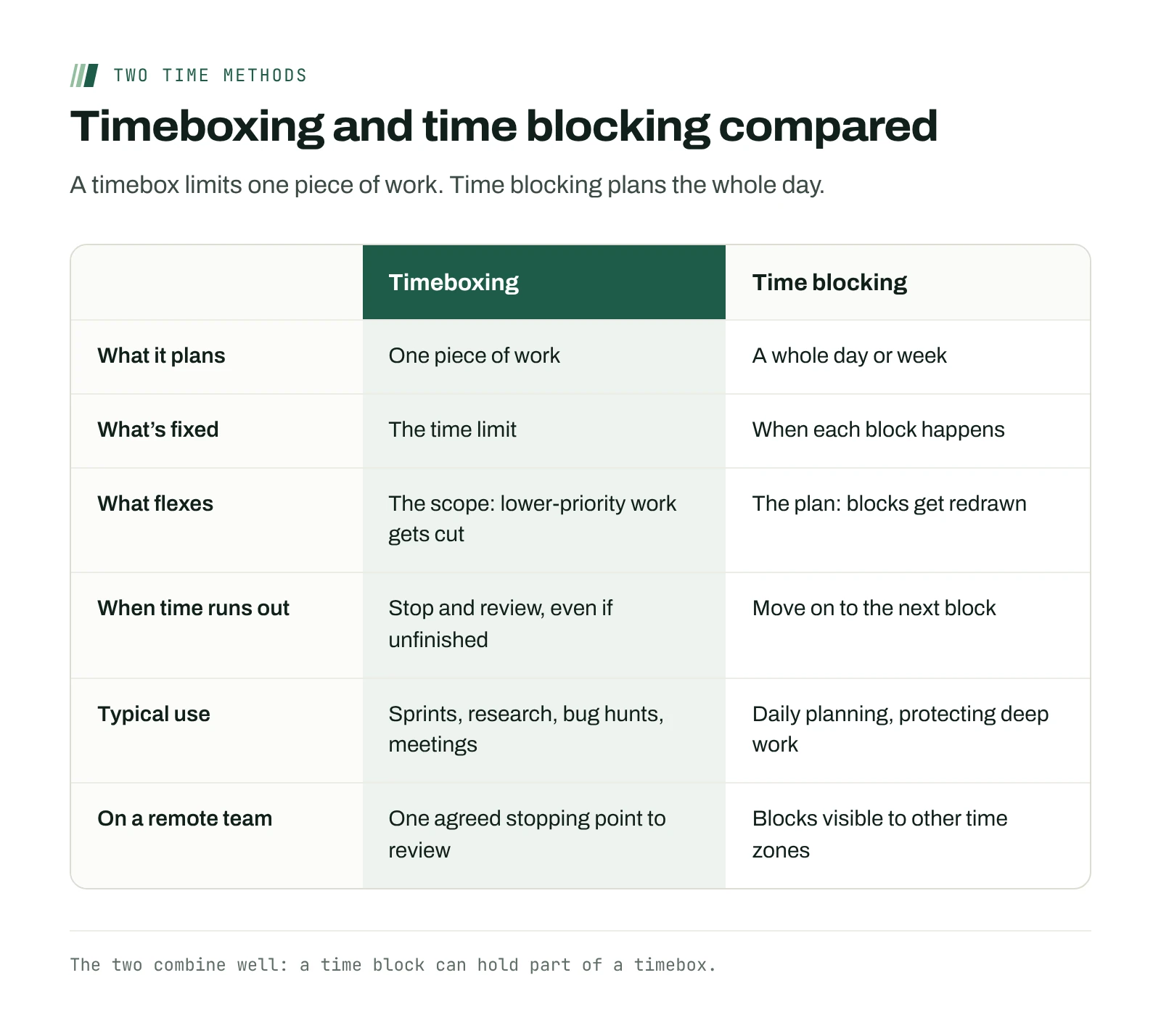
Timeboxing is setting a fixed, agreed amount of time for a piece of work, then stopping when the time runs out and reviewing what got done, so the scope flexes while the deadline holds.
A timebox can be fifteen minutes for a meeting, two days for an investigation or two weeks for a sprint. What makes it a timebox is the rule at the end: you stop, look at what’s finished and decide what happens to the rest.
Timeboxing is often confused with time blocking, which plans a whole day by giving each part of the calendar a task. A timebox limits one piece of work, and a time block can hold part of one.
Where the term comes from
The Agile Alliance glossary traces timeboxing to software development methods of the late 1980s. It defines a timebox as “a previously agreed period of time during which a person or a team works steadily towards the completion of some goal.” Its “critical rule” is that “work should stop at the end of the timebox, and review progress.” The glossary traces the idea to 1988, when the timebox was described as “a cornerstone” of Scott Schultz’s Rapid Iterative Production Prototyping approach at Information Engineering Associates, a Du Pont spin-off. In 1991 its details were “described at length” in a chapter of James Martin’s book Rapid Application Development. Timeboxed iterations later became a feature of Scrum and Extreme Programming.
The Agile Business Consortium, a not-for-profit professional body, explains the trade-off: “agile approaches often fix time and cost while allowing the scope of features to flex.” It adds: “The timebox is not extended simply because more work is discovered.”
Timeboxing on a remote async team
Timeboxes suit teams spread across time zones, because one agreed stopping point replaces open-ended check-ins.
Write the box on the task: the goal, and the time the box ends in each person’s time zone.
Rank the scope up front: decide what gets cut first if time runs short. MoSCoW prioritization is one way to do it.
Review in writing: what’s done, what’s left and the decision on the rest.
Box open-ended work: research, bug hunts and design exploration tend to run long, as the planning fallacy explains.
Size the box from history: see estimates from logged time.
Example: a two-day timebox for Northwind
Example: Northwind asks whether its reports can be exported in a new format, and nobody on Alex’s nine-person delivery team knows how hard that is. Alex gives Jordan, the QA lead, a two-day timebox to find out, ending Thursday at 17:00 in Jordan’s time zone. The goal goes on the task: “Test the export with Northwind’s three largest reports and list what breaks.” Jordan ranks the work, largest report first. When the box ends, two reports are tested and the third isn’t started. Jordan posts the findings. Alex reads them the next morning and tells Priya the export works for two reports, with the third scoped as its own task. Nobody adds a third day.
Related terms
Time blocking: plans the whole day in blocks, and a block can hold part of a timebox.
MoSCoW prioritization: a way to rank the scope inside a timebox, so you know what to cut.
Focus time for remote teams: the team habits that keep a timebox’s hours free for the work.
Context switching: why one open timebox per person beats several running at once.
How to manage a remote team: where timeboxes fit in a remote team’s wider routine.
Where ActionOrder fits
ActionOrder, an efficiency and accountability tool for managers of remote teams, helps you size a timebox from real work. People log their own time against the card they’re working and can correct it; time logging is on Pro and Business. Estimates are suggested from logged time on similar cards, and the person or manager can change them. On Pro, the team view shows logged time against estimate, so the end-of-box review starts from the same facts.
Join the waitlist. ActionOrder is in pre-launch.
Sources
- What is a Timebox?Agile Alliance, Agile Glossary, checked November 22, 2026
- What is Timeboxing?Agile Business Consortium, July 9, 2026