Planning Fallacy: Why Estimates Run Late and How to Correct Them
The planning fallacy makes estimates run late even when people know past work did. See why, and correct the next estimate with your team’s own logged time.
The planning fallacy is the tendency to underestimate how long your own work will take, even when you know similar work ran late before. Estimates built from the plan leave out the delays that usually happen. The fix is to check the plan against how long similar finished tasks actually took, then correct the estimate.
What is the planning fallacy?
The planning fallacy is an optimistic bias in predicting your own completion times. You expect this project to go as planned, even though you know most similar projects did not.
Daniel Kahneman and Amos Tversky described it in a June 1977 technical report, Intuitive Prediction: Biases and Corrective Procedures. They wrote: "Scientists and writers, for example, are notoriously prone to underestimate the time required to complete a project, even when they have considerable experience of past failures to live up to planned schedules." They traced the error to "the tendency to neglect distributional data", meaning the record of how similar cases turned out.
Roger Buehler, Dale Griffin and Michael Ross tested the idea in a 1994 paper in the Journal of Personality and Social Psychology. They define it as "the tendency to hold a confident belief that one's own project will proceed as planned, even while knowing that the vast majority of similar projects have run late," and credit the term to Kahneman and Tversky (1979). In a 2019 post on the SPSP blog, Buehler notes that it appears even "for small tasks like daily household chores (such as cleaning)."
What is an example of the planning fallacy?
The best-known example is the honors thesis study. Students predicted they would finish in about 34 days, took about 56, and fewer than a third finished by their own best guess.
In Study 1 of the 1994 paper, the researchers asked 37 psychology students in the final semester of an honors thesis when they would hand it in. "When asked for their best estimate, respondents predicted, on average, that they would finish in 33.9 days." They actually took 55.5 days. Only 29.7% finished within their best estimate.
The students also predicted their finish date "if everything went as poorly as it possibly could." That worst case averaged 48.6 days, still a week short of what happened, and "fewer than half of the respondents (48.7%) finished by the time they had predicted."
Shorter work showed the same pattern. In Study 2, students picked tasks to finish within a week and "finished 37.1% of the academic projects and 42.5% of the nonacademic projects within the predicted time."
Why do estimates run late?
Estimates run late because people build them from the inside view: the steps of this task and how they should go. They skip the outside view: how long similar tasks took.
Daniel Kahneman and Dan Lovallo put it this way in Timid Choices and Bold Forecasts, published in Management Science in 1993: "Overly optimistic forecasts result from the adoption of an inside view of the problem," which "anchors predictions on plans and scenarios." Buehler's team saw the same thing when students thought aloud. They "focused primarily on future scenarios when predicting their completion times."
Experience doesn't fix it, because people explain it away. In two of the 1994 studies, students "attributed their past prediction failures to relatively external, transient, and specific factors." Each late task looks like a one-off: the client was slow, the tool broke.
| Aspect | Inside view | Outside view |
|---|---|---|
| Starts from | The plan and steps for this task | How similar finished tasks went |
| Question it asks | How long should this take? | How long did tasks like this take? |
| What it leaves out | Delays nobody planned for | What is truly different this time |
| Use it for | The first estimate and the step list | Correcting that estimate |
How do you correct for the planning fallacy?
Take the outside view: find a group of similar past tasks, see how they went, and adjust your estimate toward that record. Kahneman and Tversky set this out as five steps in their 1977 report.
Selection of a reference class. Pick past cases like this one.
Assessment of the distribution for the reference class. Find out how they turned out, including the average.
Intuitive estimation. Make your usual estimate.
Assessment of predictability. Judge how well your information predicts outcomes.
Correction of the intuitive estimate. In their words, "the intuitive estimate should be adjusted toward the average of the reference class."
Bent Flyvbjerg applied the idea to project planning as reference class forecasting, which he bases on Kahneman's work on decision making under uncertainty. In his 2006 paper in the Project Management Journal, he calls it "a method for systematically taking an outside view on planned actions," where the outside view "is based on knowledge about actual performance in a reference class of comparable projects."
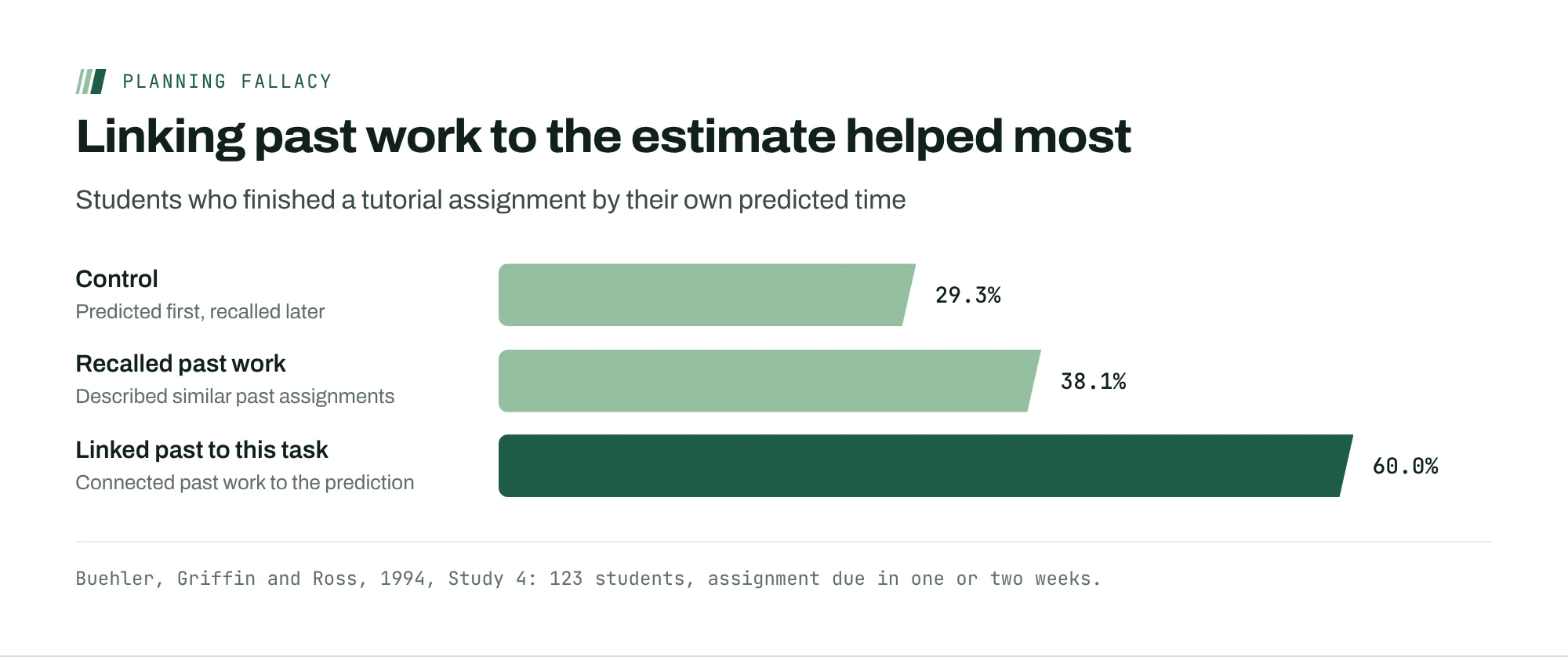
The link to the past has to be explicit. In Study 4 of the 1994 paper, students predicted when they would finish a computer tutorial assignment. Those who only recalled similar past assignments did only a little better than the control group: 38.1% finished in the predicted time, against 29.3%. Those asked to "forge a connection between the past experiences and the computer assignment" reached 60.0%. A ratio from logged time is that connection, written as a number.
How do you correct an estimate with logged time? A worked example
Divide each similar task's actual hours by its estimate, take the median of those ratios, and multiply the new estimate by it. Here is the whole calculation, ready to copy.
Example: Alex manages a 9-person delivery team. The team logs time to each task, so Alex can pull the last eight finished client change requests, each with its original estimate and its logged hours.
| Finished task | Estimate (hours) | Actual (hours) | Actual ÷ estimate |
|---|---|---|---|
| Update the Northwind homepage banner | 2 | 3 | 1.5 |
| Add a CSV export to the client dashboard | 6 | 9 | 1.5 |
| Fix a login redirect bug | 3 | 4 | 1.33 |
| Rebuild the contact form | 5 | 4 | 0.8 |
| Add a date filter to the search page | 4 | 7 | 1.75 |
| Refresh three email templates | 4 | 5 | 1.25 |
| Accessibility fixes on the signup flow | 8 | 14 | 1.75 |
| Move the help center images | 3 | 9 | 3.0 |
| Median of the eight ratios | 1.5 | ||
Pick the reference class. The last eight finished client change requests.
Divide actual by estimate for each. The CSV export: 9 ÷ 6 = 1.5. The contact form finished early: 4 ÷ 5 = 0.8.
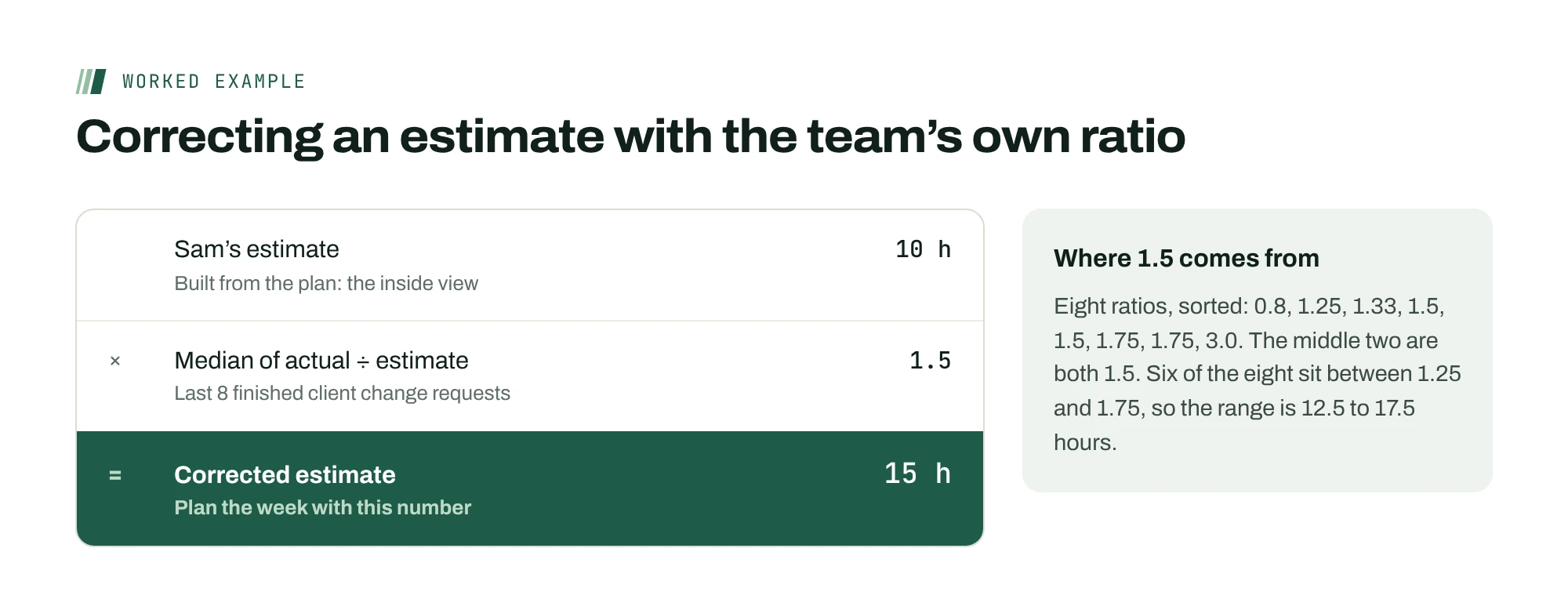
Sort the ratios and take the median. Sorted: 0.8, 1.25, 1.33, 1.5, 1.5, 1.75, 1.75, 3.0. With eight values, the median is the average of the fourth and fifth: (1.5 + 1.5) ÷ 2 = 1.5.
Estimate the new task the usual way. Sam breaks a new Northwind request, saved views on the client dashboard, into steps and gets 10 hours.
Multiply. 10 × 1.5 = 15 hours. Plan the week with 15.
Use the spread for promises. Six of the eight ratios sit between 1.25 and 1.75, so the range is 10 × 1.25 = 12.5 to 10 × 1.75 = 17.5 hours. Give dates from the top of it.
Log the actual. When saved views is done, its ratio joins the list.
Use the median, not the average. The average ratio here is 1.61, pulled up by the help center move, where the images arrived in mixed formats. The median stays at 1.5 whether that task took 9 hours or 20. In a spreadsheet, put estimates in column B, actuals in column C, =C2/B2 in column D, and =MEDIAN(D2:D9) below it.
Keep one ratio per kind of work: QA passes and design tasks may run late by different amounts. For building reference classes in more detail, see Better Estimates From Your Team’s Own Logged Time.
What else reduces the planning fallacy?
Breaking the task into steps, running a premortem and committing to specific times all help. They improve the inside view; the ratio corrects it from outside. If you add a buffer, size it from the ratio, not a round number.
Unpack the task. Buehler's SPSP post lists "decomposing the plan into smaller steps (unpacking)" among the ways to change the inside view. A step list surfaces forgotten work, such as review and handoff, but it is still a plan, so correct the total with the ratio.
Run a premortem. Gary Klein described it in Harvard Business Review in 2007: team members "assume that the project they are planning has just failed" and "then generate plausible reasons for its demise." On an async team, post the task in a thread before it starts and ask each person for one reason it ran late.
Commit to times. The same SPSP post describes implementation intentions: "making them commit to performing parts of the task at specific times and on specific dates." Put the first block of work on the calendar when you set the estimate.
How should a remote team use corrected estimates?
Use the ratio to plan work, not to judge people. Keep one ratio per kind of work, refresh it once a month, and never compare individuals.
The ratio only works if the logs are true. When logged hours are used to rank people, people pad estimates and round their logs. Chapter 6 of the playbook, Hold the team accountable without watching it, covers how to use logged time to estimate honestly.
Log time to the task, not the day, with something like the weekly timesheet. Plan the week with corrected estimates in the capacity planning template. Check how much of the week is task time with the utilization rate calculator before you add work.
On an async team, an overrun can sit unseen until the next check-in, so ask people to flag a task when it passes its corrected estimate. For the wider operating model, see how to manage a remote team without chasing it, and for more figures on time and estimates, the remote work research page.
How ActionOrder handles this
ActionOrder, an efficiency and accountability tool for managers of remote teams, suggests estimates from logged time on similar cards, and the person or the manager can change them. On Pro and Business, people log their own time against the card they're working and can correct it. Time can only be logged against a card, so each hour belongs to a piece of work, and logged time exports to CSV if you want to run the ratio yourself. On Pro, the team view shows logged time against estimate for each card, next to its owner and status. It never shows a ranking of people. Nothing runs in the background. Join the waitlist. ActionOrder is in pre-launch.
Questions people ask
Is the planning fallacy a cognitive bias?
Yes. Buehler describes it as "an optimistic prediction bias in which people underestimate the time it will take them to complete a task." Kahneman and Tversky traced it to neglecting the record of similar cases, a judgment error rather than only wishful thinking. They noted it "frequently occurs even when underestimation of duration or cost is actually penalized," so incentives alone don't remove it.
What is the Kahneman planning fallacy?
It is the term Daniel Kahneman and Amos Tversky gave to underestimating how long your own projects will take despite experience of past delays. They described it in a 1977 report and proposed a fix: pick a reference class of similar cases and adjust your estimate toward its average. Kahneman and Lovallo later linked over-optimistic forecasts to the inside view.
How do you overcome the planning fallacy?
Correct each estimate with the outside view. Collect estimates and actual hours for similar finished tasks, take the median of actual divided by estimate, and multiply new estimates by it. Unpacking the task into steps and running a short premortem improve the first estimate. Refresh the ratio monthly and never use it to rank people.
Does planning for the worst case fix it?
Not reliably. In the 1994 thesis study, students' worst-case predictions averaged 48.6 days against an actual 55.5, and fewer than half finished by them. Simply recalling past work didn't help much either. What helped was linking past work directly to the new prediction, which is what a ratio from your own logged time does.
Sources
- Exploring the “Planning Fallacy”: Why People Underestimate Their Task Completion TimesRoger Buehler, Dale Griffin and Michael Ross, Journal of Personality and Social Psychology 67(3), 1994
- Intuitive Prediction: Biases and Corrective ProceduresDaniel Kahneman and Amos Tversky, Decision Research technical report PTR-1042-7746, June 1977
- The Planning Fallacy: An Inside ViewRoger Buehler, SPSP Character & Context blog, May 30, 2019
- Timid Choices and Bold Forecasts: A Cognitive Perspective on Risk TakingDaniel Kahneman and Dan Lovallo, Management Science 39(1), 1993
- From Nobel Prize to Project Management: Getting Risks RightBent Flyvbjerg, Project Management Journal 37(3), August 2006
- Performing a Project PremortemGary Klein, Harvard Business Review, September 2007