Capacity planning: matching your team’s real hours to the work
What capacity planning means, where the term comes from, and a worked two-week example for a remote team across time zones.
Capacity planning is the practice of working out how many hours a team actually has for planned work in a period, after time off, meetings and other demands, and matching the work you commit to against that number.
It has two sides. Supply is the hours your people can give to planned work. Demand is the estimated work you want done. Capacity planning compares the two before the period starts, so you cut or move work on purpose instead of finding out in the last week. For a team, it is a short exercise repeated every sprint or month, not a one-time headcount forecast. It also differs from utilization, which looks back at how hours were actually used.
Where the term comes from
In operations and production planning, NC State University’s Supply Chain Resource Cooperative defines it as “the process of determining the amount of capacity required to produce in the future,” done at several levels, down to material requirements planning.
Software teams use the idea in short planning cycles. The Scrum Guide by Ken Schwaber and Jeff Sutherland (November 2020 version) says the more Developers know about “their past performance, their upcoming capacity, and their Definition of Done,” the more confident they will be in their Sprint forecasts. Scrum Alliance, a not-for-profit that offers Scrum training and certification, calls capacity “the maximum amount of work a team can complete in a given timeframe.” Its method starts from each person’s available hours, subtracts meetings, holidays and leave, then applies a focus factor for time not spent on direct work, noting that “Common focus factors are 0.6-0.8.”
Capacity planning on a remote team across time zones
On a remote team, write the plan down where everyone can see it. The capacity planning template gives you the sheet.
Plan by person and skill: Nine people are not nine interchangeable units. A test-heavy sprint runs out of QA hours long before design hours.
Collect every calendar: Gather time off and public holidays for each country your team works in before you plan, not after.
Count async overhead: Written handoffs, reviews that wait a time zone and client messages take real hours. A focus factor below 1 covers them.
Don’t plan to 100%: A plan that only works if nobody is ever sick pushes people toward presenteeism.
Check estimates against logged time: Estimates run optimistic (the planning fallacy), so compare them with what work actually took. Estimates from logged time shows how.
Example: Alex’s two-week sprint
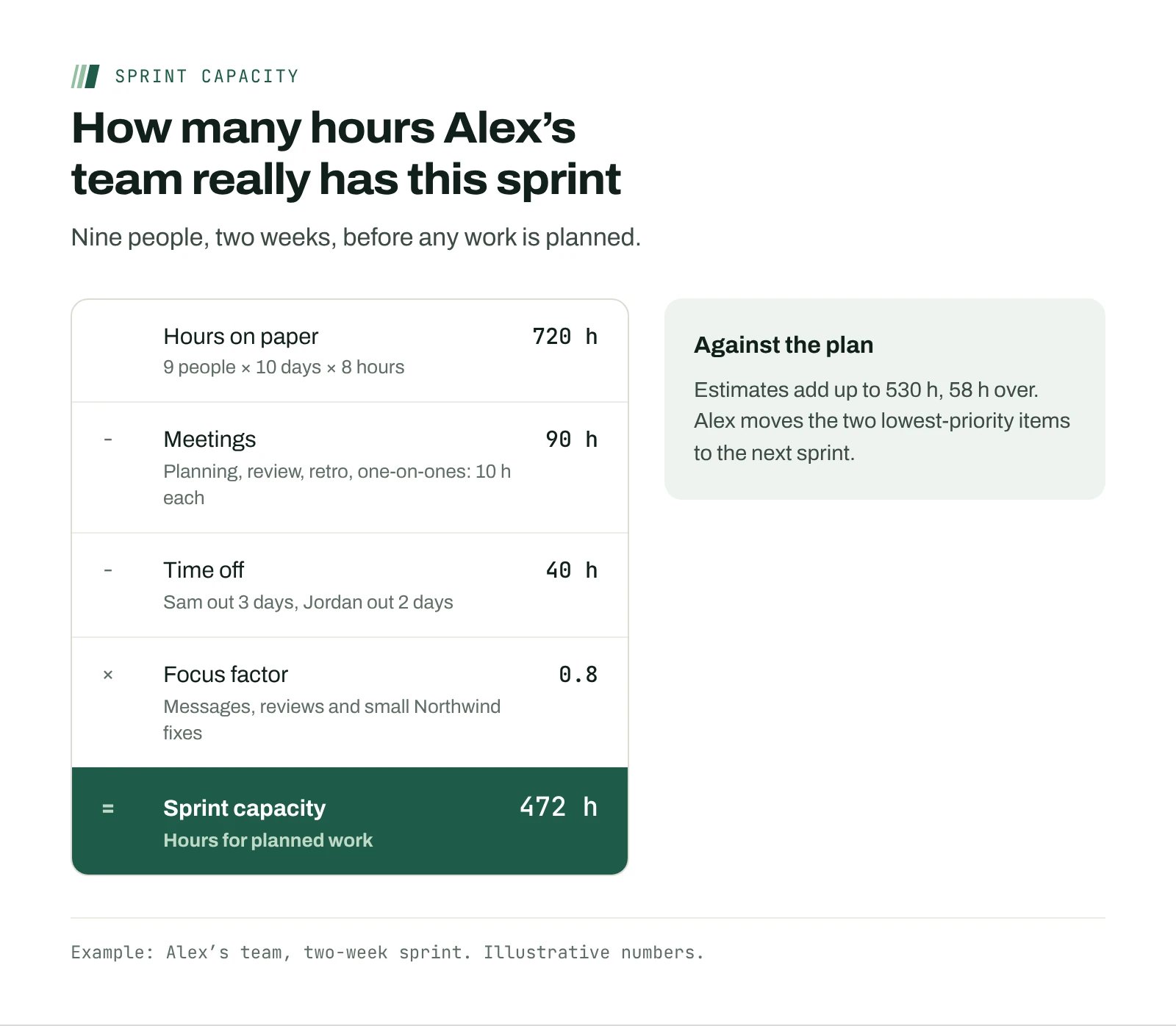
Example: Alex plans a two-week sprint for the 9-person team. On paper each person has 80 hours, 720 in total. Alex subtracts 10 hours each for planning, review, retrospective and one-on-ones, then 40 hours of time off: Sam is out three days and Jordan two. That leaves 590 hours. A focus factor of 0.8 for messages, reviews and small Northwind fixes brings it to 472. The estimates on the planned work add up to 530 hours, 58 over. Rather than ask people to stretch, Alex and Priya move the two lowest-priority items to the next sprint and tell Northwind in the Monday update.
Related terms
WIP limits: cap work in progress, which keeps a capacity plan honest mid-sprint.
Timeboxing: fixes the time first and fits the work to it, the same idea at task level.
Utilization rate calculator: looks back at how available hours were used.
Results-only work environment: judges people by outcomes, which only works when outcomes fit real capacity.
How to manage a remote team: the wider routine that sprint planning sits in.
Where ActionOrder fits
ActionOrder, an efficiency and accountability tool for managers of remote teams, helps with the demand side of the plan. Estimates are suggested from logged time on similar cards, and the person or manager can change them. People log their own time against the card they’re working; time logging is on Pro and Business. The team view, on Pro, shows logged time against estimate, so your next plan starts from what the work actually took.
Join the waitlist. ActionOrder is in pre-launch.
Sources
- Capacity planningSupply Chain Resource Cooperative, NC State University, checked November 22, 2026
- The 2020 Scrum GuideKen Schwaber and Jeff Sutherland, November 2020
- What is Capacity Planning for a Scrum Team?Scrum Alliance, checked November 22, 2026