Directly Responsible Individual (DRI): Meaning and Origin
What a directly responsible individual is, where the term came from, and how to name one owner per item on a remote team.
Directly responsible individual (DRI) is a management term for the one named person who owns a project, task or decision, answers for whether it succeeds and makes the final call, even when others do much of the work.
A DRI is a person, not a team or a committee. The DRI can ask for input, hand pieces to others and lean on experts, but the question “who owns this?” has one answer. The idea overlaps with the A in RACI: RACI splits involvement into four roles, while a DRI names only the owner.
Where the term comes from
The term is associated with Apple. In a Fortune feature on how Apple works, which ran in the magazine’s May 23, 2011 issue, Adam Lashinsky wrote that “At Apple there is never any confusion as to who is responsible for what.” He added: “Internal Applespeak even has a name for it, the ‘DRI,’ or directly responsible individual.” He also reported that “the DRI’s name will appear on an agenda for a meeting, so everybody knows who is responsible.”
GitLab, the software company, has a page on DRIs in its public handbook. It says “Apple coined the term” and that the approach “ensures clear ownership and eliminates ambiguity about decision-making authority.” The handbook also ties the idea to RACI: the DRI for a project or workstream “would sit the A - Accountable role.”
How to use a DRI on a remote async team
On a distributed team, unclear ownership looks like a thread full of opinions and no decision, where every round of replies can cost a day. Naming a DRI turns it into one person’s call with a deadline. GitLab’s handbook, written for a company that says “At GitLab we communicate and work asynchronously,” tells DRIs they “should welcome input from others but are not required to convince or justify their choices.”
Write the name next to the item: in the ticket, the doc header or the agenda line, the way Apple’s agendas did.
Let the DRI close input: they ask for comments by a set time, decide, and write two lines on why.
Hand off in writing: when a DRI goes on leave, name the next one and attach a handover document.
Don’t keep every DRI yourself: if your name is on every item, read how to stop being the router.
Example: a late change request
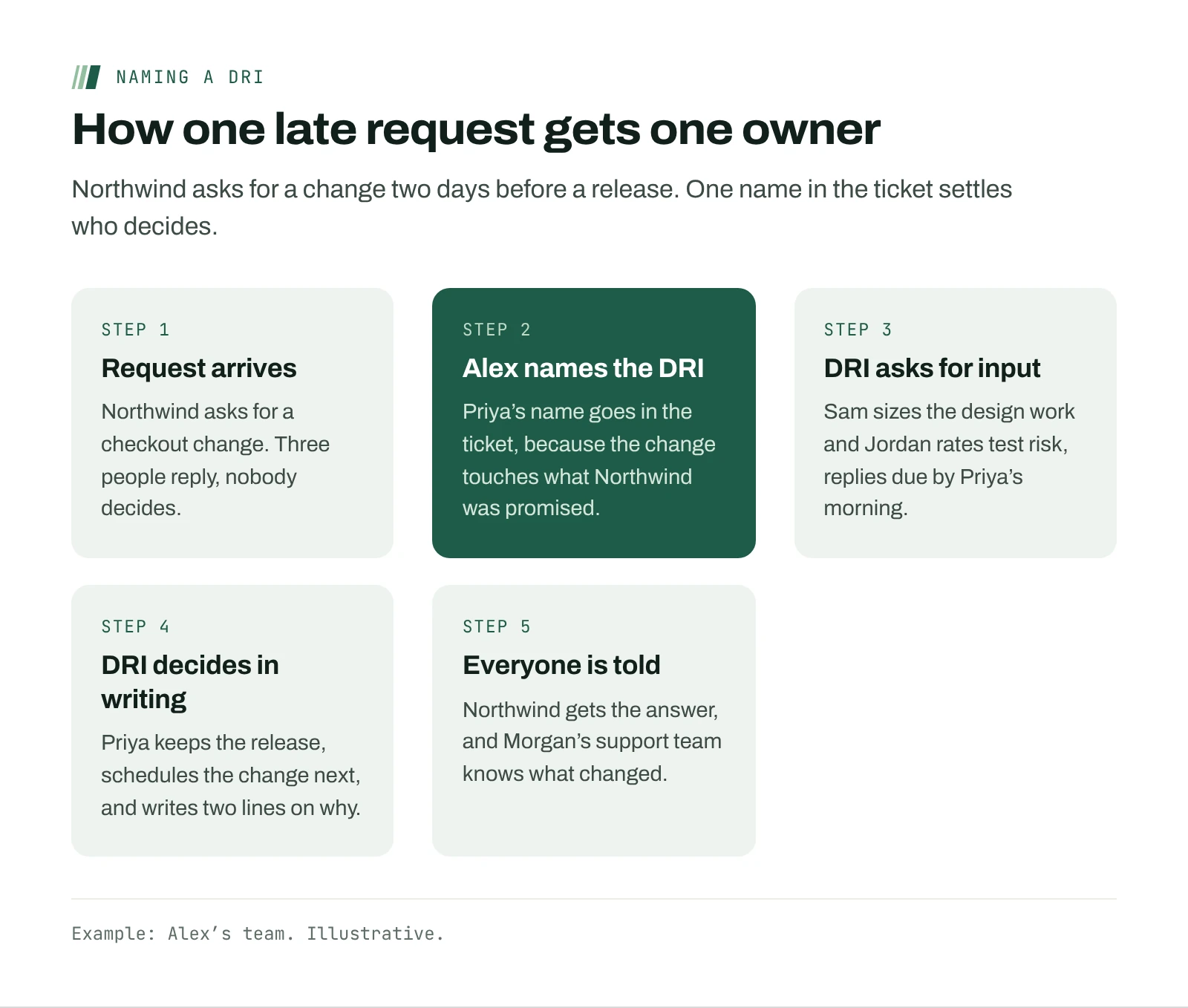
Example: Two days before a release, Northwind asks for a change to its checkout page. Sam, Jordan and Priya each reply in the thread, and nobody decides. Overnight, Alex names a DRI in the ticket: Priya, because the change touches what Northwind was promised. Priya asks Sam for the design effort and Jordan for the test risk, with replies due by her morning. She keeps the release as planned, schedules the change for the next one, writes two lines on why in the ticket and tells Northwind. Morgan is tagged so support knows what changed. One name owned the call, and nobody waited for Alex.
Related terms
RACI: the DRI is the A in a RACI chart; RACI adds who does the work, who gives input and who is told.
Bus factor: if the DRI is also the only person who knows the work, the bus factor is one.
Levels of delegation: sets how much authority a DRI has before checking back with you.
How to delegate across time zones: how to hand a DRI enough context to act while you’re offline.
How to manage a remote team: the hub guide, where clear ownership is one part of the system.
Where ActionOrder fits
ActionOrder, an efficiency and accountability tool for managers of remote teams, gives every card one owner, so the DRI question is answered before anyone asks it. Each card also carries a status: done, in progress, waiting or stuck, and people set “stuck” themselves. When the owner hands work on, delegation passes the card to a teammate with its prep and a note, and it comes back when done or handed back.
Join the waitlist. ActionOrder is in pre-launch.
Sources
- How Apple works: Inside the world’s biggest startupAdam Lashinsky, Fortune, May 23, 2011 issue (page dated August 25, 2011)
- Directly Responsible Individuals (DRI)The GitLab Handbook, GitLab, last modified October 30, 2026