RACI: What It Stands For and the One-Accountable Rule
What RACI means, why every task gets exactly one Accountable person, and a sample chart for a remote team working across time zones.
RACI is a responsibility assignment matrix that lists the work down one side and people or roles across the top, then marks each cell Responsible, Accountable, Consulted or Informed so everyone can see who does what.
The four letters split involvement into levels. Responsible people do the work, and there can be several. The Accountable person owns the result and answers for it, and there is only one. Consulted people give input before the work is finished. Informed people hear about progress or the outcome afterward. A chart where every row has exactly one A tells anyone, in any time zone, whose call it is.
RACI is not a decision process. It names an owner, but it doesn’t say how options get weighed or when input closes. For that, see RACI, DACI and RAPID compared.
Where the term comes from
RACI is taught as a project management tool. The Open University course Managing virtual project teams calls it “One popular type of RAM,” short for responsibility assignment matrix, and credits its sample chart to a 2013 publication from the Project Management Institute (PMI).
PMI’s guide Stakeholder Management and RACI defines Accountable as “The single person who owns the outcome and answers for it” and states the rule: “every task has exactly one Accountable person.” IT@Cornell agrees: “You can only have one A for an item in the RACI.” US federal guidance uses it too: Section508.gov, a General Services Administration website, publishes a RACI matrix for building accessibility into each stage of a product’s life.
How RACI works on a remote async team
On a team spread across time zones, “who owns this?” can wait overnight for an answer, and the work waits with it. A RACI chart answers the question in writing before anyone asks.
Put the chart where the work lives: pin it in the project or in your working agreement.
Write one name in the A column: “the team” can’t answer for a result. If two people both feel accountable, split the task.
Give Consulted a deadline: say, comments by 15:00 UTC Wednesday. Then the Responsible person moves ahead.
Keep Informed short: those people get the written update, not a meeting.
Update it when people change: leave and handoffs move letters, so pair each change with a handover document.
Example: a RACI chart for Alex’s team
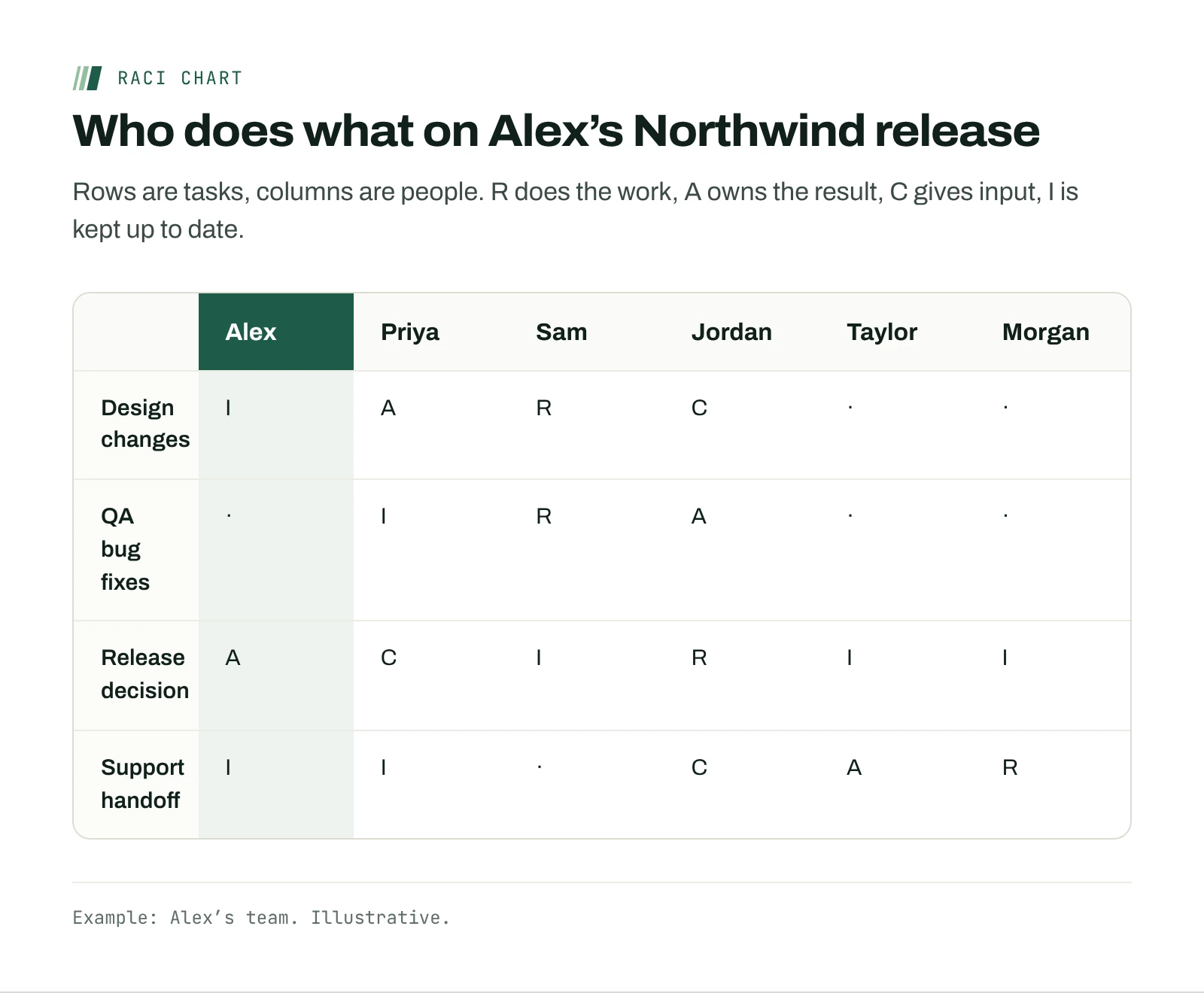
Example: Alex manages a 9-person delivery team shipping a site update for client Northwind across several time zones. Questions about who approves what kept landing in Alex’s inbox overnight, so Alex pins a four-row RACI chart in the project. Priya is Accountable for design changes because she owns the Northwind relationship; Sam does the work, and Jordan is Consulted on testing. Jordan is Accountable for closing QA bugs, which Sam fixes. Alex keeps one A, the release go/no-go, with Jordan Responsible for the test run. Taylor is Accountable for the support handoff, and Morgan carries it out. Every row has one A, and Alex holds only one.
Related terms
Directly responsible individual: a DRI names one owner for a project or task, like the A in RACI, without the other columns.
Bus factor: if one name fills most of the R column, that work has a bus factor of one.
Decision-making frameworks: compares RACI with DACI and RAPID by kind of decision.
Levels of delegation: sets how much authority the Accountable person has.
How to manage a remote team: the hub guide, where clear ownership is one part of the system.
Where ActionOrder fits
ActionOrder, an efficiency and accountability tool for managers of remote teams, applies the one-owner rule to every card it shows. Every card has one owner and a status: done, in progress, waiting or stuck, and people set “stuck” themselves. When the owner passes work on, delegation hands the card to a teammate with its prep and a note, and it comes back when done or handed back. The owner can change. The rule of one owner doesn’t.
Join the waitlist. ActionOrder is in pre-launch.
Sources
- 1.2 Responsibility assignment matrix, Managing virtual project teamsThe Open University, OpenLearn, checked November 22, 2026
- Stakeholder Management and RACI: Who Does What, and Who Answers for ItProject Management Institute, July 29, 2026
- RACI and RASCI DefinitionsIT@Cornell, Cornell University, checked November 22, 2026
- RACI Matrix for ICT Accessibility Integration Across the Product LifecycleSection508.gov, General Services Administration, reviewed or updated September 2025