Presenteeism: what it means and how it shows up on remote teams
Both meanings of presenteeism, where the term comes from, and how to keep presence from passing for progress on a remote team.
Presenteeism is showing up for work, in person or online, while not working effectively, either because you are sick or unwell or because being seen to work has replaced doing the work.
The term has two senses. In health research it means working while ill: the person is there, but symptoms cut into focus and output. In management writing it also means presence that doesn’t match output, such as long hours or a status light that is always green. Either way it is harder to spot than absenteeism, because the person is still there.
Where the term comes from
A chapter by Maria Karanika-Murray and Cary L. Cooper in Presenteeism at Work (Cambridge University Press, 2018) dates the first studies to around 1996, when Cooper “first introduced the term.” His definition held both senses: “being at work when you should be at home either because you are ill” or “because you are working such long hours that you are no longer effective.”
The health sense reached a wide business audience in October 2004, when Harvard Business Review published Paul Hemp’s article on “the problem of workers’ being on the job but, because of illness or other medical conditions, not fully functioning.” OSHwiki, published by the European Agency for Safety and Health at Work, notes definitions that go beyond coming to work while ill to “being physically present but functionally absent.”
What presenteeism looks like on a remote team
Remote work moves presenteeism online. OSHwiki points to findings that suggest an increase in “virtual presenteeism”: “not travelling to work but working from home while being ill.” A 2020 post on the UK government’s Digital people blog describes digital presenteeism as feeling “under pressure to always be available online.” Across time zones, that pressure has no natural end to the day.
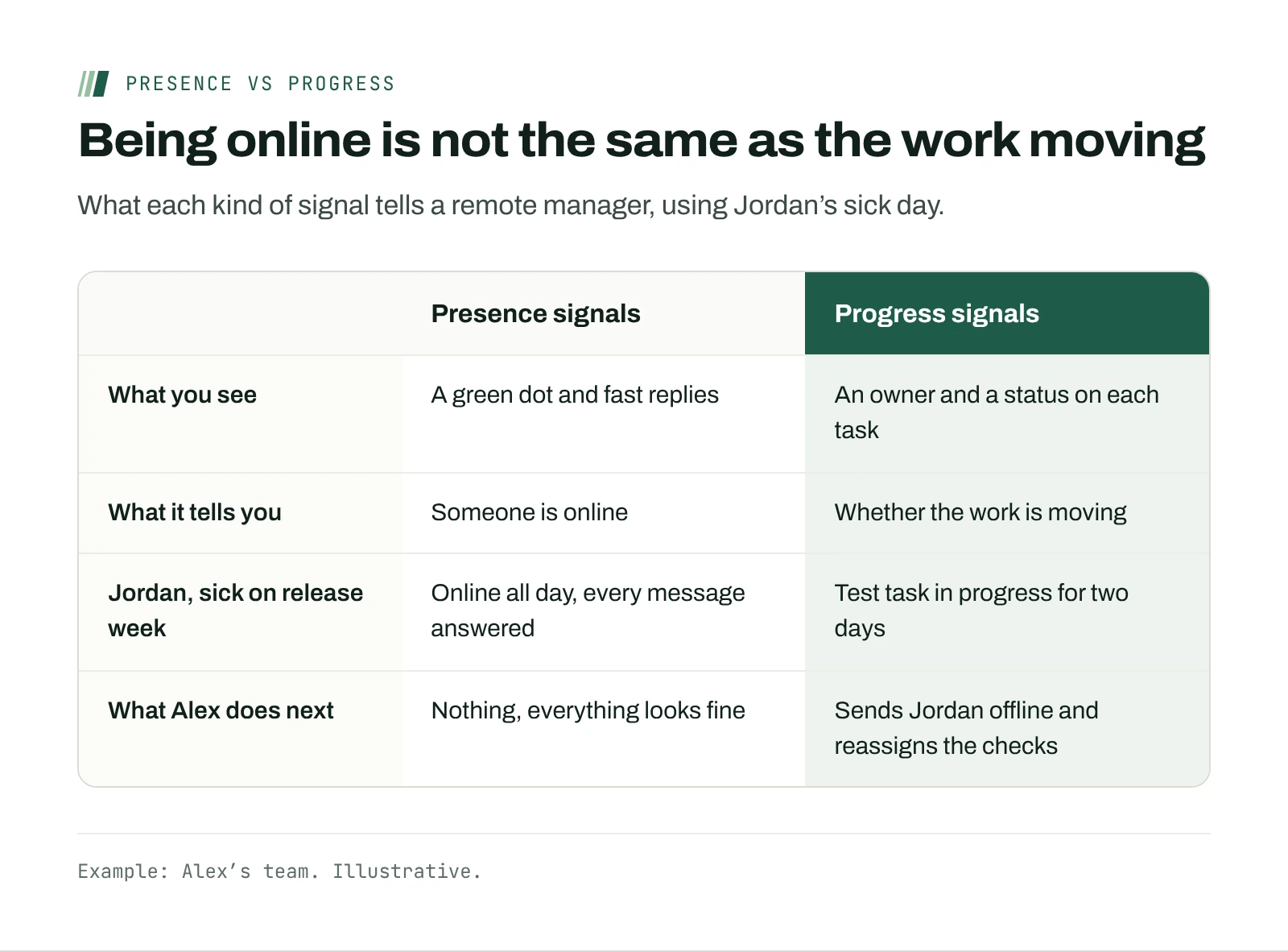
Read progress from the work: Check who owns each task and whether it is done, in progress, waiting or stuck. A green dot shows someone is online, not that the work is moving. See how to know if remote employees are working.
Make sick days offline days: Tell people who are ill to log off, and reassign their urgent tasks in writing.
Plan for absence: If your capacity plan only works at full strength, people will feel they have to work sick to keep it.
Agree on response times: With a response-time agreement, nobody has to stay online to look responsive. Tools that count clicks and online time measure presence, not progress; the bossware article covers them.
Example: a sick day spent online
Example: Jordan, the QA lead on Alex’s team, has a fever in the week of a Northwind release. Jordan logs on anyway, replies within minutes and stays green all day, but finishes only half the test checklist and misses a broken export. Alex sees that the test task has sat in progress for two days despite the steady replies. Alex tells Jordan to log off, hands the remaining checks to Sam with Jordan’s notes, and asks Priya to tell Northwind the release moves a day. The team then adds a rule to its working agreement: sick means offline, and your tasks get a new owner.
Related terms
Results-only work environment: judges people by outcomes, not hours, which removes the reason to perform presence.
Proximity bias: crediting the people you see most, the habit presenteeism plays to.
Accountability without surveillance: holding a remote team to its commitments without watching activity.
How to manage a remote team: the wider routine that keeps attention on outcomes.
Where ActionOrder fits
ActionOrder, an efficiency and accountability tool for managers of remote teams, takes status from the work, not from presence. Every card has one owner and a status: done, in progress, waiting or stuck, and people set “stuck” themselves. The team view, on Pro, shows each card’s owner, status and queue time. It never shows screens, keystrokes, clicks or app activity, and it doesn’t rank people. Nothing runs in the background.
Join the waitlist. ActionOrder is in pre-launch.
Sources
- Presenteeism: An Introduction to a Prevailing Global PhenomenonMaria Karanika-Murray and Cary L. Cooper, in Presenteeism at Work, ed. Cary L. Cooper and Luo Lu, Cambridge University Press, 2018
- Presenteeism: At Work, But Out of ItPaul Hemp, Harvard Business Review, October 2004
- Presenteeism: An overviewOSHwiki, European Agency for Safety and Health at Work, checked November 22, 2026
- Digital PresenteeismAbby Peel, Digital people blog, GOV.UK, Oct 27, 2020