Manager of Managers: How to Lead Managers on a Remote Team
A manager of managers leads through other managers: how the role differs from first-line management, how to coach and run skip-levels, and a weekly checklist for remote teams.
A manager of managers is a leader whose direct reports are managers rather than individual contributors. The job moves from running the work to building the managers who run it: shared priorities, coaching, cross-team blockers and honest signal from every level. On a remote, async team, most of that signal has to come from written work.
What is a manager of managers?
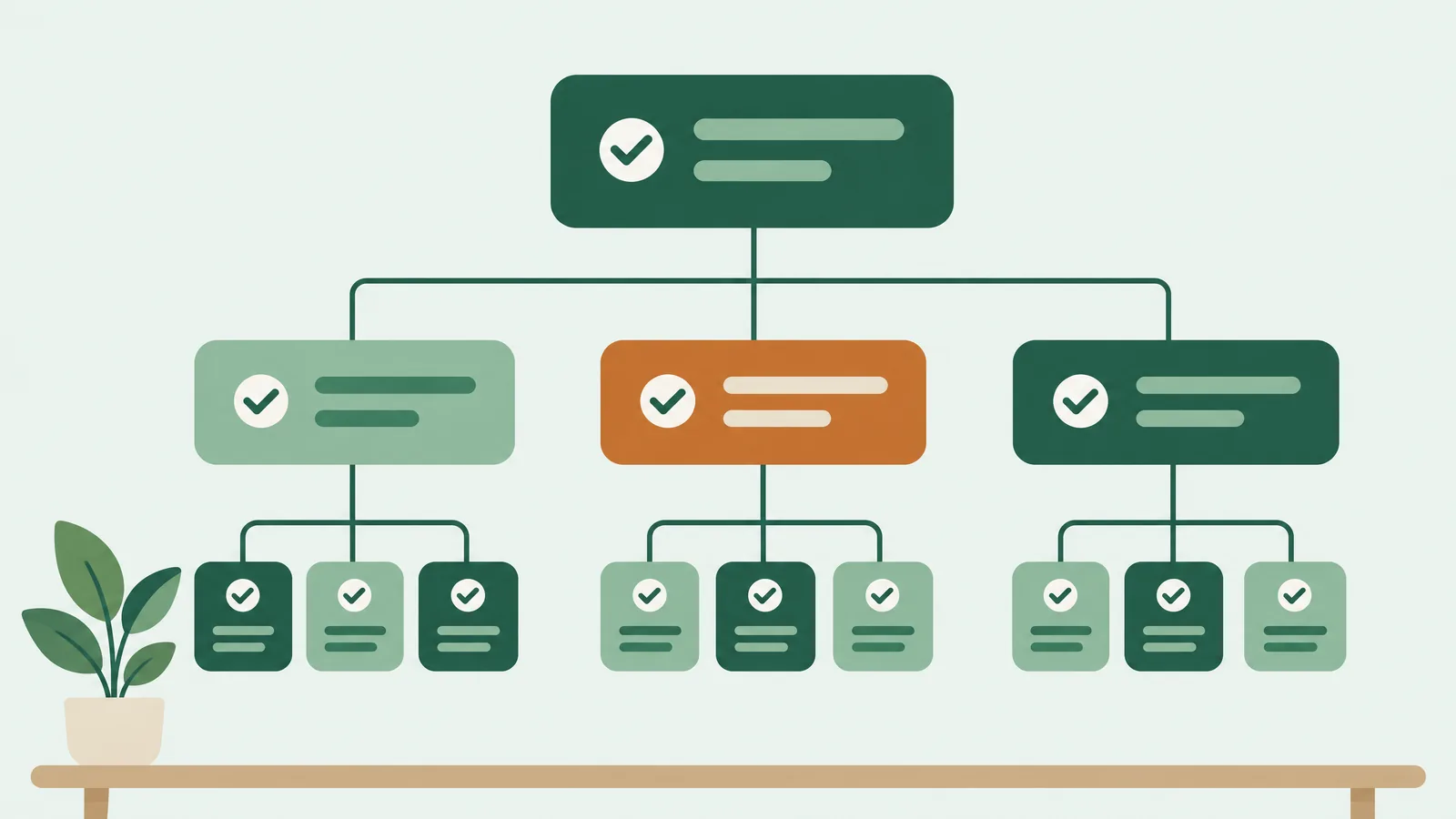
A manager of managers is someone whose direct reports lead teams of their own. The title is often director, senior manager or head of a function. What defines the role is the structure: at least one layer of managers sits between you and most of the work.
That layer changes what your output is. Writing on a16z on November 13, 2015, Ben Horowitz quotes the equation Andy Grove uses to introduce management in High Output Management: "A manager’s output = the output of his organization + the output of the neighboring organizations under his influence." One level up, your output is your managers' teams' output.
How is a manager of managers different from a first-line manager?
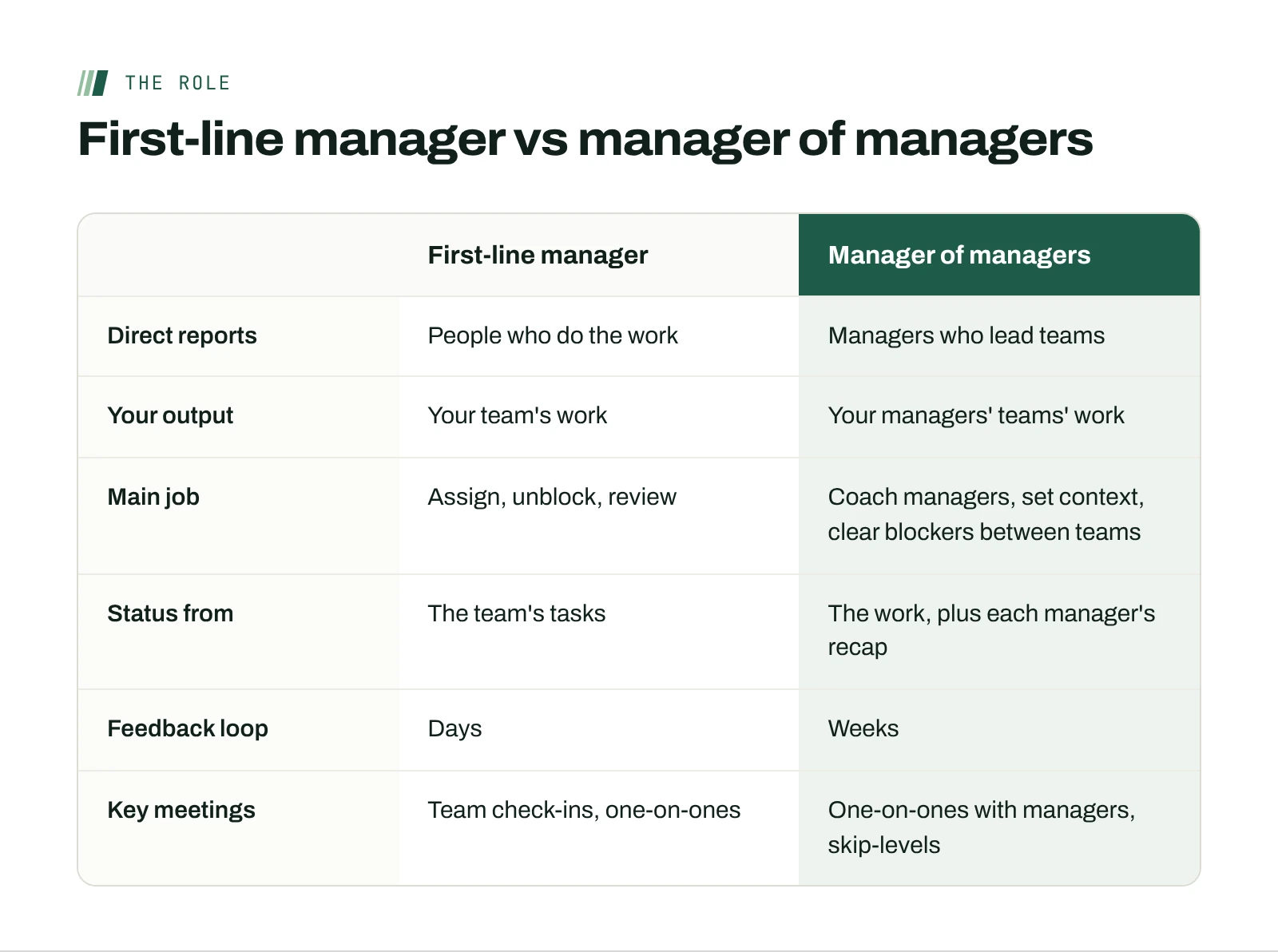
A first-line manager runs the work through the people who do it. A manager of managers runs the system through the people who manage it. Three things change at once:
Who you serve. Your reports are managers, so your job is to improve their judgment and protect their authority. If you answer their team's questions yourself, you teach the team to skip its manager.
How long feedback takes. A first-line manager sees the result of a decision in days. A change to how teams set priorities can take weeks to show up.
Where information comes from. Each manager decides what to pass up. On a remote team, a quiet manager and a struggling team look the same unless status lives on the work.
What does a manager of managers do?
A manager of managers sets shared priorities, develops the managers, clears blockers between teams and carries context up and down. The doing and the approving belong to the managers below you.
Google's Project Oxygen research maps the skills. On Google re:Work, Google says it "analyzed over 10,000 data points about our managers, taken from performance reviews and feedback surveys" and lists 10 key behaviors. They start with "Be a good coach" and "Empower the team without micromanaging," and include "Collaborate across Google" and "Make strong decisions." One level up, coaching and empowerment apply to people who lead teams, and collaboration applies across teams, where most of your blockers sit.
In an April 21, 2015 article, Gallup, which sells workplace consulting, reported that "managers account for at least 70% of the variance in employee engagement scores across business units." More figures on managers are on our remote work research page.
Each team still needs the basics: one owner per task, written status and a ranked list that ties to your shared priorities. If a team is missing them, start with how to manage a remote team without chasing it.
How do you coach the managers who report to you?
Coach managers on how they lead, with specific, regular feedback about decisions they made. Keep each one-on-one on their team, their decisions and their growth, not on task status you can already read.
In "Ten Myths of Managing Managers" (MIT Sloan Management Review, Fall 1991), based on interviews with 261 managers in eighteen large U.S. service and manufacturing organizations, Clinton Longenecker and Dennis Gioia write that "Managers want and need regular feedback on their performance." One of their recommendations: "Schedule regular one-on-one meetings to provide specific feedback on performance."
Add these four questions to each manager's one-on-one meeting agenda:
Which decision this week are you least sure about?
Where did you step into work someone on your team owns, and why?
What is stuck on your team that you can't unstick alone?
What do you need from me or from another team, and by when?
When a manager brings you a problem, ask what they plan to do first. Answer every time and you become the router one level up. Start checking their team's tasks, and the signs in how to stop micromanaging apply to you.
Example: Taylor, head of support and operations, manages Alex, who runs a 9-person delivery team, and Morgan, the support lead. In a one-on-one, Alex mentions rewriting two of Sam's client designs the night before they were due. Taylor leaves the designs alone and asks what Sam would have needed to get them right. Alex adds a draft checkpoint to client design work.
How do you run skip-level meetings on a remote team?
A skip-level meeting is a conversation between you and the people who report to your managers, without their manager present. On a remote team, run them on a fixed schedule, tell your managers first, and bring back themes, not names.
GitLab's public handbook describes a skip-level as a meeting where "a manager’s manager meets directly with team members without the direct manager present." It says skip-levels "should be held at least quarterly," one-on-one or in groups of no more than 10 to 15 people. An async round works across time zones:
Tell your managers first. Share the schedule and the questions before anything reaches their teams.
Send three questions in writing a week ahead. What gets in your way? What should we stop doing? What would you change about how work reaches you?
Offer a short call. Anyone in a far time zone can answer in writing instead.
Share themes with each manager before you act. A skip-level is for signal: never reassign work or overrule a manager in one.
How many managers should report to a manager of managers?
There is no single right number. Gallup's research says the answer depends on several factors, and that the quality of the manager matters more than the count.
In a January 13, 2026 analysis of U.S. workers, Gallup reported that "the average number of people reporting to managers has increased from 10.9 in 2024 to 12.1 in 2025," while the median held at about five to six people. Its conclusions: the answer "depends on four factors," and "Manager talent trumps span of control."
For a manager of managers, span is about how many managers you can coach well. Each needs a standing one-on-one, a read of their weekly recap and a quarterly skip-level round. Count those hours before you take on another team.
What should a manager of managers check each week?
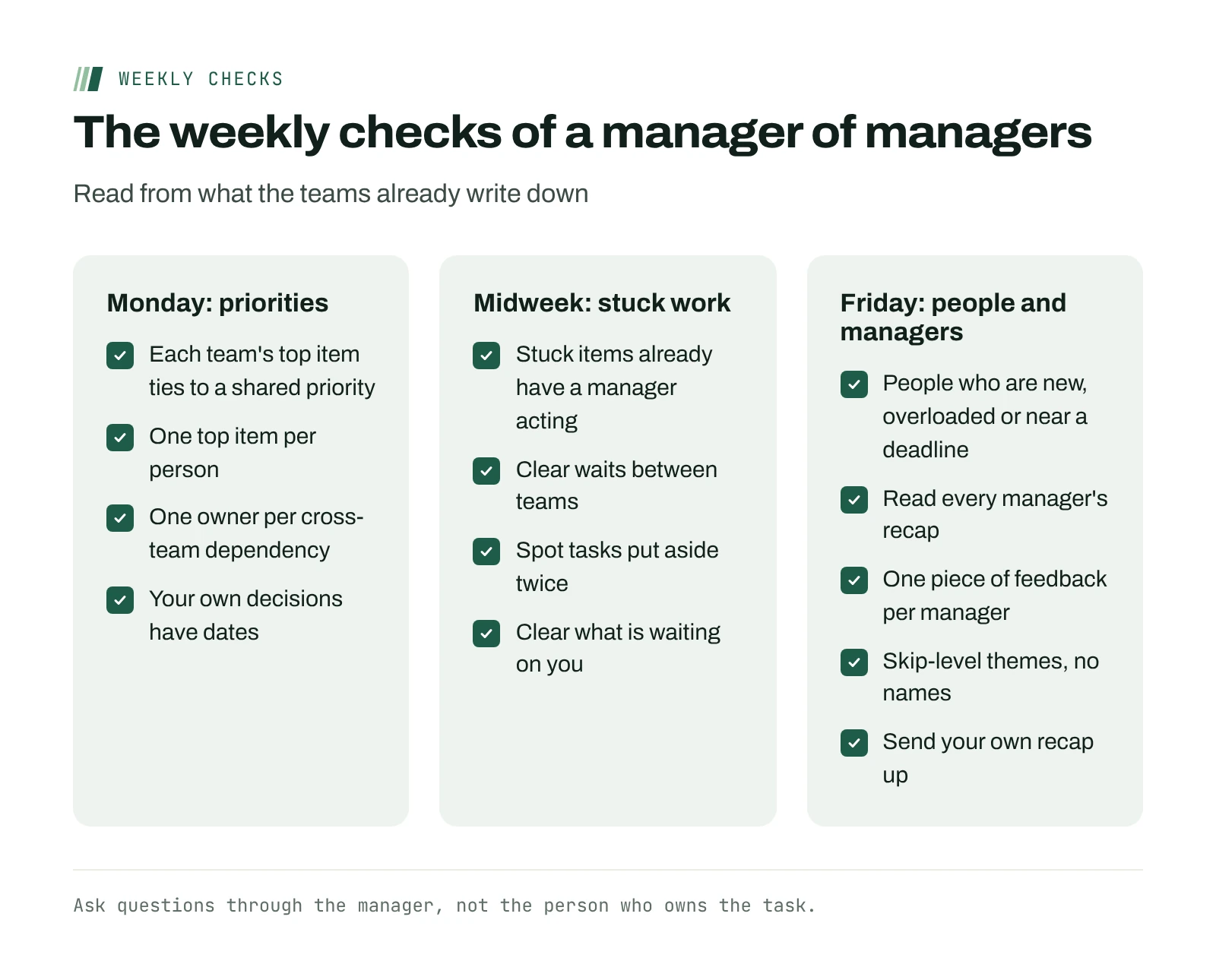
Run a short set of checks on fixed days, from what is already written down: priorities on Monday, stuck work midweek, and people, managers and skip-level signal on Friday. Copy the list into a doc or your task tool.
If a check means asking someone for an update, fix status first: Make status come from the work covers the four states and the stuck rule these checks rely on.
Monday: priorities
Each team's ranked list is posted, and its top item ties to a shared priority.
No one has two top items, and no two teams rank the same dependency differently.
Every cross-team dependency due this week has one owner, named on both teams' lists.
Any decision only you can make this week has a date, and your managers know it.
Midweek: stuck work
Read every item marked stuck, and check that its manager has already acted.
Look for work waiting on another team. Cross-team waits are yours to clear.
Look for tasks put aside twice. They are often stuck before anyone says so.
List the decisions, reviews and approvals waiting on you, and clear them first.
Ask your questions through the manager, not the person who owns the task.
Friday: people, managers and skip-level signal
People: note anyone new, overloaded, back from leave or near a hard deadline, and check that their manager has a plan.
Managers: read each manager's recap before you write yours, and reply with one question or one decision, not a rewrite.
Managers: write down one specific piece of feedback for each manager's next one-on-one.
Managers: note any manager who spent most of the week doing the work instead of leading it.
Skip-level signal: add themes from skip-level notes or questions sent up the line, without names.
Your recap: send your own update up the line: what moved, what's stuck and since when, and decisions needed by date. The weekly status report template gives it a fixed shape.
Example: On Wednesday, Taylor sees a Northwind support ticket on Morgan's team marked stuck for a day, waiting on a fix from Alex's team. Taylor doesn't message the person who owns the fix. Taylor asks Alex and Morgan, in the shared thread, to agree on one owner and a date. Alex moves the fix to the top of the delivery team's list.
How do you make the jump from manager to manager of managers?
Make the jump by deciding what you will stop doing before your calendar decides for you. The common trap is keeping part of your old job, such as answering your former team's questions, which leaves the new manager below you with the title but not the authority.
The first move into management is already hard. Linda A. Hill, a Harvard Business School professor and coauthor of Being the Boss, told HBS Working Knowledge in January 2011 that experienced leaders read her book Becoming a Manager because many of them "never really made the psychological transformation from being an individual contributor to being a manager." Moving up a level asks for a second change of the same kind.
Managers need support for both. In global data published April 22, 2025, Gallup reported that "Manager engagement fell from 30% to 27%" in 2024. It added that "The best organizations Gallup has studied put manager training and development at the center of their strategy."
In your first week, write a stop-doing list: answering your managers' teams directly, approving routine work, sitting in every team meeting. Then use the playbook's first 30 days chapter to set up each team, and start the weekly checklist above.
How ActionOrder handles this
ActionOrder, an efficiency and accountability tool for managers of remote teams, reads the tools your teams already use and gives each person one clear next step at a time. Every card has one owner and a status (done, in progress, waiting or stuck), and people set stuck themselves. On Pro, the team view shows each card's owner and status, queue time, how long a priority has sat at the top, skips and a Friday recap, so your weekly checks start from the work. It never shows screens, keystrokes, app activity or a ranking of people. Nothing runs in the background. Join the waitlist. ActionOrder is in pre-launch.
Questions people ask
What is a manager of managers called?
There is no single title. Common ones are director, senior manager, head of a function and, in larger companies, vice president. What makes the role is that your direct reports manage teams of their own.
What are the three types of managers?
A common textbook split is first-line managers, who lead the people doing the work; middle managers, who lead other managers; and top managers, who set direction for the whole organization. A manager of managers is usually a middle manager.
What is a higher title than manager?
Titles vary by company, but senior manager, director and head of a function usually sit above manager, with vice president above those. Scope matters more than the title.
Should a manager of managers still do hands-on work?
A little, if it keeps you close to the work, but keep it off the critical path. In Gallup's span-of-control analysis, U.S. managers who spent more than 40% of their time (the median) on individual contributor work were less engaged, and the gap grew with team size.
How often should a manager of managers hold skip-level meetings?
GitLab's handbook sets a floor of once a quarter. On a remote team, add a written question between rounds so people in far time zones can raise things without waiting for a call.
Sources
- AndyBen Horowitz, a16z, November 13, 2015 (quoting Andrew S. Grove, High Output Management)
- Following the data: The research behind great managersSarah Calderon and Debbie Newhouse, Google re:Work, August 2025
- Managers Account for 70% of Variance in Employee EngagementRandall Beck and Jim Harter, Gallup (vendor research), April 21, 2015
- Ten Myths of Managing ManagersClinton O. Longenecker and Dennis A. Gioia, MIT Sloan Management Review, Fall 1991
- Skip Level Meetings - OverviewThe GitLab Handbook, GitLab, last modified December 5, 2025
- Span of Control: What's the Optimal Team Size for Managers?Jim Harter, Gallup (vendor research), January 13, 2026
- Being the BossCarmen Nobel, Harvard Business School Working Knowledge, January 17, 2011
- Global Engagement Falls for the Second Time Since 2009Jim Harter and Ryan Pendell, Gallup (vendor research), April 22, 2025