Proximity Bias: How It Shortchanges Remote Employees
Proximity bias rewards the people a manager sees, not the work they ship. See where it shows up, what research found, and an audit to run before review season.
Proximity bias is the tendency to favor the people you see most often, usually those in the office, when you hand out work, ratings and promotions. On a remote or hybrid team, presence gets judged instead of output. You counter it by rating written evidence of work and checking, by location, who got what before each review cycle.

What is proximity bias?
Proximity bias is judging people more favorably because you see them more. Future Forum, a research consortium created by Slack, which sells workplace messaging software, defines it as “An unconscious tendency to favor the people we’re physically closer to.”
Writing for SHRM in March 2022, Arlene S. Hirsch called proximity bias “the tendency for people in positions of authority to show favoritism or give preferential treatment to employees who are closest to them physically.”
Nobody has to dislike remote employees for this to happen. A manager who sees someone every morning knows more about their week and thinks of them first. Over a year, those small edges become different assignments, ratings and careers.
Where does proximity bias show up at work?
Proximity bias shows up wherever a manager decides from memory instead of from a record.
Assignments. The person in view gets the new project because theirs was the first name that came to mind. In a July 2021 SHRM survey of 817 supervisors, “Forty-two percent of supervisors say they sometimes forget about remote workers when assigning tasks.”
Reviews. Visible effort reads as commitment. Finished work from another time zone reads as nothing much.
Promotions. Cases rest on readiness and standing with senior people, which are easier to build in a hallway than in a document.
Informal decisions. Questions get settled at a desk or in the five minutes after a meeting. Everyone else reads about it later, if someone writes it down.
Credit. Whoever presents the result gets remembered for it, and that is often the person sitting near the manager.
Example: Alex manages a 9-person delivery team. Priya, the account lead, sits near Alex three days a week. Sam, the designer, works six hours ahead. When Northwind asks for new reporting pages, Alex and Priya settle the plan after Tuesday’s standup, and Priya takes the client call. By the time Sam reads the note, it’s decided. Nobody judged Sam’s work. Sam just wasn’t in the room.
What does research show about proximity bias?
Research shows that being seen at work shapes how people are judged, even when the observer learns nothing about the work. Whether remote staff lose out on promotion depends on the setup.
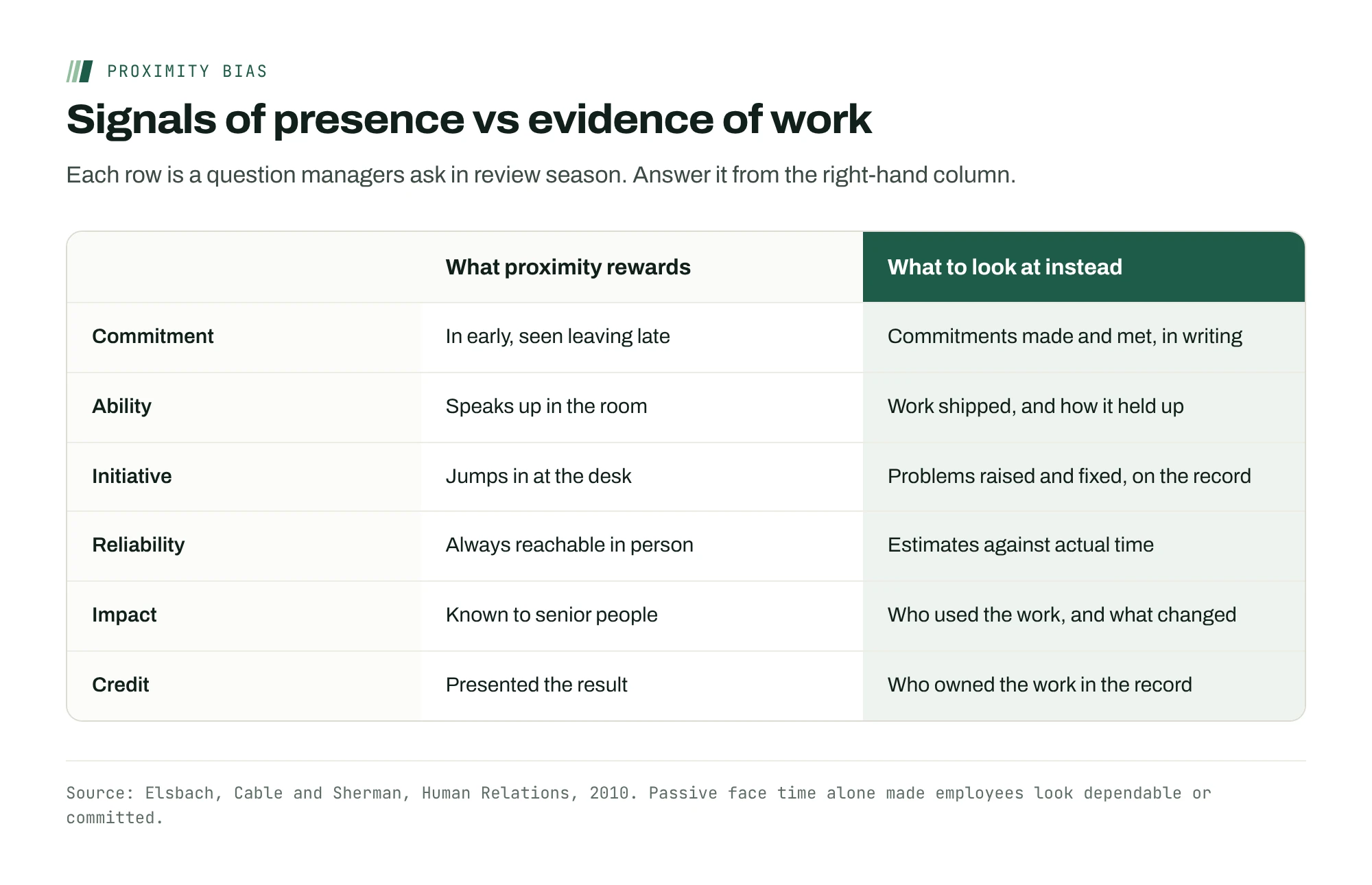
Being seen changes judgments. In a 2010 paper in Human Relations, Kimberly Elsbach, Dan Cable and Jeffrey Sherman found that passive face time, “the amount of time one is passively observed, without interaction,” led observers to see employees as “either ‘dependable’ or ‘committed’.” An experiment suggested these judgments “are made spontaneously (i.e. without intent or knowledge of doing so).” Elsbach and Cable later noted in MIT Sloan Management Review that for passive face time, “no information is required about what you are doing or how well you are doing it.”
Mostly-at-home workers were promoted less. Nicholas Bloom, James Liang, John Roberts and Zhichun Jenny Ying ran a work-from-home experiment at CTrip, a “NASDAQ-listed Chinese travel agency,” published in the Quarterly Journal of Economics in 2015. Call center volunteers were randomly assigned to home or office for nine months, and the home group worked “4 shifts a week at home” and “the 5th shift in the office.” “Home working led to a 13% performance increase,” yet “their promotion rate conditional on performance fell.” The working paper puts the drop at “about 50%,” from small numbers: 17 people promoted or moved up in the home group and 23 in the office group.
Hybrid workers were not. Bloom, Ruobing Han and James Liang ran a six-month randomized trial of hybrid working “on 1,612 employees in a Chinese technology company,” published in Nature in June 2024. The hybrid group worked from home two days a week. Hybrid working “did not affect performance grades over the next two years of reviews,” and the authors found “no evidence for a difference in promotions over the next two years.” Its 395 managers also changed their view of hybrid work’s effect on productivity from negative to positive.
Many managers still prefer the office. In the SHRM survey, run online July 16 to 19, 2021, 67 percent of supervisors of remote workers “admit to considering remote workers more easily replaceable than onsite workers,” and “72 percent say they would prefer all of their subordinates to be working in the office.”
The setup matters: staff at home four days a week lost ground on promotion, and hybrid staff at home two days a week did not. Neither study tells you whether your own process is fair, which is why the audit below checks your own numbers. More figures are on our remote work research and statistics page.
How is proximity bias different from “face time” assumptions?
Face time is the input, and proximity bias is the judgment that follows. A face-time assumption is a belief you can state out loud: people seen working are working harder. Proximity bias doesn’t need the belief.
Elsbach and Cable wrote that managers’ inferences from passive face time “are unintentional.” So a manager who sincerely supports remote work can still rate the visible person higher and think of them first for a stretch project.
That changes the fix. You can’t talk yourself out of a judgment you don’t notice making. You have to change what the decision is based on, replacing signals of presence with evidence of work. Time together still has real value. The problem starts when presence stands in for evidence.
How do you counter proximity bias on a remote or hybrid team?
You counter proximity bias by making the record, not your memory, the basis for every decision about a person.
Rate output evidence. Base reviews on what shipped, what was promised and delivered, and what it changed. In Harvard Business Review, Gleb Tsipursky advises managers to “practice valuing deliverables, collaboration, and innovation, as opposed to employee location.” Chapter 6 of the playbook, Measure the work instead, lists signals that come from the work, and How to Know If Remote Employees Are Working turns them into a weekly check.
Write decisions down. Anything decided at a desk or after a meeting goes into the team thread or a decision log the same day, with who decided and why.
Keep 1:1s equal. Same length and frequency for everyone, remote or not. Tsipursky recommends “more frequent (weekly or biweekly), low-stakes performance evaluations or one-on-one check-ins.” A shared one-on-one meeting agenda gets each person’s wins written down.
Rotate visible work. Put client calls, demos and leadership updates on a written rotation so each person presents their own work. Skip-level meetings give remote people time with your manager, too.
Calibrate by location. Before ratings are final, compare them by location and ask for the evidence behind every top and bottom rating.
None of this needs monitoring, which only creates a different presence signal. Accountability Without Surveillance explains why outcome signals work better, and How to Manage a Remote Team sets out the full operating model.
How do you audit reviews and promotions for proximity bias?
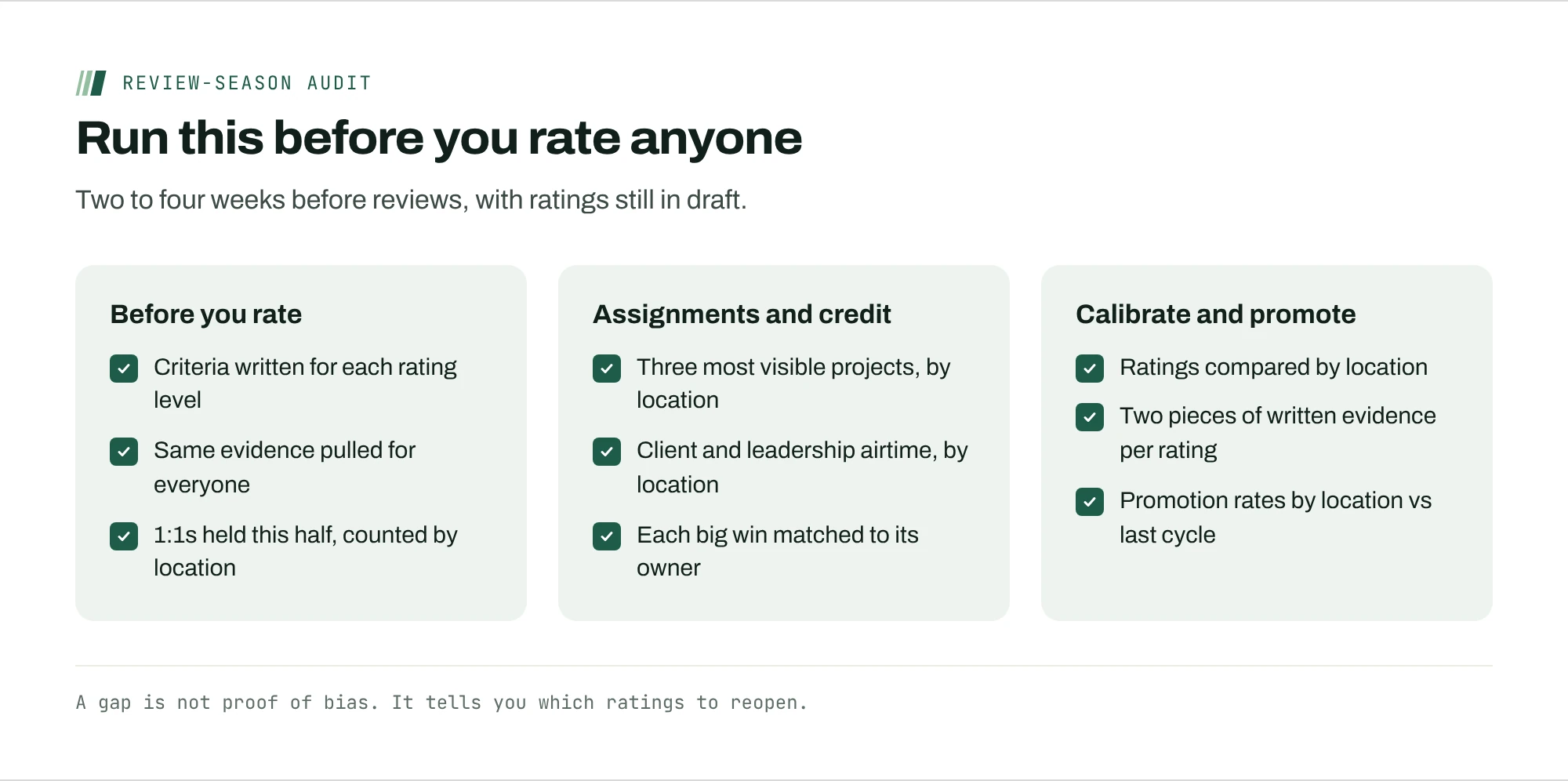
Audit reviews and promotions by comparing who got what, by location, and by checking that every rating rests on written evidence. Run this checklist two to four weeks before review season, with ratings still in draft, and again before promotion decisions. Copy it into a doc. Each item is answered with a yes, a no or a number.
Before you rate
- Write the criteria for each rating level before you open anyone’s file.
- Pull the same evidence for everyone: work shipped, commitments met and written feedback, for the whole period.
- Count the 1:1s you held with each person this half, by location.
Evidence
- Each rating cites at least two pieces of written evidence: a link, a document or a result.
- Strike any reason that describes presence, such as “always around” or “first one in”.
- For each person you see often, ask: would I give this rating from the written record alone?
Assignments and visibility
- Compare who got the three most visible projects this half, by location.
- Compare who presented to clients or senior leaders this half, by location.
- For each big win, match the name in the announcement to the owner in the record.
Calibration
- Compare the average rating and the share of top ratings for in-office, hybrid and remote people.
- Have someone who doesn’t manage the person ask for the evidence behind each top and bottom rating.
- Log every calibration change, and its reason, in the decision log.
Promotion decisions
- List everyone who meets the written bar before you choose whom to nominate.
- Compare nomination and promotion rates by location with the last cycle.
- If “visibility with leadership” counts, give every candidate the same way to earn it.
After the cycle
- Share the criteria and the evidence behind each rating with the person rated.
- Set next half’s rotation for demos, client calls and leadership updates.
- Rerun the location comparison at mid-cycle, not only at review time.
A gap doesn’t prove bias on its own, because small teams produce lumpy numbers. It tells you which ratings and assignments to reopen.
How ActionOrder handles this
ActionOrder, an efficiency and accountability tool for managers of remote teams, reads the tools your team already uses and gives each person one clear next step at a time. Every card has one owner and a status: done, in progress, waiting or stuck. People set “stuck” themselves. The team view, on Pro, shows each card’s owner and status, queue time, how long a priority has sat at the top, skips and a Friday recap. It never shows screens, keystrokes, clicks, app activity, anyone’s inbox or calendar, and it never ranks people. Nothing runs in the background. You get the same kind of record for the person down the hall and the person six hours ahead. Join the waitlist. ActionOrder is in pre-launch.
Questions people ask
What is an example of proximity bias at work?
A manager and an in-office account lead settle a client request in a quick chat after standup, and the account lead gets the project. A remote designer with the right skills learns about it later from a note. Nobody judged the designer’s work. Their name just never came up, because they weren’t in the room.
How do you avoid proximity bias in performance reviews?
Write the criteria first, then pull the same evidence for everyone: work shipped, commitments met and written feedback. Make each rating cite written evidence, strike reasons that describe presence, and compare ratings by location in calibration. Run the audit checklist two to four weeks before reviews, while ratings are still in draft.
Does working remotely hurt your chances of promotion?
It can, but it doesn’t have to. In a 2015 study of call center staff who worked from home four days a week, promotion rates fell for the same performance. In a 2024 trial of hybrid work, two days a week at home, there was no difference in promotions over two years. How your company decides matters more than where you sit.
What does distance bias mean?
Distance bias is a close cousin of proximity bias, seen from the other side: rating people lower, or forgetting them, because they are far away. For a remote employee the effect is the same, with fewer chances at work, credit and promotion. The fixes are the same too: written evidence and equal access to visible work.
What is proximity psychology?
People use the phrase for the idea that physical nearness shapes who we notice, trust and remember. At work, the best-studied version is passive face time. Elsbach, Cable and Sherman found that being seen at work leads observers to judge employees as dependable or committed, spontaneously and without meaning to.
Sources
- What is proximity bias?Future Forum (created by Slack), September 7, 2022
- Preventing Proximity Bias in a Hybrid WorkplaceArlene S. Hirsch, SHRM, March 22, 2022
- SHRM Research Reveals Negative Perceptions of Remote WorkSHRM, July 26, 2021
- How passive ‘face time’ affects perceptions of employees: Evidence of spontaneous trait inferenceElsbach, Cable and Sherman, Human Relations, 2010
- Why Showing Your Face at Work MattersElsbach and Cable, MIT Sloan Management Review, Summer 2012
- Does Working from Home Work? Evidence from a Chinese ExperimentBloom, Liang, Roberts and Ying, NBER; Quarterly Journal of Economics, 2015
- Does Working from Home Work? (working paper, full text)Bloom, Liang, Roberts and Ying, NBER, March 2013
- Hybrid working from home improves retention without damaging performanceBloom, Han and Liang, Nature, June 12, 2024 (abstract via LSE Centre for Economic Performance)
- What Is Proximity Bias and How Can Managers Prevent It?Gleb Tsipursky, Harvard Business Review, October 4, 2022