Async Standups: Questions, Examples and When to Drop the Meeting
Async standup questions for delivery, support and client teams, with example answers, posting windows and a checklist for dropping the live standup.
An async standup replaces the live daily standup with short written updates that each person posts on their own schedule, in one thread or tool. It works when the questions fit the team's work, blockers come first, a named person reads at a set time, and live calls are kept for work that needs a conversation.
What is an async standup?
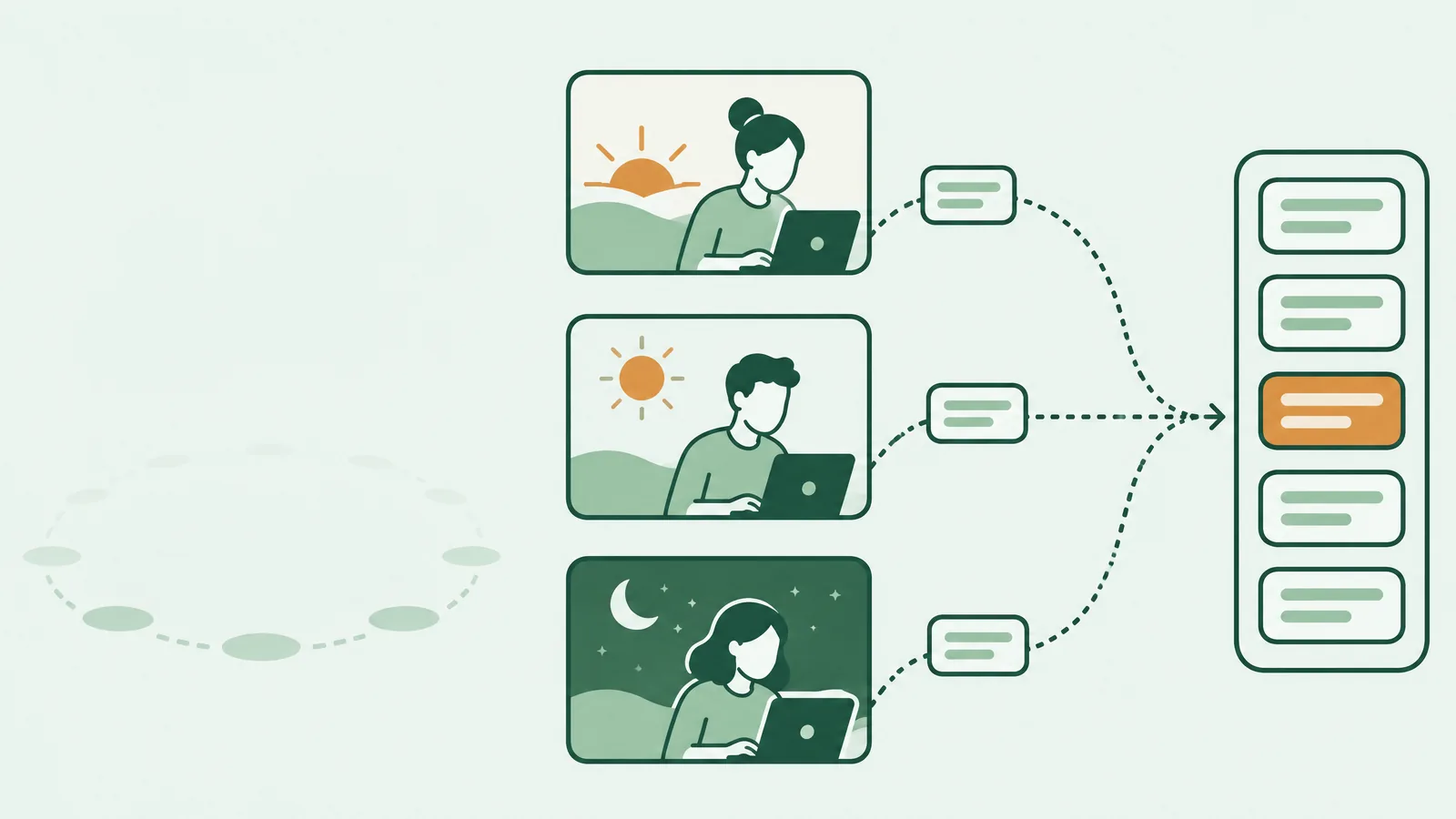
An async standup is a daily check-in held in writing. Each person answers the same short questions in one shared place, and others read and reply on their own time. It keeps the job of a standup, spotting what's stuck, without a shared clock.
Scrum no longer tells teams what to say at a standup. The 2020 Scrum Guide lets developers pick their own structure "as long as their Daily Scrum focuses on progress toward the Sprint Goal and produces an actionable plan for the next day of work." When Scrum.org listed what that revision cut, the list included "The three questions for the Daily Scrum." Yesterday, today and blockers is a habit, not a rule.
For the full system of replacing status meetings, read Async Meetings: How to Replace a Status Meeting. For a four-line template, use the daily standup template.
Which daily standup questions should you ask?
Ask daily standup questions that point forward and surface problems: what is blocked, what you'll finish or hand off next, and what is at risk. Drop the question about yesterday.
Viktoria Stray, Nils Brede Moe and Dag Sjøberg observed 102 daily stand-ups and interviewed 60 members of 15 teams in five countries (IEEE Software, accepted manuscript). Talking about what had been done "often ended up as cumbersome reporting with superfluous details." Their first recommendation is "Omit Question 1," which they say "will reduce status-reporting and self-justification."
Lead with blockers, so a reader who stops after one line still sees them.
Ask about the next handoff, not the whole day. It gets a promise someone can check.
Ask for a person and a date on every blocker.
Stop at three or four questions. Each one is asked of every person, every day.
What should delivery, support and client teams ask?
Three question sets by team type cover most remote teams: delivery teams need handoffs and risks, support teams need shift handovers and escalations, and client teams need decisions and promises. Paste the one that fits into your standup bot or thread.
Delivery or engineering team
Async standup: delivery team
Post in your first working hour. Four questions.
Async standup: delivery team, [name], [date]
1. Blocked: What is blocked, waiting on whom, since when? Or "Nothing."
2. Next: What will you finish or hand off before your next update? Link each item.
3. Handoff: What are you passing to someone else today, and to whom?
4. Risk: Is anything you own on track, at risk or late against its date?
Post by: the end of your first working hour. Read and reply: [manager], by [time] in their time zone.
Why these questions: most delivery delays are waits between people, from design to build to QA. Blocked and Handoff surface them; Risk flags a date early. A GitLab team asks something similar in weekly issue updates: "How confident are you that this will make it to the current milestone?" (GitLab Handbook).
Example: Sam, the designer on Alex's 9-person delivery team, posts: "Blocked: Nothing. Next: Northwind empty-state designs to Jordan by 3 pm (link). Handoff: Jordan, for test cases. Risk: filters design at risk if Northwind's feedback misses Thursday."
Support and operations team
Async standup: support and operations
Post in the last 30 minutes of your shift. Four questions.
Async standup: support, [name], [shift]
1. Handover: What are you passing to the next shift? Link each ticket and say what's left.
2. Escalated: Which tickets are waiting on another team, and since when?
3. Pattern: What did you see three or more times this shift?
4. Help: Do you need cover, a decision or an expert? Name who, and by when.
Post by: the last 30 minutes of your shift. Read by: the next shift, first thing, and the support lead once a day.
Why these questions: ticket counts already live in the help desk. Ask for what it can't show: context for the next shift, tickets stuck outside the team, and repeats that point to a product problem. For long handovers, use the end-of-day report template.
Example: Morgan, the support lead on Taylor's team, posts: "Handover: three Northwind billing-export tickets, notes in each (links). Escalated: export bug, waiting on Alex's team since Monday. Pattern: four password-reset failures on the new login page. Help: @Taylor, refund decision on the export bug by Thursday noon."
Client or account team
Async standup: client team
Post by noon on Monday, Wednesday and Friday. Four questions.
Async standup: client team, [name], [date]
1. Decided: What did each client ask for or decide since your last update?
2. Waiting: What are we waiting on from a client, and when does the wait start to move a date?
3. Promised: What have we promised this week, who owns it, and when is it due?
4. Changed: Any change in scope, deadline or tone the team should know about?
Post by: noon your time, Monday, Wednesday and Friday. Read by: the delivery lead, the same afternoon.
Why these questions: account work runs on client events, not daily tasks, so three posts a week fit. They carry what the delivery team can't see on its board: client decisions, waits that move dates, and promises made on its behalf.
Example: Priya, the account lead for Northwind, posts: "Decided: Northwind approved layouts 3 and 4, asked for a CSV export. Waiting: final terms copy, needed by Thursday or Jordan's test date slips. Promised: Friday status report, owner Priya. Changed: the CSV export is new scope; @Alex, please size it."
What does a strong async standup answer look like?
A strong async standup answer names the thing, the person, the date and a link, so the reader can act without a follow-up question. A weak one describes how busy someone was.
| Question | Weak answer | Strong answer |
|---|---|---|
| Blocked | "Waiting on a few things." | "Checkout retest, waiting on Sam's final designs since Tuesday." |
| Next | "Working on the dashboard." | "Dashboard filter tests done and handed to Alex by 3 pm ET (link)." |
| Risk | "Should be fine." | "At risk: Friday release slips a day if the terms copy isn't in by Thursday." |
| Help | "Anyone around?" | "@Taylor: approve the refund exception on ticket 4412 by Thursday noon." |
When a weak answer shows up twice, reply with the question it skipped, such as "Waiting on whom?"
When should people post and read across time zones?
Set two windows: a posting window in each person's own time zone, and a reading window for whoever answers blockers. The Asynchronous agile guide by Sumeet Moghe makes the same point: "it's important to agree on a time by which everyone will post their updates and a time by which everyone will read them."
Posting window: each person's own day, as in the sets above.
Reading window: one named reader, after most posts are in.
Reply rule: every Blocked or Help line gets an answer or an owner before the poster's next day starts.
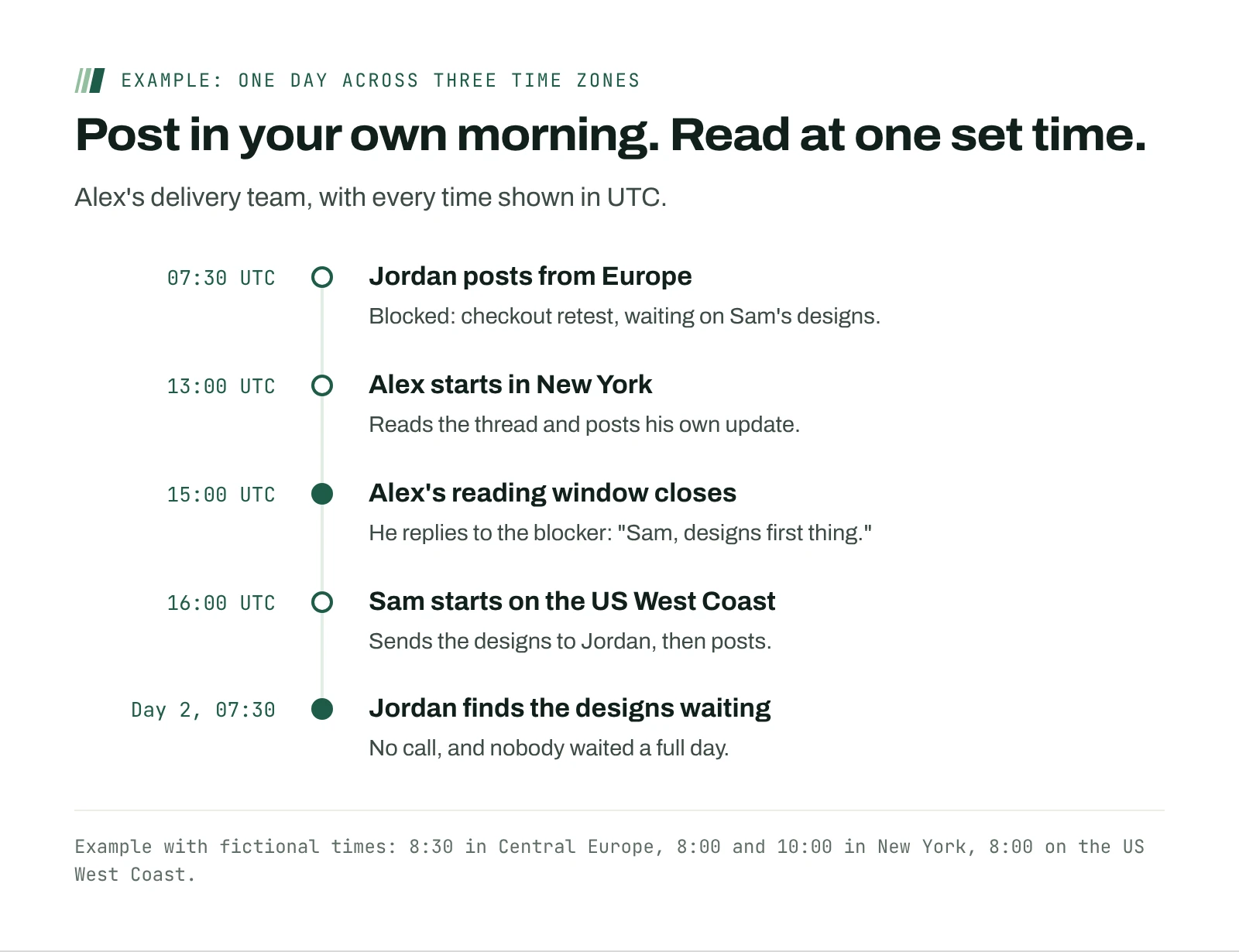
Example: Jordan, the QA lead, posts at 8:30 in Europe, waiting on Sam's designs. Alex reads every post by 10:00 in New York and replies: "Sam, designs first thing." Sam sends them at 8:00 on the US West Coast. Jordan starts the next day with the designs, and nobody joined a call. Find shared hours with the time zone overlap finder.
How do you keep people reading the updates?
People keep reading when posts are short, start with what needs action and get replies. Unanswered posts teach everyone to stop looking. Honeycomb, which sells observability software, put the problem bluntly in a post on replacing stand-ups: "No one reads async stand-ups."
Blockers first, in every post. A reader skimming ten posts reads ten first lines.
Link to the work instead of describing it.
Reply to every Blocked and Help line. "Seen, on it by 2 pm" is enough.
Make "Nothing" a full answer, so quiet days stay short.
Raise blockers when they happen. Atlassian's standup guide (Atlassian sells Jira) says standups "aren't the only time to mention blockers." Mark the task stuck right away; the standup line just points to it.
Agree on reply times once for the whole team: see how to write a response-time agreement.
Should you drop the live standup?
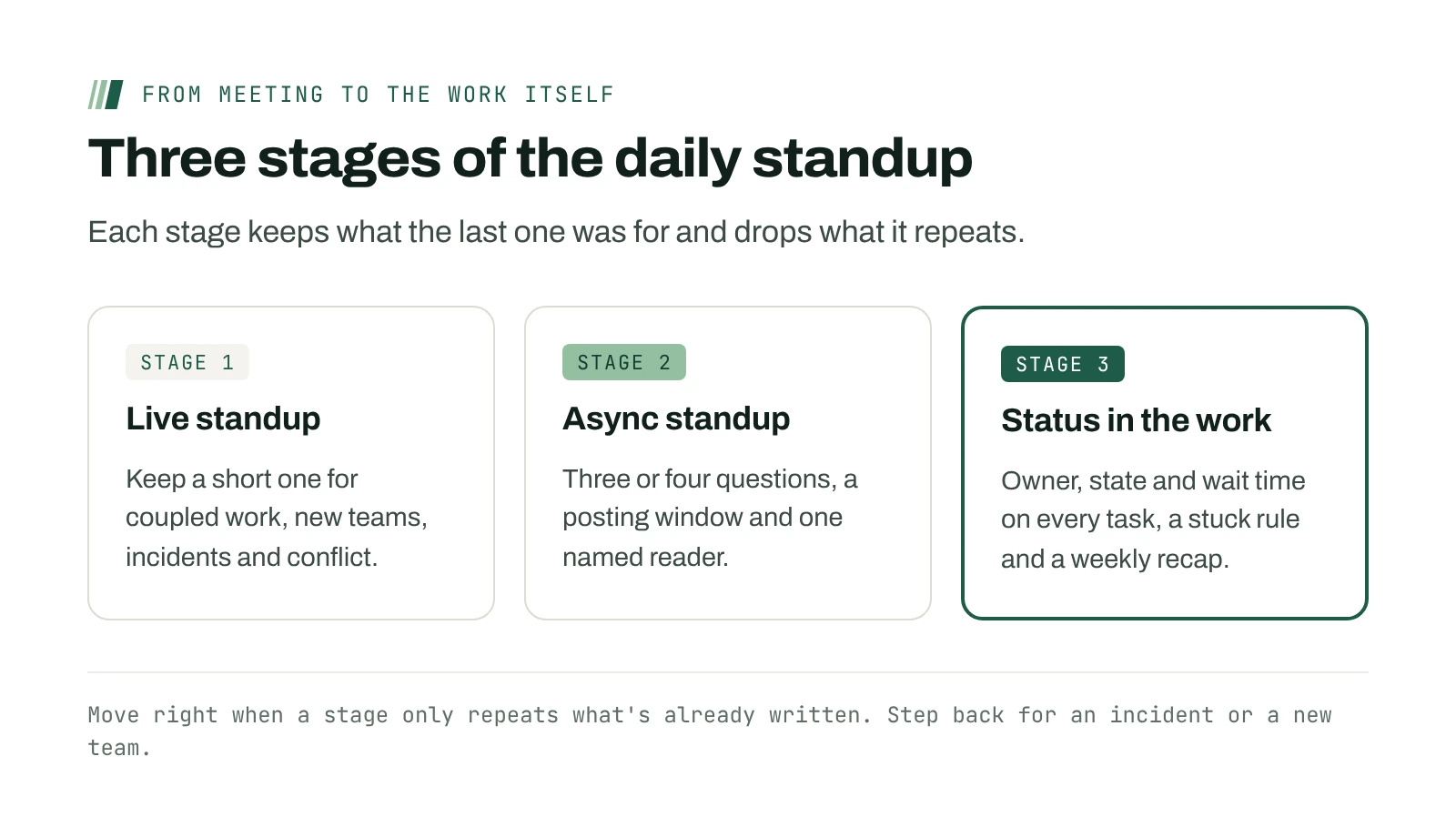
Drop the live standup when the work is loosely coupled, written blockers get answered within the reading window, and nobody misses the call after a four-week trial. Otherwise, keep a short live sync.
Stray, Moe and Sjøberg found that "not all teams benefit from meeting five times a week." Their alternative: post answers in writing daily and hold "a less frequent physical meeting" for problem-solving.
Go fully async when:
Any shared meeting time lands in someone's early morning or late evening.
Most tasks are owned end to end by one person, with few same-day handoffs.
The live standup mostly repeats what's already on the board.
Keep a short live sync, two or three times a week, when:
The work is tightly coupled, as in a release where several people change the same thing that day.
The team is new and people can't yet read each other's updates well.
There's an incident. Talk live until it's resolved.
There's conflict over scope or priority. Talk, then write the decision down.
Honeycomb's post adds one more reason: even the teams that do async best "still use synchronous communication for the one thing you can't do well asynchronously: being human together." Keep a regular slot for that.
When can the async standup go too?
The async standup can go when every task already shows its owner, its state and how long it has waited, and the posts only repeat that.
Signs: posts restate ticket titles, Blocked lines stay empty because people flag stuck work on the task, and replies have shrunk to reactions. One GitLab team ties its updates to the work and posts weekly: its handbook says "Team members post updates every Wednesday" and "Updates are required for all assigned issues."
A stuck rule and a weekly recap replace the daily post. Chapter 3 of the playbook, Make status come from the work, sets out both; the weekly status report template and how to stop chasing status updates fill in the details. Pause the async standup for two weeks; if blockers surface later, bring it back. Then read How to Manage a Remote Team Without Chasing It.
How ActionOrder handles this
ActionOrder, an efficiency and accountability tool for managers of remote teams, answers most standup questions from the work itself. Its run feed gives each person one card at a time, ranked across the team's tools by urgency, impact, shared priorities, effort and what it unblocks. Every card has one owner and a status: done, in progress, waiting or stuck, and people set "stuck" themselves. Delegation hands a card to a teammate with its prep and a note. On Pro, the team view shows each card's owner and status, how long it sat in the queue, and a Friday recap. Integrations are read-only, so ActionOrder never posts in your standup channel. Join the waitlist. ActionOrder is in pre-launch.
Questions people ask
Are daily standups micromanagement?
They can become it when the meeting exists mainly so a manager can collect status. Stray, Moe and Sjøberg list "Managers or Scrum Masters use the meeting primarily to receive status information" among the main problems they found. Write the questions for teammates, not the manager, and see how to stop micromanaging a remote team.
What are the three standup questions in agile?
Atlassian, which sells Jira, lists them as "What did I work on yesterday?", "What am I working on today?" and "What issues are blocking me?" The 2020 Scrum Guide dropped them. For an async team, ask about blockers first and swap yesterday for what you'll finish next.
What does it mean to have an async meeting?
It means holding the meeting in writing or recordings, with an owner, a reply deadline and a recorded outcome, so nobody has to be online at once. An async standup is the most common kind; Async Meetings: How to Replace a Status Meeting covers the rest.
How often should an async standup happen?
Daily for delivery teams with same-day handoffs, at each shift change for support, and two or three times a week for client teams. Stray, Moe and Sjøberg's fourth recommendation is "Adapt the frequency." If most posts say "no change," cut days before you cut questions.
Sources
- The 2020 Scrum Guide (PDF)Ken Schwaber and Jeff Sutherland, November 2020
- Scrum Guide 2020 Update: What has been removedDave West, Scrum.org, November 18, 2020
- Daily Stand-Up Meetings: Start Breaking the RulesViktoria Stray, Nils Brede Moe and Dag I. K. Sjøberg, accepted for IEEE Software; arXiv preprint, August 23, 2018
- Weekly Async UpdatesThe GitLab Handbook, last modified December 15, 2025, checked November 22, 2026
- Make your standup asyncSumeet Moghe, Asynchronous agile, checked November 22, 2026
- Stand-Up Meetings Are Dead (and What to Do Instead)Ben Darfler, Honeycomb (vendor blog), October 26, 2021, updated August 27, 2024
- What is a stand up meeting & tips to run oneDan Radigan, Atlassian (vendor guide), checked November 22, 2026