Operating Rhythm: A Weekly Cadence for a Remote Team
An operating rhythm gives a remote team a fixed weekly loop for priorities, status and decisions. Copy a sample calendar and a weekly business review format.
An operating rhythm is the set of recurring meetings, written updates and reviews a team runs on a fixed schedule, so everyone knows when priorities are set, when status is shared and when decisions get made. For a remote team, a good rhythm is mostly written and runs on a weekly loop.

What is an operating rhythm?
An operating rhythm is the repeating schedule a team uses to plan, share information and decide. It settles three things in advance: when priorities are set, when progress is reported and when problems get decided.
Every team already has one, whether or not anyone designed it. In a guide for McChrystal Group, a leadership consulting firm, Ted Delicath writes that "Every team has an operating rhythm": "the habitual cadence in which the team meets, shares information and disperses to get work done." He adds that "most of these rhythms happen by accident."
On a remote team, an accidental rhythm looks like a calendar full of quick calls. Microsoft, which sells Microsoft 365, looked at productivity signals from its software in its "infinite workday" report of June 17, 2025, and found that "57% of meetings are ad hoc calls without a calendar invite." A designed rhythm replaces much of that with slots people can plan around. More figures on meetings and focus are on our research page.
Delicath’s guide describes three levels: strategic meetings, which are the least frequent; operational syncs; and tactical guidance for front-line teams. For a small remote team, those map onto a quarterly plan, a weekly review and a daily loop. This guide focuses on the weekly layer. If you are setting up a team from scratch, start with how to manage a remote team without chasing it.
What does a weekly operating rhythm look like for a remote team?
A weekly operating rhythm for a remote team is five or six recurring rituals, most of them written, spread across the week so each day has one clear job. Here is a sample calendar to copy and adjust.
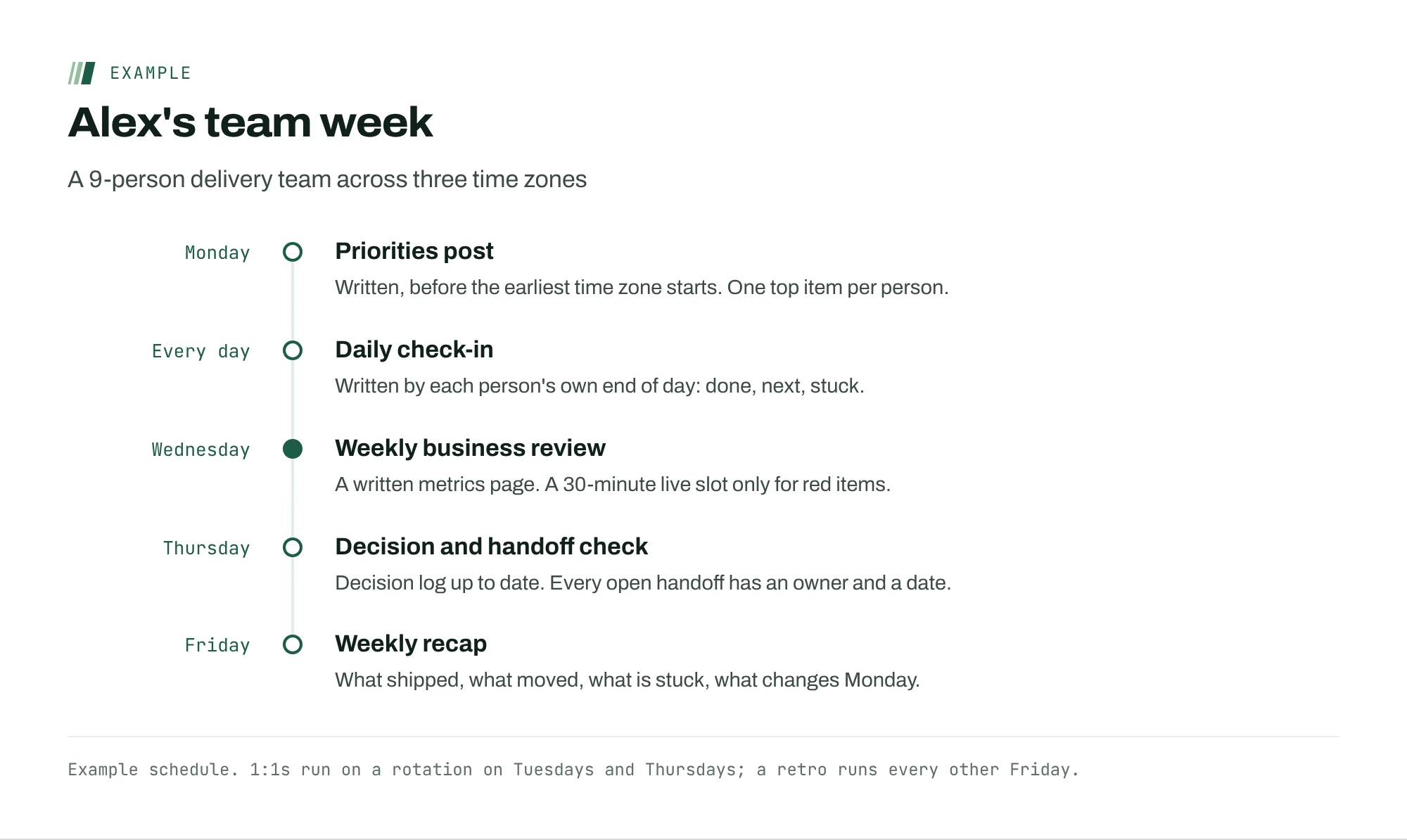
Example: Alex manages a 9-person delivery team spread across three time zones, with a few hours of shared overlap. Alex runs the week like this.
| Day | Ritual | Written or live | Owner | Output |
|---|---|---|---|---|
| Monday | Priorities post | Written, posted before the earliest time zone starts work | Alex | One ranked list for the week, with one top item per person and the reason for any change |
| Every day | Daily check-in | Written, by the end of each person’s own day | Each person | Three lines: done, next, stuck (with who can unblock it) |
| Tuesday and Thursday | 1:1s on a rotation | Live, 30 minutes | Alex and one teammate | Four or five a week, so each person gets a 1:1 every two weeks; notes kept in a shared doc |
| Wednesday | Weekly business review | Written metrics page; optional 30-minute live slot for red items only | Metric owners (Jordan, Priya), run by Alex | Each metric marked routine or red; every red item gets an owner and a next step |
| Thursday | Decision and handoff check | Written | Alex | Decision log brought up to date; every open handoff has an owner and a date |
| Friday | Weekly recap | Written | Alex | What shipped, what moved, what is stuck and what changes on Monday |
| Every other Friday | Retro | Written thread, optional 45-minute call | Rotating facilitator (Sam this time) | Two or three changes to try in the next two weeks |
The weekly layer sits inside two slower ones. Keep them short and fixed.
| Layer | Ritual | Written or live | Owner | Output |
|---|---|---|---|---|
| Monthly | Monthly review | Written report, then a 45-minute call | Alex | Trends across four weekly reviews, capacity for next month, one process change |
| Quarterly | Quarterly planning | Written proposals first, then one live session | Alex with Jordan, Priya and Sam | Three to five goals, the metrics the weekly review will track, and what the team stops doing |
Each ritual has a template you can start from: the team meeting agenda for the priorities post, the daily standup template for check-ins, the one-on-one agenda, the decision log, the weekly status report for the Friday recap, the retrospective template and the monthly report. To find a live slot that doesn’t land at night for anyone, use the time zone overlap finder.
What is a weekly business review?
A weekly business review (WBR) is a fixed weekly session where the people who own the numbers go through the same metrics, in the same order, and flag anything unusual. The format comes from Amazon, and it adapts well to a small remote team if you keep it written.
Cedric Chin, who learned the practice from early Amazon executive Colin Bryar, describes it in detail on Commoncog. He writes that the Amazon-style WBR "is designed to answer three questions:"
- "What did our customers experience last week?"
- "How did our business do last week?"
- "Are we on track to hit targets?"
At Amazon, the executive team "goes through 400-500 metrics" every Wednesday morning, and "The meeting lasts 60 minutes, except for when it’s the holiday shopping season". Two rules keep it that short. "If the metric shows only routine variation, the owner will say “nothing to see here”", and "Discussions on strategy or on problem solving are not allowed during the WBR." Chin suggests that "a better way of thinking about the WBR is that it is a process control tool": it exists to spot what changed, not to debate what to do about it.
A team of nine doesn’t need hundreds of metrics. Here is how to adapt the format:
One written page. Eight to fifteen metrics in a fixed order, in a shared doc or sheet, so a change stands out.
One owner per metric. Each owner writes one line by the end of their Tuesday: routine, or red with a reason.
Routine gets one line. Nobody explains a normal week. Only red items get discussion.
No strategy in the review. Anything that needs a real decision goes to the decision log or the monthly review, with an owner and a date.
Optional live slot. Hold 30 minutes on Wednesday for red items only. If nothing is red, cancel it and say so in the thread.
| Metric | Owner | This week | Last week | Note |
|---|---|---|---|---|
| Client requests answered within one business day | Priya | 94% | 95% | Routine. |
| Defects found after release | Jordan | 3 | 1 | Red: two came from one release. Root-cause thread opened; back next week. |
| Cards stuck for more than two days | Alex | 4 | 4 | Routine. |
| Northwind milestones on track | Priya | 5 of 6 | 6 of 6 | Red: the design review slipped. Sam has a new date for Thursday. |
Example: in this part of Alex’s Wednesday page, two items are red, so the live slot happens and covers only those two.
How do you design an operating rhythm?
Design an operating rhythm by starting from the decisions your team has to make, then giving each one a fixed slot, an owner and a format. Meetings come last, and only where writing won’t do.
List the recurring decisions and reports. Most teams have five: what matters most this week, how the work is going, how the numbers look, how each person is doing, and how the process itself is working.
Match each one to a frequency. Fast-changing things, like blockers, need a daily slot. Slow ones, like goals, need a quarterly one. Delicath advises teams to "routinely fine-tune the cadence to match the speed of the environment."
Default to written. Writing works across time zones and leaves a record. Jack McGuinness, a co-founder of the consulting firm Relationship Impact, notes in Chief Executive that "meetings are most effective when the heavy lifting happens in between meetings."
Give every ritual one owner and one output. No output anyone reads means cut it.
Anchor it to time zones. Post priorities before the earliest time zone starts. Set check-in deadlines by each person’s own end of day, not by headquarters time.
Publish it and try it for four weeks. Put the whole rhythm on one page everyone can find, then hold it steady.
McGuinness describes a leadership team’s cadence as "the necessary pattern of interactions (meetings, one-on-ones, written communications)" and quotes Christopher Fussell, president of McChrystal Group: "Your rhythm should value purpose over habit, and effectiveness over efficiency." He also warns that "There are no magic one-size-fits-all formulas for how often teams should meet". Treat the sample calendar above as a starting point, not a rule.
The priorities post deserves the most care, because every other ritual refers back to it. See how to set priorities for a remote team and playbook chapter 2, Set priorities people can find.
Which parts of the rhythm should be written, and which live?
Write down anything that moves information one way: priorities, status, metrics and recaps. Keep live time for conversations that need back-and-forth, such as 1:1s, hard decisions, disagreements and the red items from the weekly review.
| Ritual | Default | Go live when |
|---|---|---|
| Priorities post | Written | Two priorities conflict and the owners can’t settle it in the thread |
| Daily check-in | Written | Rarely; a stuck item gets its own thread with the person who can unblock it |
| Weekly business review | Written | A metric is red and the fix needs more than one person |
| 1:1s | Live | Always live, unless the person prefers writing |
| Decisions | Written proposal | The decision is hard to reverse or people strongly disagree |
| Retro | Written thread | The team wants to talk through a hard stretch |
Written doesn’t mean one-way. Delicath says the operational syncs "must be a two-way street", and that holds in writing too: every question gets an answer before the next cycle.
A written rhythm also protects focus. The same Microsoft report found that "on average, employees using Microsoft 365 are interrupted every 2 minutes by a meeting, email, or notification." A known slot for status means fewer pings in between. See how to replace a status meeting, how to protect focus time and playbook chapter 3, Make status come from the work.
How often should you change your operating rhythm?
Review the rhythm once a quarter, as part of quarterly planning, and change it on purpose, one ritual at a time. Between reviews, keep the schedule fixed so people can plan their own weeks around it.
Delicath notes that "Circumstances may dictate the exact frequency that suits your team", so expect to adjust. These are the signs a ritual needs to change:
- Nobody reads its output, or the same people skip it every week.
- The same item is red in the weekly review three weeks running, and nothing changes.
- Someone joins a live slot outside their working hours every week.
- The team adds a time zone, a client or a big project.
- Status questions keep arriving between rituals.
Before you add a live ritual, run it through the meeting cost calculator and ask whether a written version would do. When you remove one, say what replaces it.
How ActionOrder handles this
ActionOrder, an efficiency and accountability tool for managers of remote teams, carries much of the daily layer of the rhythm. It reads the tools your team already uses and gives each person one clear next step at a time, already prepped with context, analysis, research and a first draft. Every card has one owner and a status: done, in progress, waiting or stuck, and people set “stuck” themselves. On Pro, the team view shows each card’s owner and status, how long a priority has sat at the top, skips and a Friday recap, so your weekly review starts from the work instead of a round of status requests. Integrations are read-only. Join the waitlist. ActionOrder is in pre-launch.
Questions people ask
What is another word for operating rhythm?
Common alternatives are operating cadence, business rhythm, management cadence and rhythm of the business. They all describe the same thing: the recurring schedule of meetings, reviews and written updates a team or company runs on. Some teams call it their meeting cadence, but a good rhythm includes written rituals, not only meetings.
What is an operating cadence?
An operating cadence is how often each part of the operating rhythm repeats: daily check-ins, a weekly review, a monthly review and quarterly planning. People often use the two terms interchangeably. Strictly, the cadence is the timing, while the rhythm is the whole system of rituals, owners and outputs that runs on it.
What does business rhythm mean?
Business rhythm, or the rhythm of the business, is the operating rhythm at company level: the fixed calendar of planning, reporting and review that every team works around, such as monthly reporting, quarterly planning and annual budgets. A team’s weekly rhythm should fit inside it, so the team’s reviews feed the company’s.
What are the four types of rhythm?
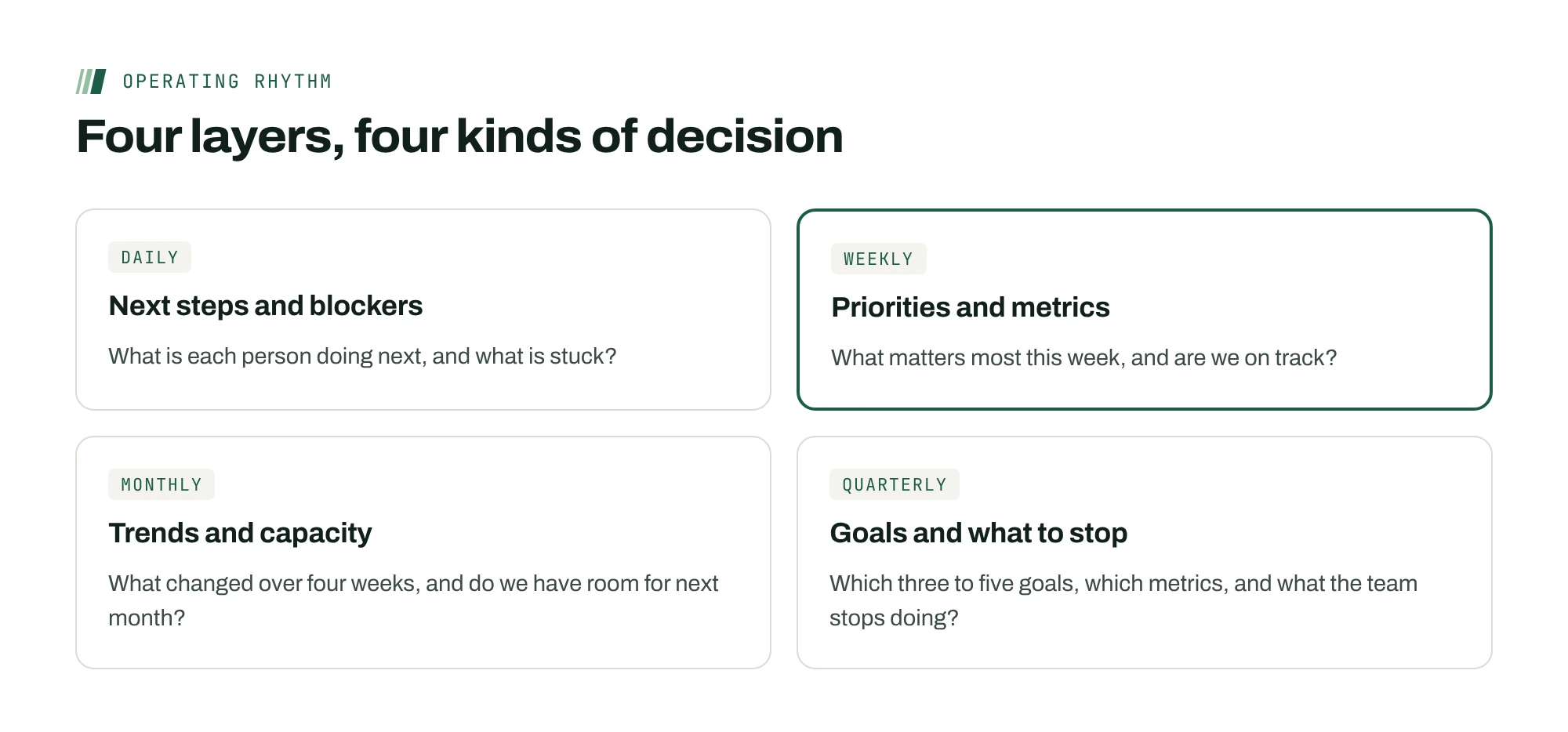
In an operating rhythm, the four common layers are daily, weekly, monthly and quarterly. The daily layer handles next steps and blockers. The weekly layer sets priorities and reviews metrics. The monthly layer looks at trends and capacity, and the quarterly layer sets goals and decides what the team stops doing.
How long should a weekly business review take?
For a small remote team, aim for about ten minutes of reading plus an optional 30-minute live slot for red items. Commoncog’s account says Amazon’s executive review runs 60 minutes for hundreds of metrics, so a team tracking a dozen should need far less. Cancel the live slot when nothing is red.
Sources
- Guide to Establishing an Effective Operating RhythmTed Delicath, McChrystal Group (consulting firm), March 7, 2022
- How Cadence Enables Great Leadership TeamsJack McGuinness, Chief Executive, July 16, 2021
- The Amazon Weekly Business Review (WBR)Cedric Chin, Commoncog, July 2, 2024, updated June 14, 2026
- Breaking down the infinite workdayMicrosoft WorkLab (vendor research, Microsoft 365 productivity signals), June 17, 2025