Time Theft: What Counts and How to Prevent It Without Surveillance
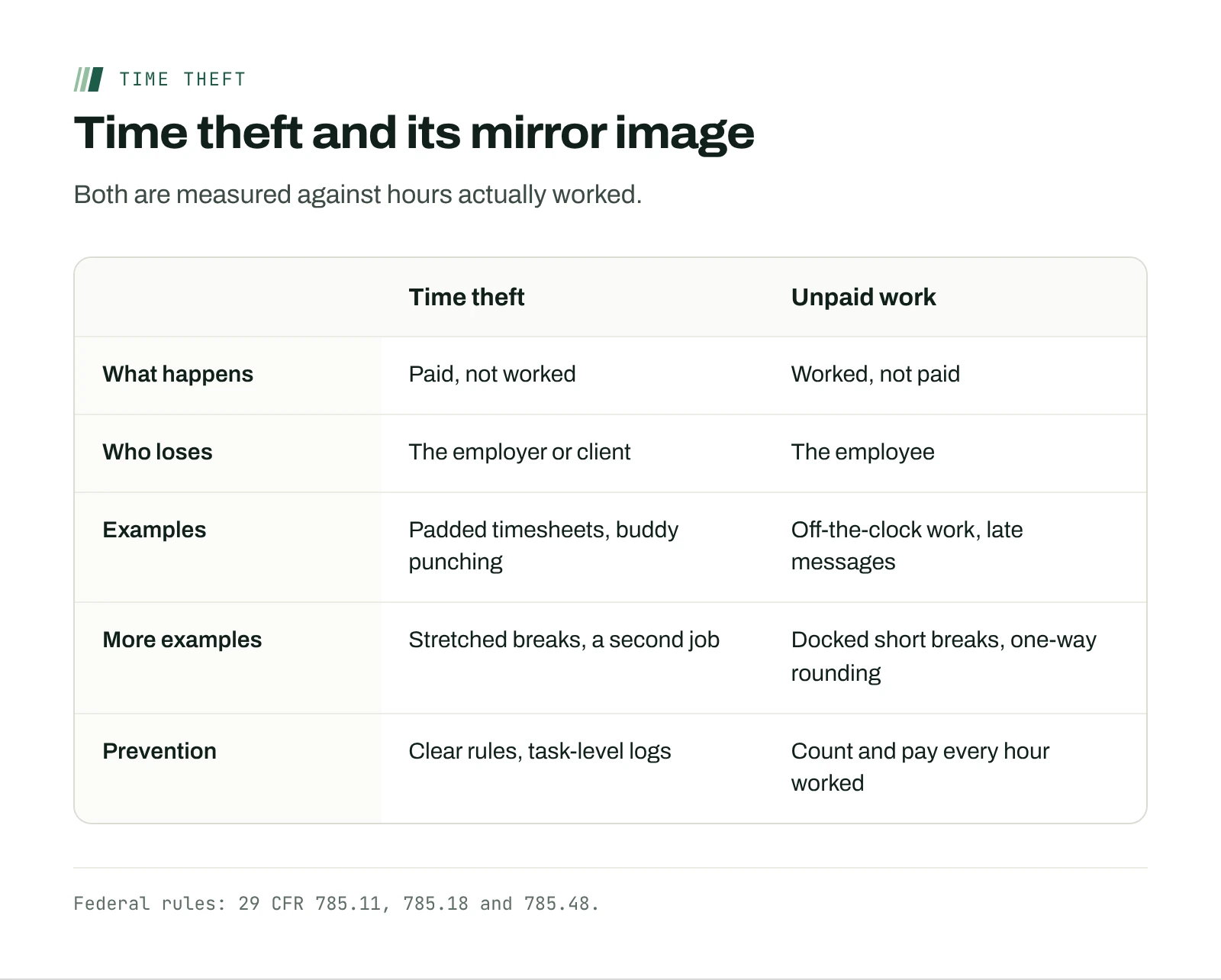
Time theft is pay for time that wasn’t worked, and its mirror image is work that wasn’t paid. Here is what counts on each side, what federal rules say, and how to prevent both without watching anyone.
Time theft is being paid for time that wasn’t worked: padding a timesheet, clocking in for a coworker, stretching breaks or doing a second job on paid hours. Its mirror image is unpaid work, which is the employer’s problem. Prevent both with a written time policy, people logging their own time against specific tasks, and review instead of surveillance.

What is time theft?
Time theft is when an employee is paid for time they didn’t work. It matters most where pay or billing depends on hours: hourly employees, hourly contractors and client work billed by the hour.
“Time theft” is a workplace term. The federal rules on pay, 29 CFR Part 785, work from a different idea: hours worked. Time theft is a gap on one side of that line, and unpaid work is a gap on the other.
On a remote team, it looks like a timesheet filled in from memory, a status kept green by a mouse jiggler, or hours that overlap with another job. But a gap can have an ordinary cause, such as waiting on someone, so treat it as a question first.
What counts as time theft, and what doesn’t?
Seven behaviors count as time theft. Breaks, waiting and off-the-clock work don’t, and off-the-clock work is unpaid work the employer owes for. Copy both tables into your time policy.
What counts as time theft
| Term | What it is | Is it time theft? | What to do instead |
|---|---|---|---|
| Buddy punching | A coworker clocks someone in or out, or logs hours for them. | Yes. | Each person logs only their own time, under their own login. |
| Time padding | Logging more hours than were worked, or rounding your own entries up. | Yes, if deliberate. An honest overestimate is an error to correct. | Log time against tasks the same day, and let people correct entries. |
| Extended breaks | Regularly stretching breaks past the agreed length. | Yes, if the limit was clear. | Put break lengths in writing. |
| Personal tasks on paid time | Long personal errands or side projects during logged hours. | Yes, if long or regular. A quick personal message isn’t. | Say what’s fine. Log anything longer as a break. |
| Faked activity | A mouse jiggler or script that keeps a status “active.” | Yes, if the hours are logged as work. | Judge finished work, not activity. See mouse jiggler detection. |
| Another job during paid hours | Working for another employer during hours you’re paid or billed for. | Yes, for the overlapping hours. | Agree on core hours and outside-work disclosure. See overemployment. |
| Billing the wrong client | Logging one client’s hours, or internal hours, to another client. | Yes, from the client, if deliberate. Honest mix-ups need correcting. | Log time only to the task it was spent on. See billable hours tracking. |
What isn’t time theft, and what the employer owes
| Term | What it is | Is it time theft? | What the federal rule says |
|---|---|---|---|
| Short rest breaks | Pauses of about 5 to 20 minutes. | No. Leaving them unpaid is the problem. | Rest periods “must be counted as hours worked” (29 CFR 785.18). |
| Meal breaks | A real meal break, ordinarily 30 minutes or more, fully off duty. | No. They are generally unpaid. | Not worktime if “completely relieved from duty”; an office worker required to eat at the desk “is working while eating” (785.19). |
| Waiting on others | On-duty time spent blocked on a file, a review or a reply. | No. It’s a process problem. | People waiting on duty “are all working during their periods of inactivity” (785.15). |
| Off-the-clock work | Work before logging in, after logging off or from home. | No. It’s unpaid work the employer owes for. | “Work not requested but suffered or permitted is work time” (785.11). |
| One-way rounding | Rounding so the employee always loses the minutes. | No. It can underpay people. | Accepted only if, over time, people are paid for “all the time they have actually worked” (785.48). |
Add your own break lengths and rounding rule, then put both tables in your remote work policy.
What do federal rules say about hours worked?
Under the Labor Department’s rules for the Fair Labor Standards Act (FLSA), an employer pays for the work it allows, counts short rest breaks as hours worked, and may round time only if it evens out.
Work you allow is work time, at home too. Why someone kept working doesn’t matter: “The reason is immaterial” (29 CFR 785.11). Section 785.12 applies the rule “even at home”: “If the employer knows or has reason to believe that the work is being performed, he must count the time as hours worked.”
A rule on paper isn’t enough. “The mere promulgation of a rule against such work is not enough,” says section 785.13. Management “must make every effort” to enforce it.
Stretched breaks can go unpaid if the limit was clear. The Labor Department’s Fact Sheet #22 says unauthorized extensions “need not be counted as hours worked” when the employer “has expressly and unambiguously communicated” the break’s length, that extensions break its rules, and that “any extension of the break will be punished.”
Rounding has to even out. Section 785.48 accepts rounding “to the nearest 5 minutes, or to the nearest one-tenth or quarter of an hour,” presuming it “averages out so that the employees are fully compensated for all the time they actually work.”
Employers keep the records. For employees under the minimum wage and overtime rules, 29 CFR 516.2 requires “Hours worked each workday and total hours worked each workweek.”
Break rules vary by state. “Federal law does not require lunch or coffee breaks,” the Labor Department says, but when employers offer short breaks, “federal law considers the breaks as compensable work hours.” Its state table of meal period rules, revised January 1, 2023, shows how much those rules differ from state to state.
These are federal rules for covered employees. Laws vary by state and change, and contracts and policies matter too. Check the rules where each person works, and talk to an employment lawyer before you change pay or discipline anyone. This is general information, not legal advice.
How do you prevent time theft without surveillance?
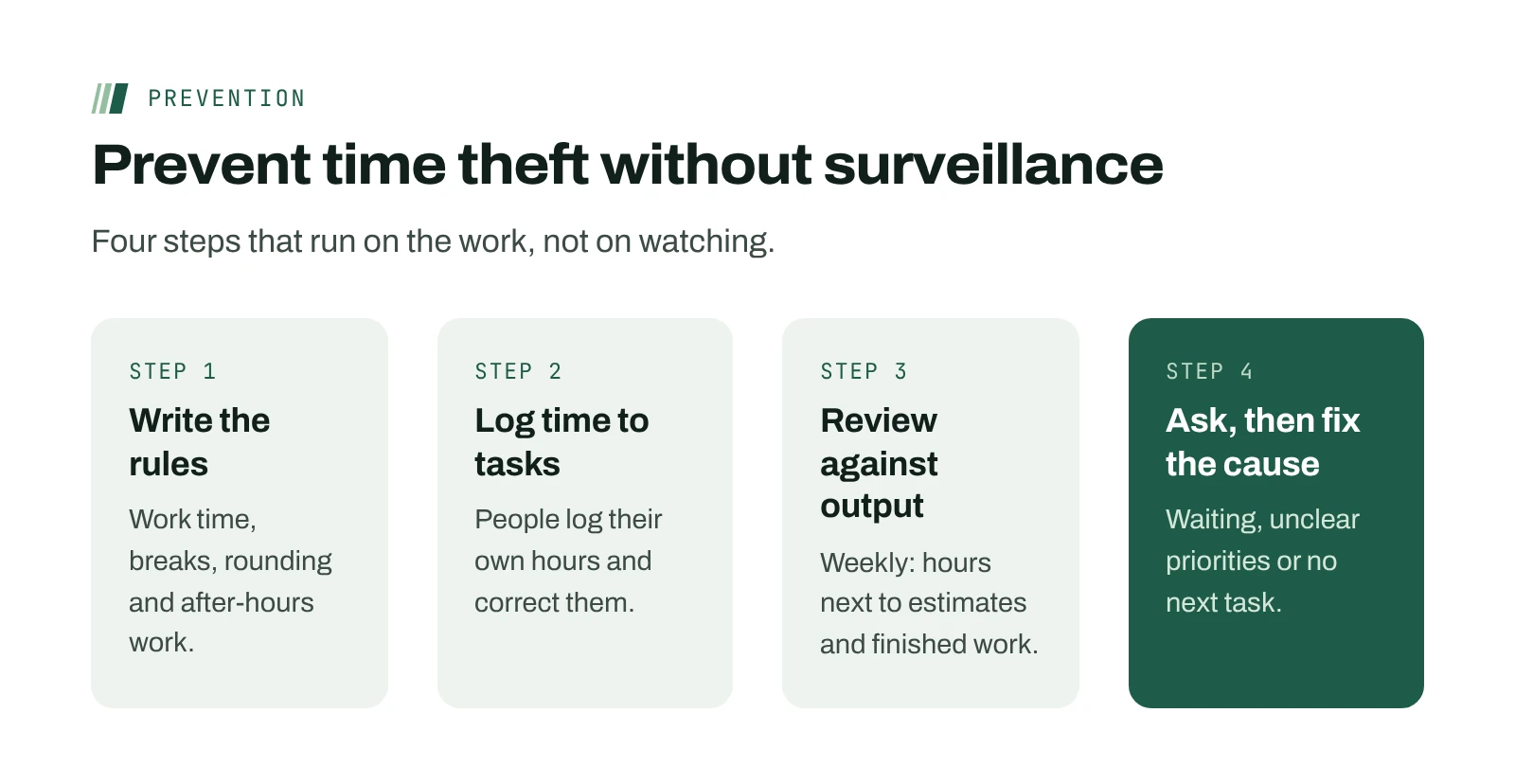
Write down what counts as work time, let people log their own time against specific tasks, review it against estimates and output, and fix what wastes time before you look for someone to blame.
Write the rules down. Cover break lengths, personal moments, after-hours work and rounding. Copy this and fill the brackets:
Work time and breaks
- Work time is any time spent on assigned work, including after hours and from home. Log all of it.
- Short breaks of up to [15] minutes are paid. Meal breaks are [30] minutes, unpaid and fully off duty; if you work through one, log it.
- Personal errands longer than [15] minutes are logged as a break.
- Log time against the task you worked on each day, and correct mistakes when you find them.
- We [don’t round time] [round to the nearest 5 minutes, up and down]. Where [state] law requires more, we follow it.
Have people log their own time against specific tasks. “8 hours, admin” can’t be checked; a task-level entry can. Start with a weekly timesheet, and see time tracking for remote employees.
Review logged time against estimates and output. Do it weekly, and before invoicing for client work. A big gap is a question, not a verdict.
Fix the causes. Unclear priorities, waiting on others and no next task produce idle hours that look like time theft. How to manage a remote team without chasing it covers the system.
Round fairly, or not at all. Round both ways and check that it evens out.
Pay for all hours worked. Log and pay after-hours messages, or change the workload.
Ask before you assume. Start with the specific entries and an open question.
Example: Taylor, head of support and operations, reviews last week’s timesheets for Morgan’s support team. One agent logged six hours against an escalation estimated at one. Taylor asks Morgan first: the agent spent the afternoon waiting on engineering while keeping the customer updated. That was real work, and the fix is a rule for handing blocked escalations back. The review also shows the opposite problem: another agent answers customers most nights after logging off, and none of it is on the timesheet. That’s unpaid work, so Taylor asks the agent to log it and moves the late queue to the next shift.
Chapter 6 of the playbook, Hold the team accountable without watching it, shows how to set up the weekly review.
Why does keystroke and screenshot monitoring backfire?
It measures activity instead of work, and it tells people they aren’t trusted. Someone blocked on a client file and someone who has checked out leave the same idle line, and a mouse jiggler makes either look busy.
It also weighs on people. Reporting its 2023 Work in America survey, the American Psychological Association says: “Data show 56% of workers who experience monitoring also feel tense or stressed out at work, compared with 40% of those who are not monitored.” That is an association, not proof of cause.
See bossware and employee monitoring software for what these tools record and miss, accountability without surveillance for moving off them, and how to know if remote employees are working for signals that come from the work.
What should you do if you suspect time theft?
Check the record over three or four weeks, then ask the person privately, with specifics. Compare logged time with estimates, finished work and core hours, look for an ordinary cause, and correct the record or the process. If a pattern continues, apply your written policy as you would for anyone, and involve HR.
What an employer may do about proven time theft depends on state law, the employment contract, your policy and the facts. Talk to an employment lawyer before you act. This is general information, not legal advice.
How ActionOrder handles this
Time theft and unpaid work both start with hours that aren’t tied to anything. ActionOrder, an efficiency and accountability tool for managers of remote teams, ties them to the work. Time logging is on Pro and Business. People log their own time against the card they’re working and can correct it, and time can only be logged against a card. Every logged hour is task time. Nothing runs in the background. Hours are visible to the person, their managers, and admins with a payroll or billing role. People set a card to “stuck” themselves, so blocked time has a name, and on Pro the team view shows logged time against estimate. Join the waitlist. ActionOrder is in pre-launch.
Questions people ask
What is considered time theft?
Time theft is being paid for time that wasn’t worked. Common forms are buddy punching, padding a timesheet, stretching breaks past a clear limit, long personal tasks on paid time, faked activity such as a mouse jiggler, and working another job during paid hours. Short breaks, real meal breaks and waiting on others are not time theft.
Is rounding time theft?
Rounding your own entries up is time padding. Employer rounding is accepted under 29 CFR 785.48 only if it evens out, so people are paid over time for all hours worked. Rounding that always favors the employer can underpay people. This is general information, not legal advice.
Are short breaks paid?
Under federal rules, yes: rest periods of about 5 to 20 minutes count as hours worked, while real meal breaks, fully off duty, generally don’t. Federal law doesn’t require breaks, but some states have break rules. This is general information, not legal advice.
Is it time theft to answer a personal message at work?
No. A quick personal message is a normal part of a workday, like a short break. It becomes a problem when personal tasks fill long or regular stretches of logged time, so say in your policy what’s fine.
Can you be fired or go to jail for time theft?
It depends on state law, the employment contract, company policy and the facts, so there is no single answer. If you suspect time theft, or are accused of it, talk to an employment lawyer. This is general information, not legal advice.
Sources
- 29 CFR Part 785, Hours WorkedElectronic Code of Federal Regulations (eCFR), checked November 22, 2026
- 29 CFR Part 785 Subpart C, Rest and Meal PeriodseCFR, checked November 22, 2026
- 29 CFR 785.48, Use of time clockseCFR, checked November 22, 2026
- 29 CFR 516.2, Employees subject to minimum wage or minimum wage and overtime provisionseCFR, checked November 22, 2026
- Fact Sheet #22: Hours Worked Under the Fair Labor Standards Act (FLSA)U.S. Department of Labor, Wage and Hour Division, revised July 2008
- Breaks and Meal PeriodsU.S. Department of Labor, checked November 22, 2026
- Minimum Length of Meal Period Required under State Law for Adult Employees in Private SectorU.S. Department of Labor, Wage and Hour Division, revised January 1, 2023
- Electronically monitoring your employees? It’s impacting their mental healthMichele Lerner, American Psychological Association, September 7, 2023