Overemployment: Signs a Remote Employee Has Two Jobs
Overemployment shows up in commitments and availability, not in activity data: what it is, what the law says, how common it is and six output checks to run fairly.
Overemployment is holding two or more full-time jobs at once, usually remote and often without either employer knowing. For a manager, the signs are patterns in output and availability, such as missed core hours or slipping commitments, and each has many possible causes. Check the work against clear agreements, then talk privately before drawing any conclusion.

What is overemployment?
Overemployment is working two or more full-time jobs at the same time, most often remote ones with overlapping hours, and usually without telling either employer.
The idea took off during the pandemic. Business Insider reported in August 2021 that "Overemployed.com was set up in April to help people find and work several jobs at once," founded by a person calling themselves "Isaac." A Reddit community, r/overemployed, also grew; Fortune reported in July 2025 that it had "more than 430,000 members."
An employment lawyer quoted by Fox Business in September 2022 said: "Almost always, the person intended to hold the two jobs without letting the respective employers know."
Others use the word more broadly. Economists at the Federal Reserve Bank of St. Louis define it as "occurring when individuals have a full-time job and also work additional hours for other employers." Moonlighting is different again: Cornell's Legal Information Institute, citing USLegal, says it "usually refers to when a person holds a second job outside of normal working hours."
Is overemployment legal?
In the US, having more than one job is generally lawful, but overemployment can break an employment agreement or company policy, and that can cost someone the job. It depends on the contract, the policy and the state.
At-will employment. Under the employment-at-will doctrine, as Cornell's LII describes it, either side may end the employment "at any time and for almost any reason," with exceptions such as public policy and implied contracts.
Contracts and policies. Check outside-employment, conflict-of-interest and confidentiality clauses. John-Paul Deol, the lawyer quoted by Fox Business, noted that most employment agreements today have a clause that prohibits employees from working for another company.
State off-duty conduct laws. Some states protect lawful activity outside work:
California. Labor Code section 96(k) lets the Labor Commissioner take claims for lost wages "that arise from retaliation for lawful conduct during nonworking hours and away from the employer’s premises," according to the Labor Commissioner's Office. Section 98.6 protects employees from retaliation for exercising their Labor Code rights.
New York. Labor Law section 201-d protects, among other things, political activities "outside of working hours" and legal recreational activities "outside work hours, off of the employer's premises and without use of the employer's equipment or other property." Recreational activities are ones "for which the employee receives no compensation," and the law excepts activity that "creates a material conflict of interest related to the employer's trade secrets, proprietary information or other proprietary or business interest."
Colorado. C.R.S. 24-34-402.5 bars firing an employee for "engaging in any lawful activity off the premises of the employer during nonworking hours." Its exceptions include a restriction that "is necessary to avoid a conflict of interest with any responsibilities to the employer or the appearance of such a conflict of interest."
All three laws speak of conduct outside working hours; overemployment questions usually turn on hours that overlap and conflicts of interest. Laws vary by state and change, so check the current rules where your people work and talk to an employment lawyer before you act. This is general information, not legal advice.
How common is overemployment?
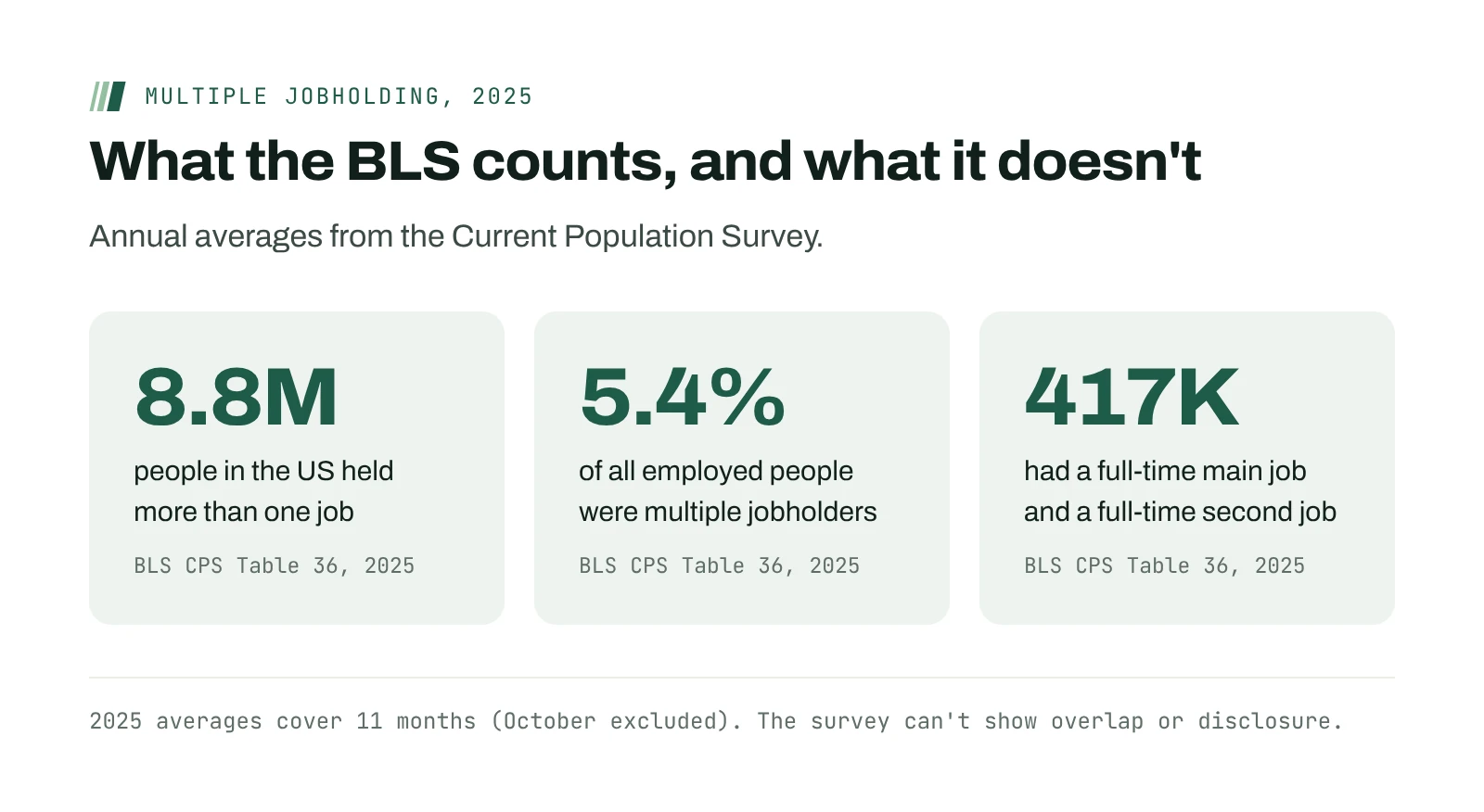
There is no official count of secret overemployment. The closest figure is multiple jobholding: in 2025, an average of 8.8 million people in the US, 5.4% of the employed, held more than one job, according to the Bureau of Labor Statistics.
The figure comes from the Current Population Survey, which defines multiple jobholders as "people who had two or more jobs during the survey reference week," at least one of them a wage and salary job. It counts jobs, not whether hours overlap or employers know.
Most people with two jobs are not working two full-time ones: 417,000 had two full-time jobs, fewer than 1 in 20. The 2025 figures are 11-month averages that exclude October. More figures are on our remote work research page.
What are the signs a remote employee may have two jobs?
The signs are patterns in availability and output that last for weeks. None of them proves a second job, and each has ordinary causes such as caregiving, overload or unclear priorities.
Recurring gaps in core hours. The same blocks go quiet each week, or core-hours meetings are missed at the same times.
Replies outside the agreed window. Threads that need this person wait longer than your response-time agreement allows.
Commitments that slip without a flag. Work misses its date and nobody hears beforehand.
Thin handoffs and avoided ownership. Handoffs lack context, and time-bound work keeps going to someone else.
Compare each person with their own past, and look at the whole team first: a pattern shared by several people points to the system. For broader outcome signals, read how to know if remote employees are working.
Don't look for proof outside the work. Searching someone's online profiles or installing tracking software turns a question about commitments into an investigation of a person. Our guides to bossware and employee monitoring software explain why.
How do you check output instead of monitoring?
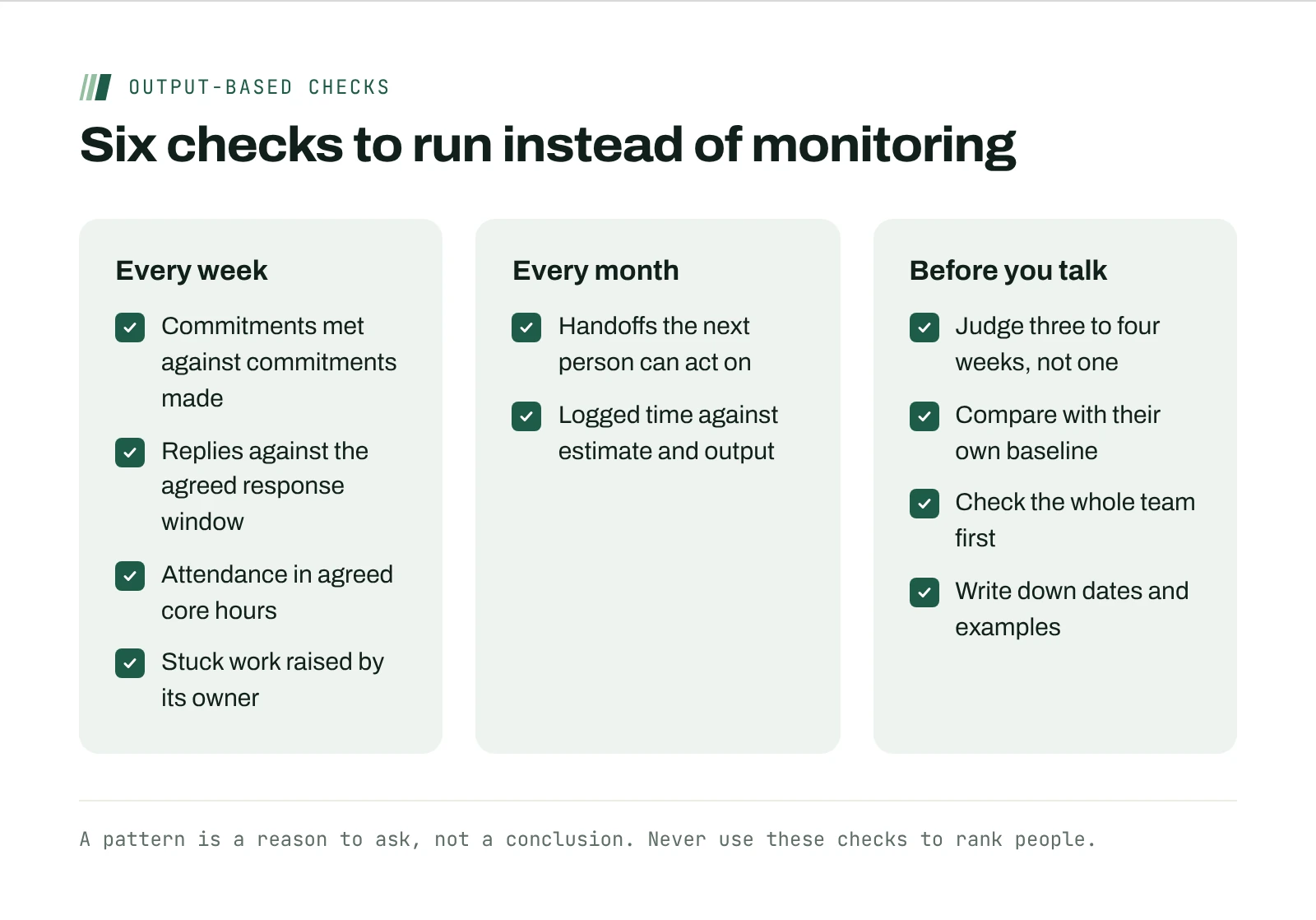
Run a small set of checks on outcomes, on a fixed schedule, for everyone on the team. Each compares the work with something agreed in advance, so a pattern points to a question, not a suspicion. Copy this table into a doc or spreadsheet.
| Check | What to look at | How often | Pattern worth a conversation | Other common causes |
|---|---|---|---|---|
| Commitments met vs. made | Items each person committed to, and how many reached done by the agreed date | Weekly | Fewer done than their usual for three or more weeks, with no flag before the date | Scope grew, a blocked dependency, unclear priorities |
| Response time vs. the agreed window | How long threads needing this person wait, against your response-time agreement | Weekly, on a sample of threads | Replies regularly outside the window in core hours, at the same times each week | Overload, too many channels, a time-zone mismatch |
| Availability during agreed core hours | Attendance at decisions and meetings scheduled inside agreed core hours | Weekly | The same core-hour blocks missed or declined week after week | Caregiving, recurring appointments, a schedule that no longer fits |
| Handoff quality | Whether the next person can act on handed-off work without a call | Each handoff, reviewed monthly | Handoffs bounce back for missing links, decisions or context | No handoff standard, a rushed end of day |
| Estimate vs. actual on owned work | Logged time against estimate, and finished work against logged time (where people log time) | Monthly | Logged hours steady while finished work falls, or large gaps left unexplained | Estimates were off, the work changed, a learning curve |
| Stuck items left unflagged | Work that sat with no status change before anyone said it was stuck | Weekly | Blockers found by teammates or a client rather than raised by the owner | It doesn't feel safe to say stuck, or there's nowhere to flag it |
Four rules: judge three to four weeks, never one; compare each person with their own baseline; check the whole team before any one person; and write down dates and examples, not impressions. Never use it to rank people.
How to start a fair conversation
Bring facts, not a theory. Two or three dated examples from the checks, raised one to one, privately, on a call.
Describe the pattern and ask an open question. Opening with "Do you have another job?" turns a conversation about work into an accusation.
Agree what changes. Restate the core hours and response window, agree one or two changes and a date to review.
If outside work comes up, use the policy. Ask for disclosure the way your written policy does, and bring in HR before any decision.
Example: Alex manages a 9-person delivery team and has seen a four-week pattern in Sam's work.
Alex: "I want to talk about the last four weeks. You missed the Tuesday and Thursday design reviews, which sit in our core hours, and two Northwind mockups slipped without a note. What's getting in the way?"
Sam's answer decides the next step: a caregiving clash might mean moving the reviews, overload means re-ranking Sam's work, and outside work in core hours means reading the policy together, with HR. Alex writes down what was agreed and checks again in two weeks.
What should you do if an employee has a second job?
Start with what your agreement and policy say. If the second job doesn't overlap agreed hours, create a conflict of interest or break a written term, there may be nothing to act on. If it does, involve HR or counsel first.
Ask for disclosure in writing: what the outside work is, when it happens and whether it touches clients, competitors or confidential information.
Agree a change: firm core hours, a reduced schedule, a contractor arrangement paid by outcome (see paying remote contractors hourly or by outcome), or ending the arrangement through your normal process.
Treat everyone the same way, and document what you did and why.
How do you prevent overemployment problems?
Write the expectations down for the whole team. Overemployment is hardest to handle when nobody recorded the hours and outcomes the job requires.
A working agreement with core hours, reply windows and how people show they're away. Start from the working agreement template.
An outside-work policy that says what's allowed and what needs disclosure. The remote work policy template is a starting point to review with counsel.
Owned, dated work: one owner, a definition of done and a due date for every task, so the checks have something to compare.
The playbook chapter Hold the team accountable without watching it covers this routine, and accountability without surveillance explains why activity data is the wrong tool. For the whole model, start with how to manage a remote team.
How ActionOrder handles this
ActionOrder, an efficiency and accountability tool for managers of remote teams, keeps the answer in the work. Every card has one owner and a status: done, in progress, waiting or stuck, and people set "stuck" themselves. On Pro, the team view shows each card's owner and status, queue time, how long a priority has sat at the top, skips, logged time against estimate and a Friday recap. Time logging is on Pro and Business, and time can only be logged against a card. Every logged hour is task time. The team view never shows screens, keystrokes, clicks, app activity, anyone's inbox or calendar, or a ranking of people. Nothing runs in the background.
Join the waitlist. ActionOrder is in pre-launch.
Questions people ask
Is overemployment illegal?
Holding more than one job is generally lawful; the usual risk is breaking an agreement or policy and losing the job. Some states protect lawful conduct outside working hours, with exceptions such as conflicts of interest. Laws vary by state and change, so check with an employment lawyer. This is general information, not legal advice.
Can you go to jail for overemployment?
The usual consequences of holding two jobs are employment ones, such as losing a job or a contract dispute. Falsified timesheets or billing two employers for the same hours can raise separate legal questions that depend on the facts and the state, so talk to a lawyer. This is general information, not legal advice.
How is overemployment different from moonlighting?
Moonlighting usually means a second job outside normal working hours. Overemployment means two full-time jobs whose hours overlap, often undisclosed. A policy can allow one and not the other, so spell out which outside work needs disclosure.
Should you use monitoring software to catch overemployment?
It's a poor fit. Activity data shows that a computer was in use, not whether commitments were met, and covert tracking costs trust with the whole team. Checks on commitments, reply windows and core-hours availability answer the question you actually have.
Sources
- A community about secretly working 2 full-time jobs has exploded…Business Insider India, August 17, 2021
- Bosses are catching on to their ‘overemployed’ staff…Preston Fore, Fortune, July 3, 2025
- Secret ‘overemployment’ grows as a remote work trend, but risks are involvedCortney Moore, Fox Business, September 26, 2022
- Beyond the 9 to 5: Decoding the Overemployment TrendSerdar Birinci and Carlos Garriga, Federal Reserve Bank of St. Louis, March 3, 2025
- MoonlightingLegal Information Institute, Cornell Law School, last reviewed July 2021
- Employment-at-will doctrineLegal Information Institute, Cornell Law School, last reviewed March 2025
- Laws that Prohibit Retaliation and DiscriminationCalifornia Labor Commissioner’s Office, June 2026
- New York Labor Law section 201-DNew York State Senate, revision of September 8, 2023
- C.R.S. 24-34-402.5Colorado Revised Statutes (2022 Colorado Code), Justia, checked November 22, 2026
- Multiple jobholders by selected characteristics (Table 36)U.S. Bureau of Labor Statistics, last modified February 20, 2026
- Concepts and Definitions (CPS)U.S. Bureau of Labor Statistics, last modified November 3, 2026